







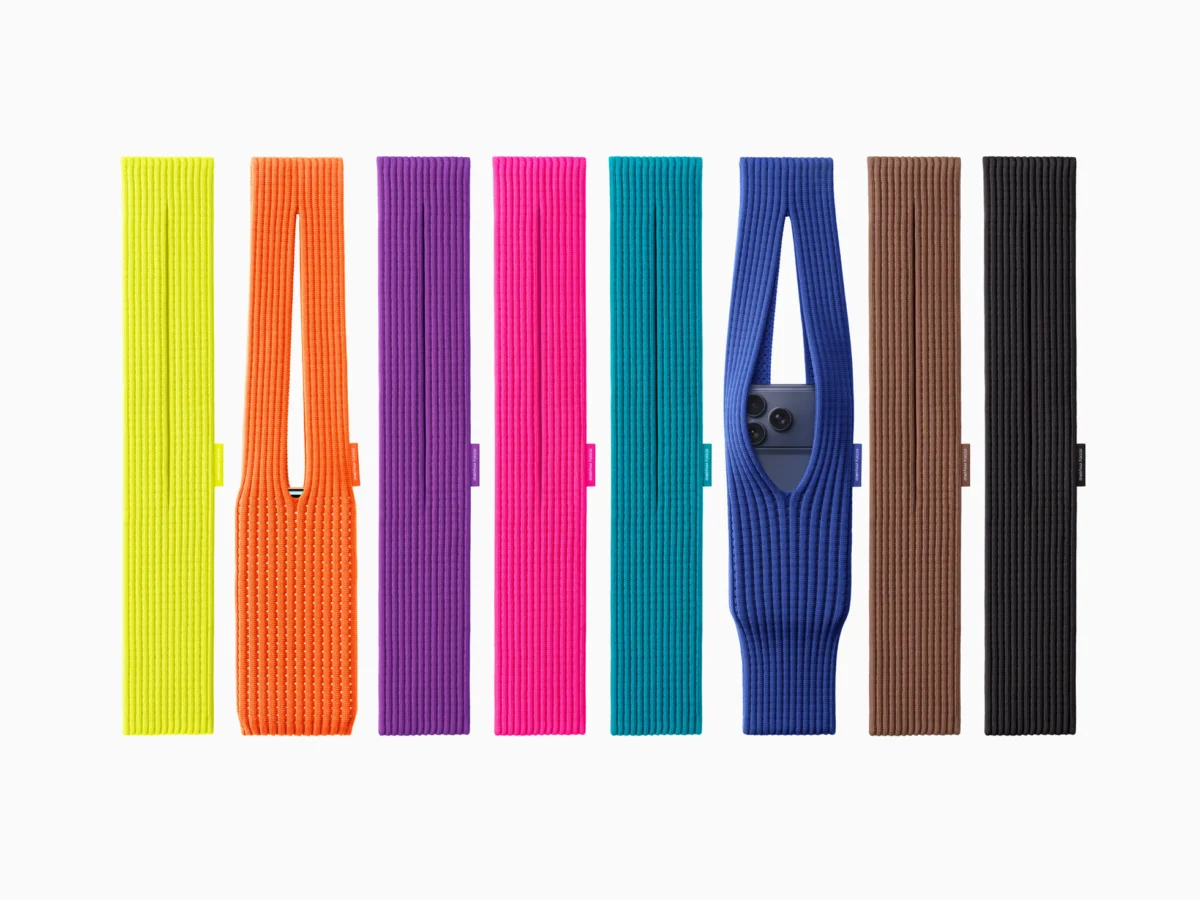
Apple has officially introduced its latest limited-edition accessory, the iPhone Pocket, a high-end textile sling developed in collaboration with the renowned Japanese fashion house Issey Miyake. The product, which debuted on the Apple Store this week, represents a significant move into the luxury fashion-tech space, retailing for $149.95 for the short handheld version and $229.95 for the longer, crossbody model. This launch follows a history of high-margin accessories from the Cupertino-based tech giant, including the much-discussed $19 polishing cloth, but moves the brand further into the realm of avant-garde designer wear.
The iPhone Pocket is more than a simple protective sleeve; it is an extension of the "A Piece of Cloth" (APOC) design philosophy pioneered by the late Issey Miyake. According to product specifications on Apple’s retail site, the accessory is constructed from a single piece of fabric, utilizing a ribbed mesh structure that mirrors the iconic pleating techniques for which the Miyake brand is globally recognized. The design is intended to be functional yet minimalist, allowing the textile to stretch and reveal the iPhone display through the open-weave structure, thereby blending digital utility with textile artistry.
Historical Context: The Relationship Between Steve Jobs and Issey Miyake
The collaboration between Apple and the Issey Miyake label is rooted in a decades-old friendship between Apple co-founder Steve Jobs and the Japanese designer. In the early 1980s, during a visit to Sony’s headquarters in Japan, Jobs was struck by the corporate uniforms designed by Miyake. Jobs envisioned a similar sense of unity for Apple employees and commissioned Miyake to design a vest for the company. While Apple employees famously rejected the idea of a corporate uniform, the partnership between the two creative icons persisted.
Jobs eventually asked Miyake to design a personal uniform for him—a request that led to the creation of the iconic black mock-neck sweaters that became Jobs’ signature look for the remainder of his life. Reports indicate that Miyake provided Jobs with hundreds of these garments, which came to symbolize the "quiet luxury" and functional minimalism of the Apple brand under Jobs’ leadership. Although Issey Miyake passed away in 2022, his design house continues to operate under his foundational principles, and the iPhone Pocket serves as a posthumous realization of the aesthetic synergy between the two brands.
Technical Specifications and Design Philosophy
The iPhone Pocket utilizes the APOC concept, which was first introduced by Miyake and Dai Fujiwara in 1997. The APOC system uses computer-controlled knitting or weaving technology to create finished garments from a single thread, significantly reducing material waste and labor costs while allowing for complex, three-dimensional shapes. The iPhone Pocket applies this technology to the smartphone form factor, creating a "sock-like" enclosure that provides a tactile, soft-touch alternative to traditional plastic or leather cases.

The product is available in two distinct configurations:
- The Short Pocket: Retailing at $149.95, this version is designed for hand-carrying or attachment to other bags. It is available in a wider array of vibrant colors, including a "Lemon" yellow that has already garnered significant attention on social media.
- The Crossbody Pocket: Retailing at $229.95, this version features a longer integrated strap, allowing the phone to be worn as a primary accessory. This model is currently offered in a more limited color palette, focusing on neutral and sophisticated tones.
Apple’s marketing materials describe the textile as "open-structure," meaning that when the fabric is stretched over the device, the holes in the mesh expand. This allows users to check notifications or view the time without removing the phone from the pocket. This "peek" feature is highlighted as a primary functional benefit, distinguishing it from standard opaque sleeves.
The Growth of the Luxury Tech Accessory Market
The launch of the iPhone Pocket arrives at a time when the market for "accessories for accessories" is experiencing unprecedented growth. Industry analysts point to a shift in consumer behavior where smartphones are no longer viewed merely as tools, but as central components of a person’s fashion identity. The $229.95 price tag, while high for a textile sleeve, aligns with the pricing strategies of other luxury fashion houses. For comparison, brands like Prada, Gucci, and Bottega Veneta offer phone cases and slings ranging from $400 to over $1,000.
This trend is further evidenced by the rise of "micro-bags" and specialized phone carriers. Brands such as Bandolier have built entire business models around crossbody phone cases, which have become staples at music festivals and in urban commuting environments. Apple’s entry into this specific niche—beyond its standard $59 silicone and "FineWoven" cases—suggests a strategic move to capture a larger share of the high-discretionary-income demographic that values brand heritage and designer labels.
Market Trends: From Labubu to Stanley Cups
The iPhone Pocket’s reception has been met with a mixture of fascination and skepticism, a phenomenon often referred to as "rage-bait" marketing. However, cultural analysts suggest the product taps into a broader "blind box" and "collectible" culture. The TechCrunch report draws a parallel between the iPhone Pocket and Labubu, the monster-themed art toys from Pop Mart that have become a global sensation. While a base Labubu figure may cost $30, rare editions have fetched upwards of $10,000 on the secondary market.
The common thread between these products is the "accessory for an accessory" mindset. Consumers are increasingly investing in items designed to decorate or carry their primary purchases. This is seen in the "Stanley Cup" craze, where users purchase specialized pouches, charms, and even tiny "backpacks" for their insulated water bottles. The iPhone Pocket fits neatly into this ecosystem, offering a way to "dress" a device that is otherwise identical to millions of others.

Broader Implications for Apple’s Brand Strategy
The collaboration with Issey Miyake signals a potential shift in Apple’s long-term accessory strategy. Under CEO Tim Cook, Apple has leaned heavily into the fashion world, most notably through its multi-year partnership with Hermès for the Apple Watch. By aligning itself with names like Miyake, Apple reinforces its position as a "lifestyle" brand rather than just a hardware manufacturer.
Furthermore, the focus on the APOC concept aligns with Apple’s stated environmental goals. The "one piece of cloth" manufacturing process is inherently less wasteful than traditional cut-and-sew methods. As Apple strives to reach carbon neutrality across its entire supply chain by 2030, the adoption of advanced textile engineering like Miyake’s could play a role in future product designs beyond just phone slings.
Public and Industry Reaction
Initial reactions from the fashion community have been largely positive, praising the "quiet genius" of the Miyake label’s integration into the Apple ecosystem. Critics, however, point to the price-to-utility ratio. At nearly $230, the crossbody pocket costs nearly a quarter of the price of a base-model iPhone 16.
Official statements from Apple emphasize the aesthetic value: "Featuring a ribbed mesh structure with the qualities of the original pleats by Issey Miyake, iPhone Pocket is a beautiful way to wear and carry iPhone." While the company has not released specific sales targets for the limited-edition run, the "limited" status often drives immediate sell-outs among collectors and brand enthusiasts.
Chronology of Apple’s Notable Accessory Launches
To understand the trajectory that led to the iPhone Pocket, one must look at Apple’s history of high-priced, specialized accessories:
- 2004: Apple releases the iPod Sock, a pack of six multi-colored fabric sleeves for $29. This is often cited as the spiritual predecessor to the iPhone Pocket.
- 2015: The Apple Watch Hermès collection launches, marking the first major luxury fashion partnership.
- 2021: The $19 Polishing Cloth is released, becoming a viral sensation for its high price relative to third-party alternatives.
- 2023: Apple transitions away from leather, introducing "FineWoven" materials as part of its sustainability push.
- 2024: The Apple Crossbody Strap ($59) is released, testing the waters for phone-wearable accessories.
- 2025: The iPhone Pocket by Issey Miyake is launched, bridging the gap between the $29 "sock" of the past and the high-fashion world of today.
Conclusion
The iPhone Pocket represents a unique intersection of tech history, high fashion, and modern consumer trends. While the price point may be prohibitive for the average consumer, the product is not designed for the mass market. It is a statement piece that honors the legacy of Steve Jobs and Issey Miyake while capitalizing on the current "it-bag" culture. Whether the iPhone Pocket becomes a mainstay of the 2026 fashion season or remains a niche collectible, it underscores Apple’s continued ability to generate conversation and redefine the boundaries of the consumer electronics market. As digital wallets and "Tap to Pay" technology continue to reduce the need for traditional bags, the "phone-as-the-only-accessory" lifestyle is becoming a reality, and Apple is positioning itself to provide the wardrobe for that future.