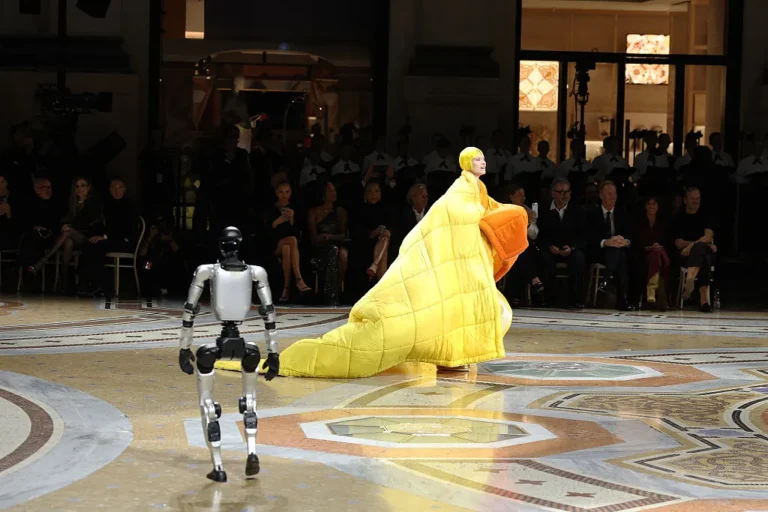










On Saturday, designer Kate Barton will unveil her latest collection at New York Fashion Week with a significant technological integration that signals a new era for the intersection of high fashion and artificial intelligence. In a strategic collaboration with Fiducia AI, Barton is introducing a multilingual AI agent built on IBM watsonx and hosted on IBM Cloud. This sophisticated digital interface is designed to serve as a bridge between the runway and the audience, allowing guests to identify specific pieces from the collection in real-time, ask detailed questions via voice or text, and engage with photorealistic virtual reality try-ons.
The presentation represents a departure from traditional runway formats, which often maintain a distance between the viewer and the garment. By integrating a visual AI lens, Barton and her technical partners are transforming the fashion show into an interactive ecosystem. This move comes at a time when the fashion industry is grappling with the implications of generative AI, moving beyond experimental gimmicks toward functional, production-grade applications that enhance the consumer experience without overshadowing the craftsmanship of the designer.
The Technological Architecture of the Runway
The backbone of this activation is a complex suite of IBM technologies orchestrated by Fiducia AI. Ganesh Harinath, the founder and CEO of Fiducia AI, noted that the project utilized IBM watsonx, IBM Cloud, and IBM Cloud Object Storage to ensure a seamless and responsive user experience. Unlike basic chatbots, this multilingual AI agent is a production-grade tool capable of detecting specific aesthetic markers and construction details of Barton’s new collection.
Harinath emphasized that the primary challenge of the project lay not in the tuning of the AI models themselves, but in the orchestration of the various technological layers. This involves synchronizing visual recognition capabilities with a natural language processing engine that can communicate across linguistic barriers. The result is a visual AI lens that acts as a digital docent, providing guests with immediate data on fabric composition, design inspiration, and availability.
For Barton, the inclusion of such technology is a natural extension of her creative process. She views technology as a fundamental component of modern design, rather than an external addition. By playing with the boundaries of the "real and the unreal," Barton intends for the AI to serve as a portal into the collection’s world. Her philosophy centers on "tech as a tool for expanding the world around the clothes," aiming to create moments of curiosity and a "double take" for the audience.
A Chronology of Innovation and Industry Evolution
This is not Kate Barton’s first foray into the digital frontier. During the previous fashion season, she experimented with AI models in an earlier collaboration with Fiducia AI. That initial pilot served as a proof of concept, demonstrating that AI could be used to visualize garments in ways that traditional photography could not. The Saturday presentation marks a significant scaling of those ambitions, moving from static AI-generated imagery to a dynamic, real-time interactive agent.
The evolution of AI in fashion mirrors the historical trajectory of the internet’s integration into the industry. In the late 1990s and early 2000s, many prestige fashion houses were hesitant to establish a web presence, fearing that the digital space would dilute the exclusivity of their brands. Over time, that hesitation evaporated as the internet became an essential utility. Barton suggests that AI is currently in a similar "inevitable" phase. The industry is shifting from asking whether AI should be used to questioning the quality and ethical implementation of its presence.
While Barton is vocal about her use of the technology, she observes that many of her peers are utilizing AI more discreetly. Currently, AI is heavily embedded in the operational side of fashion—optimizing supply chains, predicting inventory needs, and managing logistics. The reluctance to publicize AI usage often stems from reputational risks, including concerns regarding creative authenticity and the potential displacement of human labor.
Supporting Data: The Economic Impact of AI in Fashion
The strategic move by Barton and Fiducia AI is supported by broader industry trends. According to recent market analysis, the global market for AI in fashion is projected to grow at a compound annual growth rate (CAGR) of approximately 40% through 2030. Generative AI, specifically, is estimated to add between $150 billion and $275 billion to the apparel, fashion, and luxury sectors’ operating profits within the next three to five years.

Research indicates that 73% of fashion executives prioritize generative AI in 2024, yet many remain in the experimentation phase. The Barton-Fiducia collaboration stands out because it moves the technology from the back office to the front-of-house consumer experience. By offering virtual try-ons, the brand addresses one of the most significant pain points in the industry: the high rate of returns in e-commerce, which can reach up to 30-40% for apparel. Photorealistic VR try-ons have the potential to reduce these figures by providing consumers with a more accurate representation of fit and drape before a purchase is made.
Official Perspectives and the Roadmap to 2030
The partnership has garnered attention from technology leaders who view fashion as a primary use case for real-time AI engagement. Dee Waddell, Global Head of Consumer, Travel and Transportation Industries at IBM Consulting, highlighted the competitive advantage of such integrations. Waddell noted that when product intelligence and consumer engagement are connected in real-time, AI evolves from a novelty feature into a "growth engine." This real-time connectivity allows brands to gather data on consumer preferences instantaneously, which can then inform future design cycles and production volumes.
Looking toward the future, Ganesh Harinath predicts a two-stage normalization of AI in the fashion world. By 2028, he expects AI-driven presentations and consumer interfaces to be standard practice across major fashion weeks in New York, Paris, Milan, and London. By 2030, he anticipates that AI will be fully embedded into the operational core of retail, moving beyond the "interface" level to fundamentally change how clothes are manufactured and distributed.
Harinath pointed out that much of the necessary technology already exists. The current differentiator for brands is the ability to assemble the right partnerships and build teams capable of operationalizing these tools responsibly. This involves not just technical expertise, but a commitment to transparency and ethical data usage.
Implications for Human Creativity and Craft
One of the most pressing dialogues surrounding AI at New York Fashion Week concerns the role of the human designer. Barton is firm in her stance that technology should not be used to "erase people." She argues that audiences are sophisticated enough to distinguish between "invention," which uses tools to push creative boundaries, and "avoidance," which uses tools to cut costs at the expense of human artistry.
The future Barton envisions is one of "heightened craft." In this model, AI handles the data-heavy tasks—such as prototyping, visualization, and production logistics—allowing the designer to focus on storytelling and the tactile elements of garment construction. She advocates for a shared industry understanding that human creativity is not an "annoying overhead cost" but the primary value proposition of fashion.
For the industry to move forward successfully, Barton suggests that there must be clear discourse regarding licensing, credit, and the protection of intellectual property. As AI models are trained on vast datasets of existing designs, the question of who owns the "style" generated by an algorithm remains a point of contention that will likely require legislative and industry-wide standardization.
Conclusion: A New Standard for the Runway
As the fashion world descends upon New York, the Kate Barton presentation serves as a litmus test for the viability of production-grade AI in a high-stakes environment. By moving past "AI for AI’s sake," Barton and Fiducia AI are attempting to demonstrate that technology can deepen the narrative of a collection rather than flattening it.
The success of this activation will likely influence how other brands approach their digital strategies in upcoming seasons. If the multilingual AI agent and virtual try-ons prove to enhance guest engagement and brand loyalty, it could accelerate the timeline for AI normalization across the industry. Until then, the focus remains on the Saturday reveal, where the fusion of IBM’s computing power and Barton’s creative vision will be put to the test on one of the world’s most prominent stages.
The ultimate goal, as Barton articulated, is to bring more people into the fashion experience through new tools while ensuring that the humans who "actually make it worth wearing" remain at the center of the story. In an era of rapid digital transformation, the Barton-Fiducia collaboration suggests that the most promising future for fashion is one where technology serves as a megaphone for human craft, rather than a replacement for it.