









The photobook Whispers Against My Neck, a collaborative effort by photographers Marisa Chafetz and Morganne Boulden, delves into the complex and often contradictory experience of coming of age in the contemporary world. Published by Pomegranate Press, the 64-page collection presents a vivid tableau of youth navigating a landscape marked by both profound intimacy and underlying peril. The project’s essence is encapsulated in its striking opening image: a blonde, pony-tailed girl, serene with a bright-orange butterfly perched on her finger, while in the background, figures discharge shotguns into the distance. This visual paradox, as Chafetz notes, serves as the "perfect microcosm" for the entire body of work, immediately establishing the central theme of co-existing safety and danger.
The Contemporary Landscape of Youth: Uncertainty and Connection
Morganne Boulden articulates the core sentiment driving the collection, stating, "I think coming of age in today’s world is really scary. There’s a lot of uncertainty and confusion, but we still have each other and can lean on our loved ones in times of need." This perspective grounds the photobook in a tangible reality, reflecting the anxieties prevalent among younger generations. Globally, youth today face a confluence of challenges unprecedented in recent history, including heightened socio-political polarization, climate change concerns, economic instability, and the pervasive influence of digital culture. A 2023 study by the American Psychological Association, for instance, revealed that Gen Z reports significantly higher levels of stress and anxiety compared to older generations, often citing societal issues as major stressors. The images in Whispers Against My Neck subtly, yet powerfully, echo this underlying societal tension, even as they celebrate moments of profound human connection. They suggest that amidst a world perceived as volatile, the bedrock of personal relationships—friends, lovers, and family—becomes an indispensable sanctuary. This reliance on intimate bonds as a buffer against external pressures is a defining characteristic of contemporary youth culture, making the themes explored within the photobook particularly resonant.
Visualizing Duality: Safety and Peril Intertwined
The artistic strength of Whispers Against My Neck lies in its masterful depiction of duality. This is not merely an abstract concept but is rendered visually through poignant juxtapositions that challenge the viewer to confront contrasting realities. Beyond the initial butterfly-and-shotgun imagery, the book offers numerous instances where the mundane rubs shoulders with the menacing, and vulnerability coexists with fortitude. For example, the collection features scenes of young people engaging in typical youthful activities: sharing cigarettes, playfully wrestling in mud pits, or intimately entangled in bedsheets. These moments, steeped in camaraderie and sensual discovery, are punctuated by more unsettling visuals.
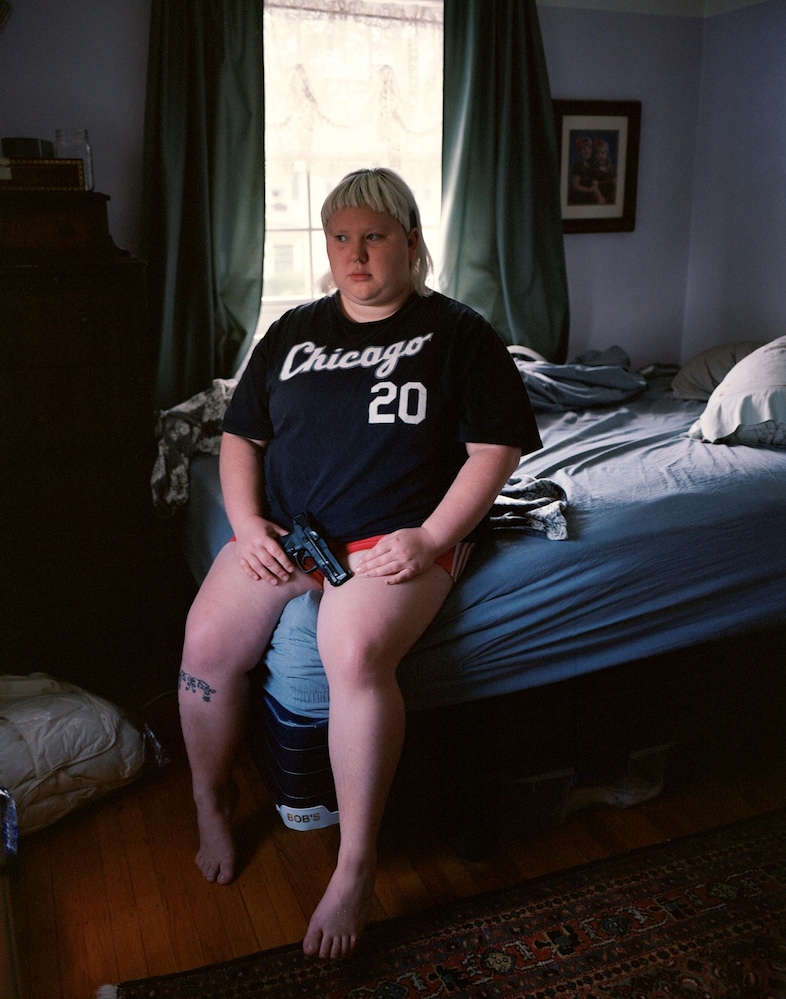
A particularly powerful sequence illustrates this duality with stark clarity. One photograph captures a subject resting on the edge of their bed, their hand gripping a handgun—a potent symbol of threat and self-preservation. Immediately following this, or in close thematic proximity, the same individual reappears in the identical setting, but the weapon is absent, replaced by the tender gesture of a friend curling their hair. This direct comparison speaks volumes about the fluctuating emotional states and external pressures that define adolescent and young adult life. It suggests that safety is often a fragile state, easily disrupted, yet equally accessible through the protective embrace of human connection. The narrative arc implied by these two images, moving from a posture of defense to one of relaxed intimacy, forms a miniature allegory for the broader journey depicted in the book.

Marisa Chafetz elaborates on this deliberate artistic choice: "While beauty is generally at the forefront of the images, there is a subtle underbelly in the work that speaks to the present moment." This "subtle underbelly" is where the photobook gains its critical depth, moving beyond mere aesthetic appeal to offer a commentary on contemporary existence. The interplay of gloomy, low-lit shots with moments of intense physicality further reinforces this theme. These visuals often show subjects engaged in acts of exertion, intimacy, or contemplation, their forms highlighted by chiaroscuro effects that emphasize both their strength and their fragility. Morganne Boulden interprets this visual language as deeply reflective of modern intimacy: "It says a lot about the way we experience intimacy in today’s world – it’s a scary place but it’s beautiful with friends and family." This statement underscores the resilience found in human bonds, portraying them as vital anchors in an unpredictable world. The photographers’ ability to capture these complex emotional states without resorting to overt sensationalism is a testament to their skilled artistic vision.
The Collaborative Vision: Merging Archives and Artistic Sensibilities
The creation of Whispers Against My Neck was a profoundly collaborative undertaking, bringing together years of individual work from two distinct yet complementary artistic voices. Both Marisa Chafetz and Morganne Boulden contributed images from their extensive archives, which were then meticulously curated through a process of mutual selection. This involved sifting through each other’s bodies of work, identifying photographs that resonated most strongly with the emerging themes. This approach, while challenging, ultimately enriched the final product, allowing for a broader, more nuanced exploration of the subject matter that no single artist could have achieved alone. The process of blending individual perspectives into a cohesive narrative is a hallmark of successful artistic collaborations, often leading to outcomes that transcend the sum of their parts.
Chafetz reflected on the collaborative journey, stating, "For me, the images are an expression of what I found beautiful, complicated, and worthy of contemplative looking during my 20s. If anything, the book reveals mine and Morganne’s commitment to living fully in the face of a lot of fear and hopelessness in this country." This statement highlights not only the personal investment of the artists but also the inherent optimism embedded within the work – a determination to find meaning and beauty despite prevailing anxieties. The collaborative process itself became a lesson in artistic surrender: "The collaborative process was a worthwhile lesson in learning to release control. The final product has a life of its own, outside of any singular vision," Chafetz explained. This speaks to the organic evolution of the project, where the combined perspectives transcended individual intentions to form a cohesive, powerful narrative.
Boulden further affirmed the synergy between their artistic approaches: "I think we both have a similar understanding of tension and intimacy." This shared sensibility for exploring complex emotional states and relational dynamics allowed their disparate images to converge into a singular, unified vision. The curator, Jesse Feinman, played a pivotal role in shaping this vision, particularly in selecting the evocative title, Whispers Against My Neck. Feinman describes the title as "an attempt to speak to physical closeness […] and what you learn about yourself (or each other) in those moments and experiences." This curatorial insight perfectly encapsulates the book’s dual focus: the tactile, immediate experience of human connection, and the deeper, often unspoken lessons gleaned from those interactions amidst a backdrop of ambient societal tension. The title itself serves as a metaphor for the intimate yet sometimes unsettling truths exchanged in close proximity, mirroring the photographic juxtapositions within the book.
Setting the Scene: Echoes of Southern America and Universal Themes
While Whispers Against My Neck deliberately avoids a fixed geographical setting to achieve a universal resonance, certain visual cues subtly suggest a milieu reminiscent of the American South. Images featuring a girl in American boardshorts flexing her bicep, or a woman posing on the bonnet of a Cadillac amidst derelict machinery in an underpass, evoke a specific regional atmosphere. These visual fragments hint at a landscape often associated with a unique blend of historical weight, economic struggle, and vibrant, often resilient, cultural identity. The South, with its rich photographic tradition from artists like William Eggleston and Sally Mann, often serves as a powerful backdrop for narratives of youth, decay, and enduring spirit. The presence of such elements, while not prescriptive, adds a layer of contextual richness for viewers familiar with these visual tropes. It suggests a certain rugged individualism and a deep connection to the land that is often characteristic of the region.

However, the overarching intent of the photobook transcends regional specificity. The images, despite their potential geographical anchors, possess a profound "timeless quality" that speaks to something inherently universal about the experience of growing up. This universality is achieved by focusing on archetypal moments of youth: first loves, friendships forged in adversity, explorations of identity, and the raw vulnerability of self-discovery. These themes resonate across cultures and generations, making the photobook accessible to a wide audience, irrespective of their own specific coming-of-age narratives. The visual language employed by Chafetz and Boulden strips away the ephemeral details of current trends to reveal the enduring emotional core of youth, echoing classic coming-of-age narratives in literature and film that have explored similar themes across various settings.
Nature as a Silent Witness and Philosophical Backdrop
A consistent thematic thread woven throughout Whispers Against My Neck is the pervasive presence of nature. It appears not merely as a decorative element but as a significant, often symbolic, backdrop to the human drama unfolding within the frames. Whether it’s the intricate patterns of tangled and knotted branches, the fleeting beauty of a sunset filtering through a silt fence, or the stark solemnity of a snow-covered graveyard, nature consistently provides a grander context for the intimate human narratives.
Marisa Chafetz eloquently explains this deliberate integration: "The landscape is the backdrop to all our human drama. It is the grandest possible context for any narrative, visual or otherwise." In this sense, nature acts as a silent witness to the turbulent journey of youth, reflecting cycles of growth, decay, resilience, and transient beauty. The gnarled branches could symbolize the complexities and entanglements of young lives, while the fleeting sunset speaks to the ephemeral nature of moments and the passage of time. The graveyard, a stark reminder of mortality, subtly underscores the preciousness of life and connection, especially when viewed through the lens of youthful discovery. This engagement with nature elevates the personal stories within the photobook to a more philosophical plane, inviting contemplation on humanity’s place within the natural world and the larger cycles of existence. This use of natural elements resonates with long-standing artistic traditions that employ landscape to mirror internal human states and universal truths.
Stillness in Action: Capturing the Universal Human Experience
At first glance, some photographs in Whispers Against My Neck might convey a sense of stillness or idleness, depicting subjects lounging on unmade beds or lost in contemplation. However, a deeper examination reveals that many of these images were captured in moments of intense action – amidst the chaos of gunfire, the vibrant energy of an indie-rock show, or other dynamic scenarios. This apparent contradiction is a deliberate artistic choice, as Chafetz suggests: "Even these images… render the world with a certain stillness."
This "stillness" is not a lack of movement, but rather a profound sense of presence and emotional resonance. It’s the ability to freeze a fleeting moment of intense experience, allowing the viewer to absorb its emotional weight and inherent complexity. This quality is central to the shared vision of the two photographers. "We both like to expand beyond the boundaries of time, place and location and focus on moments that feel universal to the human experience," Chafetz notes. By distilling chaotic or intimate events into moments of quiet intensity, the artists invite viewers to connect with the raw, unfiltered emotions of their subjects. This approach transforms specific instances into archetypal representations of joy, fear, vulnerability, and resilience, making the work resonate deeply with anyone who has navigated the tumultuous waters of youth. It is a testament to their photographic skill that they can extract such profound quietude from scenes of inherent dynamism.
Implications and Legacy of Whispers Against My Neck
Whispers Against My Neck stands as a significant contribution to contemporary photography, particularly in its nuanced portrayal of youth and the human condition. The photobook offers more than just a collection of striking images; it provides a visual ethnography of a generation grappling with unprecedented societal pressures while simultaneously seeking profound connections. Its success lies in its ability to marry stark realism with an underlying current of poetic beauty, never shying away from the difficult aspects of life but always highlighting the enduring power of human relationships.
The work’s impact extends beyond its aesthetic appeal, serving as a cultural document that captures the zeitgeist of young adulthood in the early 21st century. By presenting the co-existence of danger and safety, vulnerability and strength, Chafetz and Boulden offer a testament to the resilience of the human spirit. The collaborative nature of the project also sets an example for artistic practice, demonstrating how shared visions and a willingness to transcend individual control can lead to richer, more complex narratives. As it finds its place within the canon of photographic works documenting youth, Whispers Against My Neck will likely be remembered for its unflinching honesty, its tender observations, and its enduring message that even in the most unsettling times, there is beauty, intimacy, and hope to be found in the embrace of loved ones.
Whispers Against My Neck is published by Pomegranate Press and is available for purchase.