










The entry-level luxury watch market has seen an unprecedented influx of micro-brand dive watches over the past decade, creating a saturated landscape where differentiation is often limited to aesthetic variations of the ubiquitous cushion-shaped case. Against this backdrop, the Marvin Bathyscaphe Automatic Diver, priced at $799, emerges as a significant case study in balancing cost-effective manufacturing with high-level design execution. While many timepieces in this segment rely on generic computer-generated renderings to drive sales, the Marvin Bathyscaphe distinguishes itself through tactile mechanical complexity and a commitment to precision that exceeds standard industry benchmarks for its price point.

Historical Context and Design Evolution
The Marvin brand carries a heritage that dates back to 1850, when brothers Marc and Emmanuel Didisheim established the company in Saint-Imier, Switzerland. The "Bathyscaphe" nomenclature refers to the legendary deep-sea submersible technology, a fitting thematic inspiration for a diver’s watch. While the current model may appear contemporary, its design lineage spans over a decade, representing a refined iteration of earlier prototypes that prioritized functional deep-sea utility.
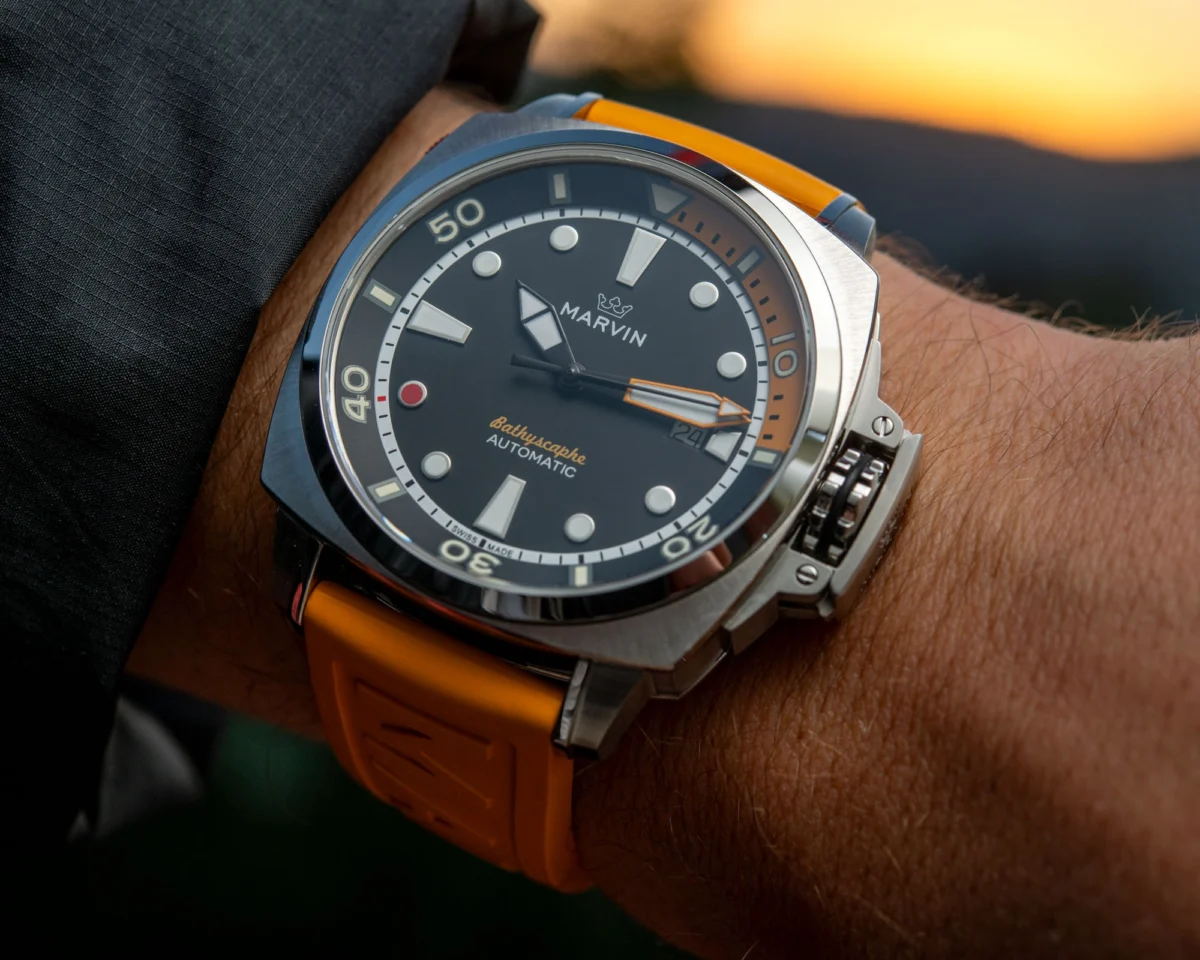
The watch features a 43mm stainless steel case that utilizes a 316L alloy, the industry standard for corrosion resistance and durability. The case geometry is defined by a cushion-shaped silhouette, a design choice that provides a robust aesthetic while maintaining a wearable profile. Despite its substantial footprint, the watch maintains a 12.1mm thickness, an engineering achievement that balances the heavy-duty requirements of a 200-meter water-resistance rating with the ergonomic necessity of a slim wrist profile.

Mechanical Precision and Component Integration
Central to the technical value proposition of the Bathyscaphe is the integration of an internal rotating bezel. Unlike traditional external bezels, which are prone to mechanical wear or accidental rotation, this internal mechanism is controlled by a dedicated knurled rotary knob located at the 10:30 position on the case. This unidirectional bezel features 120 clicks, providing tactile and audible feedback that rivals watches in significantly higher price brackets.
The movement powering the unit is the Sellita SW200, a workhorse caliber known for its reliability and ease of servicing. However, Marvin’s approach to this movement deviates from the industry norm of simply installing the base caliber. The manufacturer mandates a three-stage monitoring process: testing before assembly, post-assembly, and immediately prior to shipping. Marvin provides an accuracy guarantee of ±10 seconds per day, a specification that positions this model above the average performance of standard off-the-shelf movements, which often operate within a wider tolerance of ±15 to ±20 seconds per day.

Dial Architecture and Material Quality
The visual hierarchy of the dial is designed for maximum legibility, utilizing a matte finish that creates a subtle, grained texture. This backdrop serves to highlight the twelve applied hour markers, which are framed in polished steel. The contrast between the matte dial and the reflective, glossy outlines of the markers and hands is a classic horological technique used to enhance depth and perceived value.
A particularly sophisticated detail is the multi-tiered chapter ring. The seconds track is recessed, creating a distinct step-down transition before the transition into the steeply angled dive-time ring. This vertical integration adds a layer of complexity to the dial that is rarely found in sub-$1,000 timepieces. Furthermore, the alignment of the internal bezel, the hour markers, and the recessed rings is executed with a level of precision that ensures absolute symmetry—a feat that often eludes mass-produced watches.

The inclusion of a red marker at the 8 o’clock position serves as a signature brand element. While the exact historical origin of this specific marker remains a subject of ongoing brand documentation, it has become a recognizable hallmark for Marvin, distinguishing their product from the more traditional, monochromatic designs found in the broader market.
Case Construction and Ergonomic Considerations
The exterior construction reflects an investment in finishing that typically defines watches in the $2,000–$3,000 range. The case utilizes a combination of circular sunburst brushing on the main body and polished finishes on the bezel and internal lug additions. This juxtaposition of textures provides a high-end visual impact that defies the model’s sub-$800 price point.

The crown guard assembly is a notable, albeit divisive, feature. It utilizes a friction-fit latch mechanism featuring the etched Marvin logo. While this design provides enhanced protection for the crown, it introduces a potential point of friction: the inner edges of the latch. If not properly chamfered, these edges can be sharp during interaction with the crown. Despite this, the crown itself—equipped with a thick rubber band for grip—is highly functional, and the screw-down design ensures the integrity of the 200-meter water-resistance rating.
The caseback features an elaborate construction held by eight screws, demonstrating a commitment to structural integrity. It employs three distinct finishes: a polished periphery, a sandblasted center ring, and a brushed sea star motif. Such attention to the hidden elements of the watch is rarely seen in entry-level divers, where manufacturers frequently opt for simple, brushed-steel stamped backs.

Broader Market Implications and Strategic Positioning
The current watch market is characterized by a "render-first" culture, where brands often rely on digital imagery that fails to capture the physical reality of the product. The Marvin Bathyscaphe stands in contrast to this trend. By focusing on physical manufacturing quality, internal movement calibration, and the integration of complex features like the internal bezel, Marvin is positioning itself as a "value-driven" luxury brand.
From a macroeconomic perspective, the $799 price point places the Bathyscaphe in direct competition with heavy hitters such as the Seiko Prospex line, the Tissot Seastar, and various offerings from independent micro-brands. However, Marvin’s strategy appears to be one of "over-engineering"—providing features that are technically difficult to execute at scale, such as the internal bezel and the multi-tiered dial.

Future Outlook and Sustainability of Quality
The challenge for manufacturers like Marvin remains the scalability of such quality. As production volumes increase, maintaining the tight tolerances required for the alignment of the bezel and the three-stage calibration of the movement becomes exponentially more difficult. If the brand can maintain these standards, the Bathyscaphe could serve as a benchmark for what consumers should expect from the entry-level mechanical market.
In conclusion, the Marvin Bathyscaphe Automatic Diver is a testament to the fact that high-quality watchmaking is not strictly the domain of high-priced heritage houses. Through careful material selection, a rejection of "bog-standard" movement integration, and a focus on tactile engineering, the model successfully justifies its price. While some design elements, such as the crown guard, may require minor refinement for long-term comfort, the overall package presents a compelling argument for the viability of traditional, well-made mechanical dive watches in an increasingly digital, mass-market-oriented industry. For enthusiasts seeking a blend of historical legacy, functional utility, and superior build quality, the Bathyscaphe represents a significant, albeit understated, contender in the current horological landscape.