










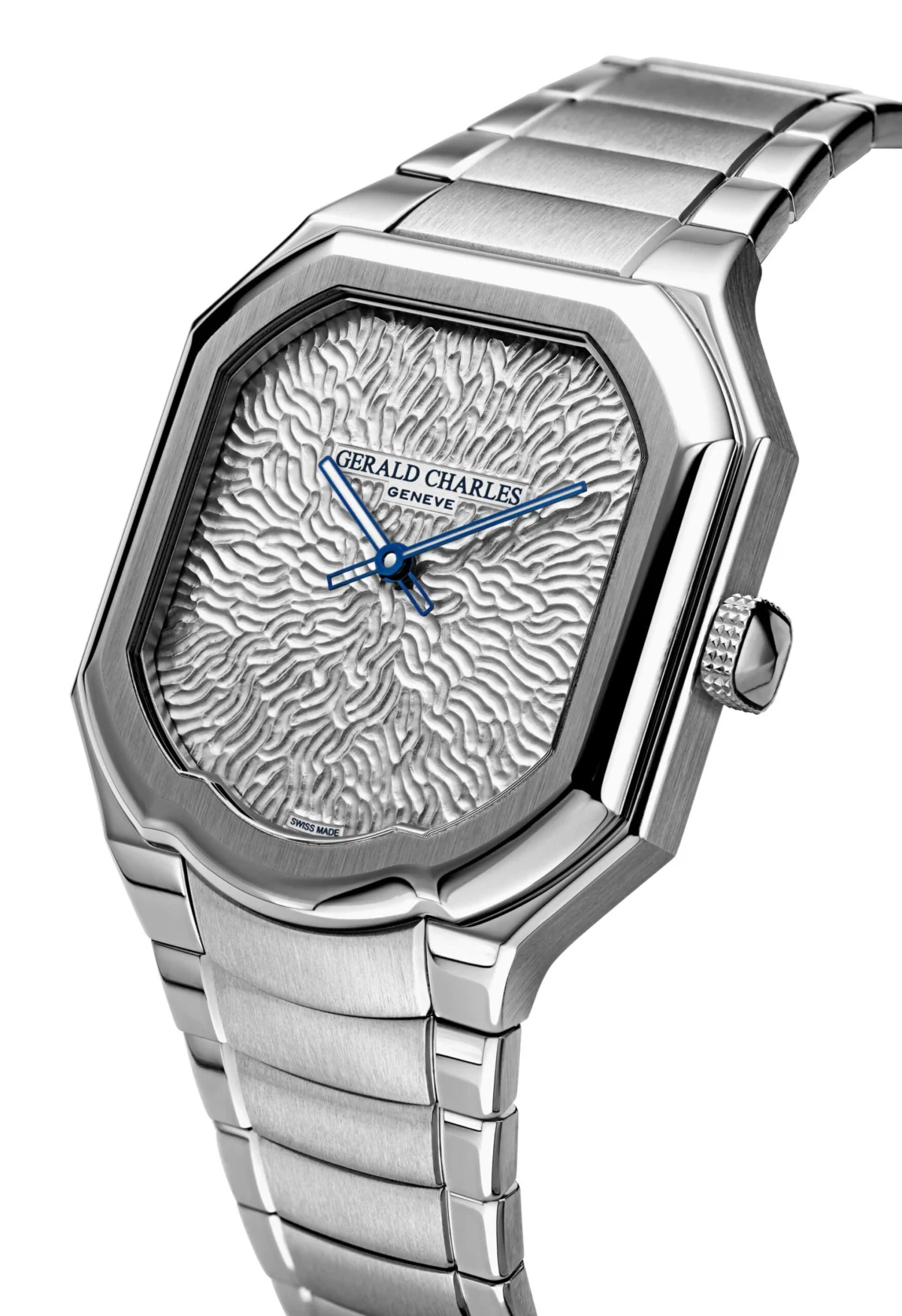
The watchmaking industry has long grappled with the tension between industrial precision and human artistry. With the launch of the Gerald Charles Masterlink Atelier Edition, the Geneva-based manufacture has sought to resolve this dichotomy by marrying its most complex case architecture with a labor-intensive, hand-crafted dial. This limited-edition release, restricted to just 75 pieces worldwide, represents a significant evolution for the Masterlink line, which debuted only in 2024 as the brand’s first foray into the competitive integrated-bracelet sports watch segment.
A Legacy Reimagined: The Design Context
To understand the significance of the Masterlink, one must look back to the foundational influence of Gérald Charles Genta. As one of the most prolific designers in the history of horology, Genta founded the Gerald Charles brand over 25 years ago. His design philosophy—which famously rejected the standard circular watch case in favor of fluid, asymmetrical, and often sculptural geometries—remains the guiding star for the current creative team.

The Masterlink, released to critical acclaim in early 2024, was designed to translate the brand’s signature “Maestro” aesthetic into a wearable, everyday sports format. The challenge, according to CEO Federico Ziviani, was to create a watch that felt seamless on the wrist despite the highly complex, asymmetrical geometry of the case. The case measures 38mm by 38mm, an unconventional dimension that belies its remarkably slim profile of just 7.99mm. By incorporating a screw-down crown while maintaining a 100-meter water resistance, the brand successfully navigated the technical hurdle of protecting a delicate movement within a thin, sporty chassis.
The Engineering of the Integrated Bracelet
The bracelet of the Masterlink is perhaps its most technically demanding feature. Unlike standard integrated bracelets that attach to a symmetrical lug structure, the Masterlink’s bracelet had to accommodate the case’s distinct "smile" curve at the 6 o’clock position. The design team opted for a system where the central links mirror the case’s curvature before transitioning into a linear profile.
Historical archives reveal that this specific bracelet geometry draws inspiration from a rare 2007 commission Genta created for the Royal Family of Sarawak. That watch, which featured a diamond-and-ruby set integrated bracelet, remained an obscure footnote in horological history until its resurgence in the public consciousness in 2024. By adapting these design codes for the Masterlink, Gerald Charles has effectively modernized a boutique concept into a refined, high-end consumer product. The lack of visible screws and the integration of a hidden butterfly clasp contribute to a clean, minimalist silhouette that emphasizes the fluid continuity of the steel.

The Atelier Edition: A Shift Toward Artisanship
The primary differentiator for the new Atelier Edition is the introduction of the Maillechort dial. Maillechort, or nickel silver, is a copper-nickel-zinc alloy known for its durability and warm, metallic luster. However, it is notoriously difficult to machine compared to standard brass, often causing rapid wear on CNC tools and requiring precise handling.
In the Atelier Edition, the brand has eschewed mechanical stamping for a traditional, manual hammering technique. Artisans at the Gerald Charles facility in Geneva strike the metal hundreds of times to create a faceted, irregular texture. This texture is not merely aesthetic; it serves a functional purpose in light interaction. While traditional sunray-finished dials reflect light from a central point, the hammered facets of the Atelier Edition scatter light across the surface, creating a dynamic, shimmering effect that changes with the angle of the wearer’s wrist.
The decision to omit hour markers was a deliberate move by the creative team to ensure the dial texture remains the primary focal point. This creates a bold, minimalist aesthetic that forces the wearer to engage with the material quality of the watch rather than relying on traditional indices for time-reading, underscoring the brand’s confidence in the dial’s visual impact.

Technical Specifications: The Caliber GCA 1000
Beneath the dial, the watch is powered by the Caliber GCA 1000, an automatic movement developed in-house. Measuring 2.67mm in thickness, this movement is the engine that allows the Masterlink to maintain its ultra-slim profile. The movement operates at a frequency of 21,600 vibrations per hour (3 Hz) and offers a 50-hour power reserve.
The GCA 1000 is comprised of 176 individual components, including 29 jewels. It incorporates an offset micro-rotor, a choice that contributes to the movement’s thinness while allowing for a clear view of the finishing through the sapphire crystal caseback. The movement is decorated with classic horological finishes, including Côtes de Genève, snailing, and circular graining, meeting the standards expected of high-end Swiss watchmaking.
Market Implications and Strategic Positioning
Priced at $31,000 USD, the Masterlink Atelier Edition occupies a rarefied segment of the luxury market. Its release comes at a time when collectors are increasingly favoring "independent" or boutique-style watchmaking over the mass-market output of larger conglomerates.

The strategy behind the limited run—25 pieces each in Golden Rose, Rhodium, and Golden Yellow colorways—serves to reinforce the exclusivity of the brand. By emphasizing the "Atelier" aspect of production, Gerald Charles is positioning itself as a manufacture that values human labor over sheer volume. The fact that no two dials are identical adds a layer of "provenance" that is highly prized by modern collectors, who often seek unique characteristics in high-end horological pieces.
From a market analysis perspective, the Masterlink Atelier Edition represents a calculated risk. By introducing an artisanal, hand-hammered dial to a technical, industrial sports watch, the brand is appealing to two distinct demographics: those who value the Genta-designed technical architecture of the case and those who prioritize traditional, high-craft decorative arts.
Official Commentary and Industry Reception
In internal communications regarding the release, Gerald Charles leadership highlighted the challenge of this production method. As CEO Federico Ziviani noted, the project was a "highwire act" of design, where the goal was to "let simplicity conceal complexity." The effort required to machine the Maillechort, combined with the artisan’s time spent hammering each individual dial, results in a production timeline significantly longer than that of a standard serial-produced watch.

Industry observers have noted that this release cements the Masterlink’s status as a serious contender in the integrated-bracelet luxury segment. While competitors often rely on experimental materials like carbon fiber or ceramic, Gerald Charles has chosen a more traditional, yet equally difficult, path by emphasizing the "hand of the maker."
Future Outlook
The release of the Atelier Edition suggests that Gerald Charles intends to continue using the Masterlink as a platform for experimentation. With the technical foundation of the GCA 1000 movement and the asymmetrical case design already established, the brand has the freedom to rotate through various dial materials and artistic finishes.
As the watchmaking industry continues to shift toward smaller-scale, artisanal production, the Masterlink Atelier Edition stands as a case study in how heritage design can be successfully updated for a modern audience. The focus on light interaction, the utilization of complex alloys, and the commitment to manual labor all point toward a brand strategy that prioritizes quality and artistic integrity over market saturation. For the 75 individuals who will secure these timepieces, the watch represents more than just a tool for measuring time; it is a manifestation of a specific, time-intensive craft that is becoming increasingly rare in the era of automated manufacturing.