







The iridescent shimmer and playful allure of body glitter, once a hallmark of early 2000s pop culture, are experiencing a significant revival, signaling a shift in beauty trends and a nostalgic embrace of Y2K aesthetics. From the music stages of artists like Zara Larsson and Tyla to the small screen with the prominent use in HBO’s "Euphoria," the resurgence of sparkle is undeniable. This trend is not merely a fleeting moment but a deliberate counterpoint to the prolonged dominance of the "clean girl" makeup aesthetic, according to Donni Davy, lead makeup artist for "Euphoria" and founder of Half Magic Beauty.
.jpg)
"We’ve been in a clean-girl makeup trend for a while now, and whenever something has been popular for a long time, there’s a tendency to go in the other direction," Davy explained. "It makes sense that glitter and shimmer are coming back, and I’m here for it." This cyclical nature of fashion and beauty suggests a collective desire for more expressive and visually impactful adornment, moving away from minimalism towards maximalism and playful self-expression.
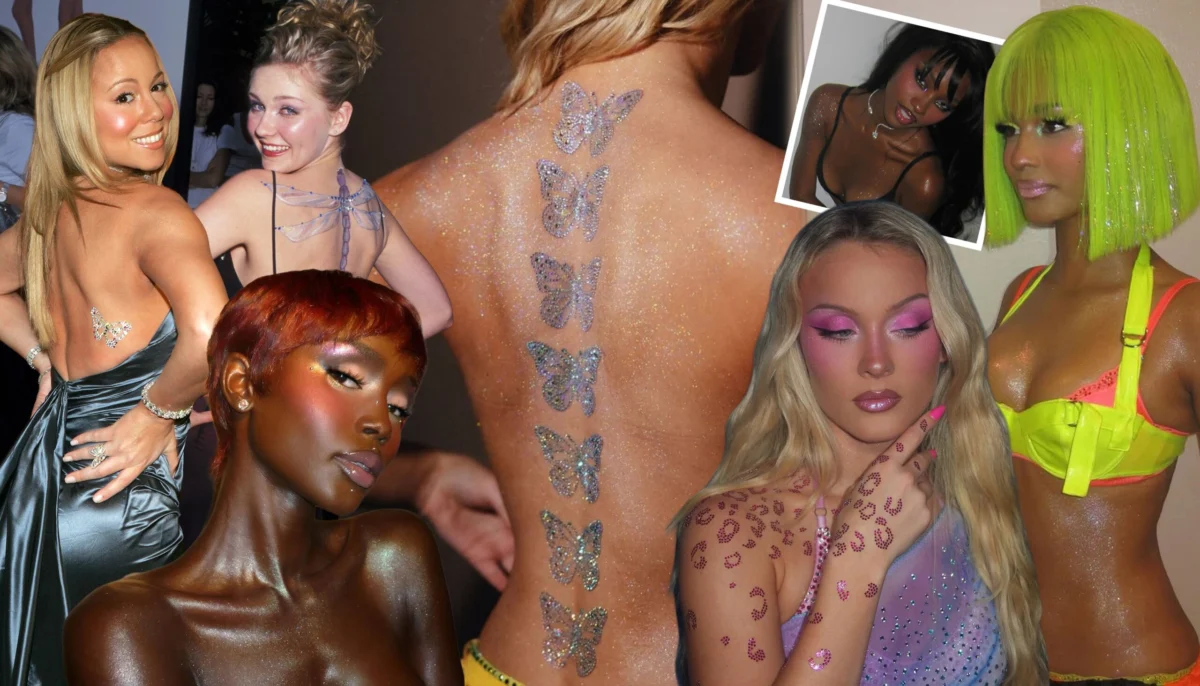
The reemergence of body glitter is closely paralleled by the comeback of crystal-coated adhesive body stickers, a staple of millennial proms. These embellishments, notably seen as butterfly "tattoos" on Zara Larsson, are bridging generational divides. Lucas Stowe, the performance-wear designer behind Larsson’s look, notes that younger generations, such as Gen Alpha and Gen Z, are discovering these elements as novelties, akin to the enduring appeal of Lisa Frank stickers. "Gen Alpha and Gen Z are seeing these things as new," Stowe observed. "I remember loving them. For [my generation], that was so exciting and new. It’s funny to [witness] Gen Z-ers seeing them through new eyes. To us, it’s nostalgia." This phenomenon highlights how cultural touchstones can be reinterpreted and embraced by new audiences, imbued with fresh meaning and appeal.

The Historical Trajectory of Body Adornment and Sparkle
The origins of modern glitter can be traced back to 1934 when machinist Henry Ruschmann of Bernardsville, New Jersey, developed an early form of glitter for industrial coatings by cutting up Mylar film and mixing it with metallic powder. However, it was in the 1990s and early 2000s that glitter as a fashion accessory reached its zenith, heavily influenced by the pop music scene and its omnipresent presence on music television networks.
"Think back to the days of Britney and Christina. They were all about being glowy, yet almost futuristic," remarked Charlie Riddle, makeup artist and Stila global beauty director and head of artistry. "People were using glitter on the arms, chest, legs, anywhere that could catch the light." This era saw an explosion of glitter products, from roll-on gels to shimmering body powders. Brands like Bath & Body Works, with their "Art Stuff" line, and Jessica Simpson’s "Dessert Beauty" edible body powders, offered accessible entry points into this shimmering world for a younger demographic. More sophisticated formulations from brands like Benefit and Urban Decay also gained traction, with Wende Zomnir, founder of Urban Decay, noting that "Body glitter blew up back then because it was a natural extension of the moment: girl-led rock bands, brands like Urban Decay shaking up the makeup landscape; permission was given."

Alongside glitter, rhinestone adhesives and other decorative body art also played a significant role. Mariah Carey’s iconic butterfly adornment from circa 2001 serves as a prime example. Makeup artist Ngozi Edeme recalled, "All the baddest video vixens had some of the body art we see today, from bedazzled tramp stamps to belly button rings." The aesthetic was characterized by a bold, often playful, and sometimes daring approach to body decoration.
The visual landscape of the early 2000s was replete with music videos featuring performers and backup dancers adorned in glitter and gemstones. This trend transcended music videos and made its way to red carpet events. Salma Hayek, at the 1998 MTV Video Music Awards, complemented her strapless dress with butterfly designs across her chest and back, which she reportedly painted herself as stickers were not readily available at the time. Kirsten Dunst, at the 1999 premiere of "Drop Dead Gorgeous," opted for a dragonfly design accented with well-placed rhinestones. Makeup artist Molly R. Stern commented on the DIY spirit of the era: "We were getting all of our supplies from the art store back then. If we could stick it on our face or body, we did." These larger, statement pieces often served as focal points, with color palettes coordinated to match eye makeup or attire.

The philosophy of the time was unequivocally "more is more." Lori Taylor Davis, global pro lead artist at Smashbox, described the prevalent aesthetic: "Think, collarbones glazed in shimmer oils, shoulders dusted in sparkle, and tiny rhinestones framing the eyes made luminous skin a statement. It wasn’t subtle; it was seen. It was about glow, and catching the light from every angle." Exposed skin, whether on the décolletage, arms, or legs, became a canvas for glitter and shimmer, a trend amplified by the fashion of the post-"Dirrty" era, characterized by low-rise jeans and revealing cutouts.
By the mid- to late-2000s, the trend evolved towards more subtle shimmer, yet artists like Kesha maintained the glitter aesthetic, propelling it into the indie-sleaze era. Makeup artist Mylah Morales, who worked with Kesha, explained their approach: "With Kesha, the inspiration is always rooted in rock-and-roll glamour and a ‘more is more’ philosophy. We looked at ‘70s disco-era icons and glam-rock legends, but modernized it. The goal was to make the glitter look like it was radiating from her skin rather than just sitting on top of it. We wanted her to look like a celestial creature caught in a strobe light." Morales emphasized integrating body adornments with facial makeup and fashion to create a cohesive, high-fashion look that blurred the lines between makeup and clothing.

Modernizing the Sparkle: Formulas and Application in 2026
The current iteration of body glitter and gemstone embellishments benefits from advancements in cosmetic formulation, offering enhanced wearability and aesthetic appeal. "Glitter has gotten more sparkly and the textures are less chunky. It’s more refined, and the colors are also more sophisticated," stated Donni Davy. Cosmetic chemists Victoria Lu and Gloria Fu of Chemist Confessions noted the significant evolution: "Back in the ‘90s and early 2000s, body glitter formulas were usually simple, large plastic glitter particles suspended in basic gels or oils, with more focus on visual impact. The concept is fun, but the actual formula and material were less than ideal with goopy, greasy textures."
Today’s formulations offer improved textures, including lightweight gels, dry-touch oils, and serum-like bases, prioritizing comfort and longevity. Furthermore, there’s a growing emphasis on safety and sustainability. "There’s also more awareness around the glitter material itself to improve eye safety, general skin irritation, and glitter’s overall environmental impact," Fu added. This includes the development of biodegradable glitters and formulations that are gentler on the skin.

Mastering the Application: Tips for a Flawless Shimmer
Achieving a seamless and long-lasting glitter application requires strategic preparation and technique. Davy advises, "You want to keep the skin slightly tacky. A slightly dewy or tacky base will help the glitter stick better." This tackiness can be achieved by layering products. Davis suggests starting with a hydrating body moisturizer to create a smooth canvas, followed by a tack layer such as a balm, mixing medium, or an adhesive, particularly in areas where the glitter needs extra hold. "If the skin isn’t prepped, glitter can look patchy instead of luminous," she cautioned.
A crucial aspect of modern glitter use is selecting cosmetic-grade products. Linnea Sumner, a special effects and beauty makeup artist at New York City’s Kimara Ahnert Studio, stressed the importance of avoiding craft glitter: "Craft glitter can have sharp edges not suitable for skin. Even if you don’t feel the sharp edges putting it on, you’ll definitely feel it taking it off, especially around your eyes."

Application is best done by pressing the glitter into the skin with a brush, rather than swiping, to ensure even distribution. Strategic placement is key to maximizing the effect. Davis recommends focusing on high points of the body, such as collarbones, shoulders, and cheekbones, where light naturally catches. Following the body’s natural contours can create an elongating effect. While symmetry is desirable, a touch of asymmetry can add an edgy, artistic flair.
To lock the look in place, a final mist of a robust setting spray is recommended. Sumner suggests "heavy-duty FX ones like the Kryolan, Mehron, Ben Nye, or extra-strong beauty options like One/Size or Skindinavia Bridal." These sprays create a protective barrier, preventing glitter transfer and ensuring the embellishments remain intact throughout the day or night.

The Art of Body Stickers and Gemstone Adornments
Unlike glitter, which benefits from a slightly tacky base, body stickers and individual rhinestones require a clean, dry surface for optimal adhesion. Stowe advises against using spray tan or body oil in the application area and recommends cleansing with rubbing alcohol beforehand. His design process, inspired by diverse cultural and artistic influences including Cher, "The Rocky Horror Picture Show," drag artistry, and Lisa Frank, begins with digital renderings before physical creation. The adhesive is engineered for extended wear, even through strenuous performances.
For beginners, Stowe suggests starting with smaller stickers on flat body surfaces, avoiding areas prone to friction from clothing. If placing stickers on curved areas, he recommends reinforcing with eyelash glue for added security or for affixing additional rhinestones.

For those freehanding designs with individual rhinestones, Edeme suggests using a white pencil to sketch the pattern on dry, alcohol-cleaned skin. Arranging the rhinestones and glue on a palette before using a specialized tool or tweezers for precise placement is an effective method. Sumner recommends Duo Brush-On Clear Adhesive for its easy application, advising to apply glue to the skin rather than the gem itself to prevent sticky fingers.
Ultimately, the contemporary approach to body adornment encourages creative exploration and personalization. "Have fun with it and let the design reflect your personality," Edeme urged. "Explore animal prints, flower designs, or even tattoo designs." The trend empowers individuals to use shimmer and embellishments as an extension of their personal style, blending makeup, fashion, and self-expression into a cohesive, dazzling statement. The revival of body glitter and gemstone embellishments signifies more than just a return to Y2K aesthetics; it represents a broader cultural embrace of joy, confidence, and unapologetic self-expression through the power of sparkle.