





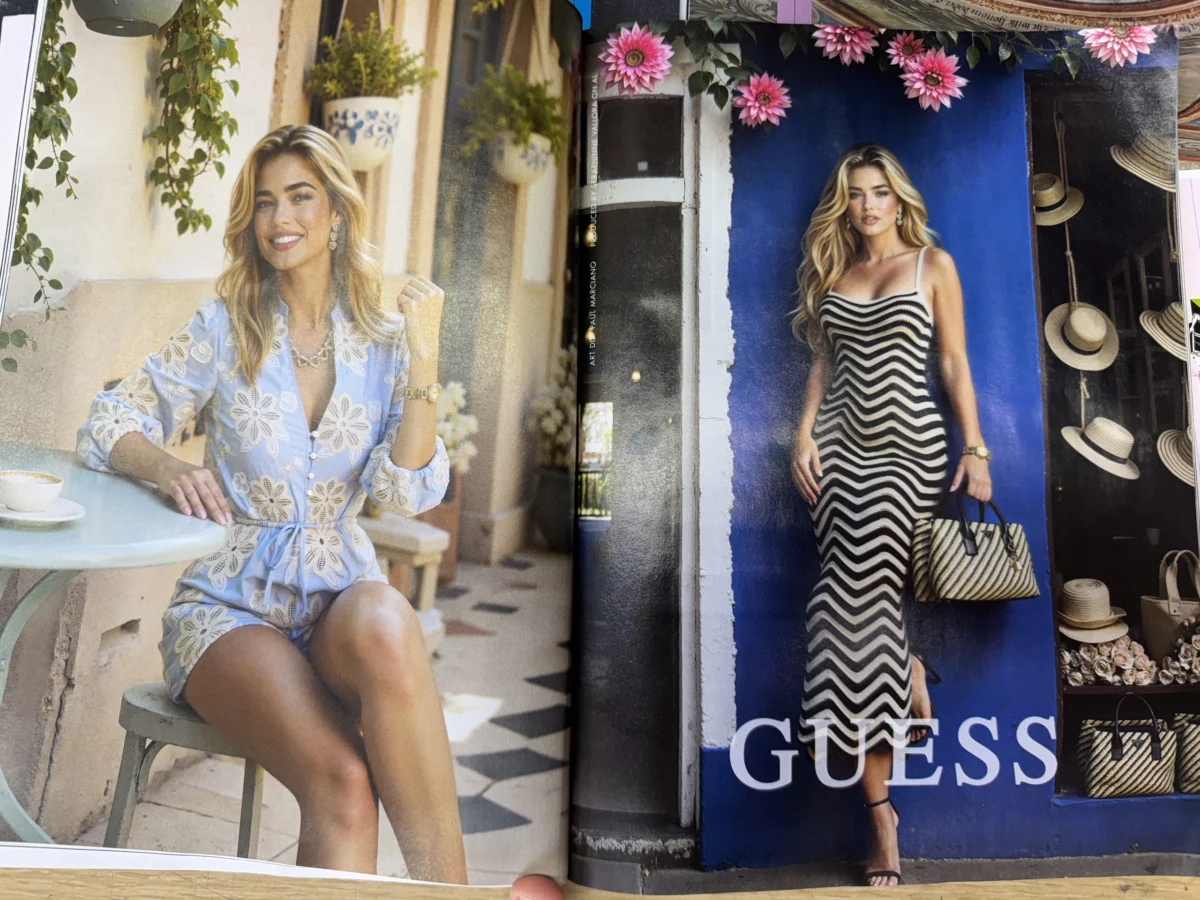
The July print edition of Vogue, long considered the definitive arbiter of global style and industry standards, recently sparked a firestorm of controversy that has reverberated across the creative world. The source of the outcry was not a radical new silhouette or a provocative editorial spread, but a full-page advertisement for the brand Guess. The image featured a model who embodied the brand’s traditional aesthetic: slender, blonde, and possessing the symmetrical perfection long associated with North American beauty standards. However, the model was not human; she was a product of generative artificial intelligence.
While the advertisement met Vogue’s internal advertising standards, its appearance in the "fashion bible" signaled a watershed moment for the industry. For professional models, photographers, and stylists, the inclusion of an AI-generated figure in such a prestigious publication represents more than just a technological curiosity—it signifies a potential existential threat to the human labor force that has underpinned the fashion economy for over a century.
The Evolution of Artificial Imagery in Fashion
The transition from human-centric photography to digital synthesis has been a gradual progression, accelerated by recent breakthroughs in machine learning. The roots of this shift can be traced back to at least 2013, when the French retailer Veepee began utilizing virtual mannequins to display inventory. Since then, the technology has evolved from stiff, uncanny-valley avatars to the photorealistic "AI artisans" of the present day.

A significant turning point occurred in 2023 when the iconic denim manufacturer Levi Strauss & Co. announced a partnership with the AI studio Lalaland.ai. The initiative aimed to create "diverse" digital models to supplement human talent, ostensibly to improve inclusivity in digital marketing. The backlash was immediate and severe. Critics, including New York Magazine, labeled the move "artificial diversity," arguing that the company was opting to simulate representation rather than hiring and paying human models from marginalized backgrounds.
Sarah Murray, a commercial model, recalls the visceral reaction she felt upon seeing an AI-generated model in a Levi’s campaign. To Murray and many of her peers, the promise that AI would only "supplement" human talent felt disingenuous. The reality, she argues, is that modeling is an increasingly precarious profession where human workers must now compete against digital standards of perfection that are physically impossible to maintain.
The Economic Imperative: Scale and Cost Efficiency
The primary driver behind the adoption of AI models is a stark economic reality. In the modern retail environment, the demand for visual content has exploded. Traditionally, a major fashion brand might produce four large-scale marketing campaigns per year. However, the rise of e-commerce and social media platforms like TikTok and Instagram has shifted that requirement to hundreds, or even hundreds of thousands, of individual pieces of content.
PJ Pereira, co-founder of the AI advertising firm Silverside AI, notes that the current marketing ecosystem was not built for this level of scale. Small-to-mid-sized brands, in particular, struggle to fund the logistics of traditional photoshoots—which involve hiring models, photographers, hair and makeup artists, and renting studio space—for every single SKU in their inventory.

AI offers a radical alternative. Using tools such as Flux from Black Forest Labs, brands can now start with a "flat-lay" product shoot—a simple photo of a garment on a flat surface—and use generative models to place that garment on a photorealistic virtual model in any setting imaginable. This process reduces the cost of content production by an order of magnitude, making it an irresistible proposition for companies looking to maximize their margins.
According to data cited by industry experts, the engagement metrics for AI-generated content can be surprisingly high. Pereira’s firm recently tested a fully AI-generated product video on TikTok that garnered over a million views. Despite a significant volume of negative comments regarding the use of AI, the video achieved a click-through rate 30 times higher than the number of complaints, resulting in a measurable spike in sales. This "silent majority" of consumers, who prioritize visual appeal and product information over the origin of the image, provides brands with a powerful incentive to continue experimenting with synthetic imagery.
Ethical Concerns and "Robot Cultural Appropriation"
The shift toward AI models has raised profound ethical questions, particularly regarding identity and representation. Sinead Bovell, a model and founder of the WAYE organization, has pioneered the term "robot cultural appropriation" to describe the practice of brands generating diverse digital identities to tell a brand story without actually engaging with the communities those identities represent.
The concern is that AI allows brands to profit from the "aesthetic" of diversity while bypassing the social and financial responsibility of employing diverse humans. This is especially damaging in the commercial modeling sector, which Bovell identifies as the "bread and butter" of the industry. Unlike high-fashion runway modeling, which offers prestige, commercial e-commerce modeling provides the financial security that allows models to maintain their careers. If this sector is automated, the path to a sustainable career in fashion may vanish for all but a tiny elite.

Furthermore, models are increasingly concerned about the legal implications of their likenesses. Sarah Murray noted that many contemporary contracts now include clauses that may allow brands to use a model’s face and physical attributes to train future AI systems. This effectively asks models to sign away the rights to their own identity, allowing a brand to create a digital "twin" that can be used indefinitely without further compensation or consent.
Legislative Responses and the Future of Labor Rights
In response to these emerging threats, advocacy groups are pushing for new legal frameworks to protect human workers. Sara Ziff, a former model and founder of the Model Alliance, is currently championing the Fashion Workers Act in the New York State Legislature. The bill seeks to regulate management agencies and provide basic labor protections for models and content creators. Crucially, it would require brands to obtain clear, informed consent and provide fair compensation whenever a model’s digital replica is used.
Proponents of the technology, such as art technologist Paul Mouginot, argue that digital avatars could actually benefit top-tier models by allowing them to "appear" at multiple shoots across the globe simultaneously. This could create new revenue streams through licensing. However, Mouginot acknowledges the inherent trade-off: while a few highly sought-after models might gain from this system, it inevitably reduces the total number of jobs available for the broader labor pool.
The Niche for "AI Artisans" and the Value of Imperfection
As the technology matures, some creative firms are positioning themselves as "AI artisans" rather than mere software operators. Sandrine Decorde, CEO of Artcare, emphasizes the need for human intentionality in AI generation. She argues that early AI models were too homogenous—characterized by symmetrical lips, identical jawlines, and a lack of character.

Artcare focuses on "fine-tuning" datasets to include the imperfections that define human beauty: a unique gaze, a slight gap in teeth, or an asymmetrical smile. Decorde also highlights a more controversial but arguably ethical application of the technology: the use of AI-generated babies and children. The fashion industry has a long history of issues regarding the exploitation of minors on sets. By using synthetic imagery for children’s clothing, Decorde suggests that brands can meet market demand without the logistical and ethical complications of employing child labor.
Conclusion: An Uncertain Trajectory
The fashion industry currently stands at a crossroads. While luxury heritage brands remain cautious, often prioritizing the "sensual reality" and human connection of traditional photography, the broader commercial market is moving rapidly toward automation.
The Guess ad in Vogue serves as a litmus test for public and industry acceptance. If the "fashion bible" continues to normalize synthetic imagery, it is likely that editorial spreads—once the exclusive domain of human artistry—will eventually follow suit. As fashion writer Amy Odell noted, the industry has a history of initial resistance followed by total assimilation, citing the eventual acceptance of reality stars like Kim Kardashian into the high-fashion canon.
For the human workers of the fashion world, the challenge will be to differentiate themselves through personal branding and "unique human stories" that AI cannot replicate. However, as the lines between the physical and the digital continue to blur, the definition of what it means to be a "model" is being fundamentally rewritten by lines of code. The future of fashion will likely be a hybrid one, but the cost of that transition—and who will pay it—remains the subject of intense global debate.