









Alex Karp, the enigmatic CEO of the spy tech firm Palantir, often described as a "supervillain" by some, presents a public image that belies the formidable and often controversial nature of his company’s operations. His sartorial choices, ranging from unremarkable blue suits at defense tech conferences to logo-covered gilets synonymous with Silicon Valley investors, project an image of an unassuming "tech bro." This outward appearance offers little hint of the significant allegations surrounding Palantir, including claims of enabling actions described by a United Nations rapporteur as "genocide" in Gaza, fostering a right-wing technocracy in the United States, or Karp’s own controversial humor, such as joking about spraying critics with "fentanyl-laced urine." Yet, this seeming disconnect between appearance and activity is likely not coincidental, as Palantir demonstrably understands the strategic importance of aesthetics in shaping public perception. This understanding is now manifesting in a new form: branded merchandise, serving as a subtle yet potent tool for cultural infiltration and the normalization of its hard power objectives.
Palantir’s Entry into Lifestyle Branding
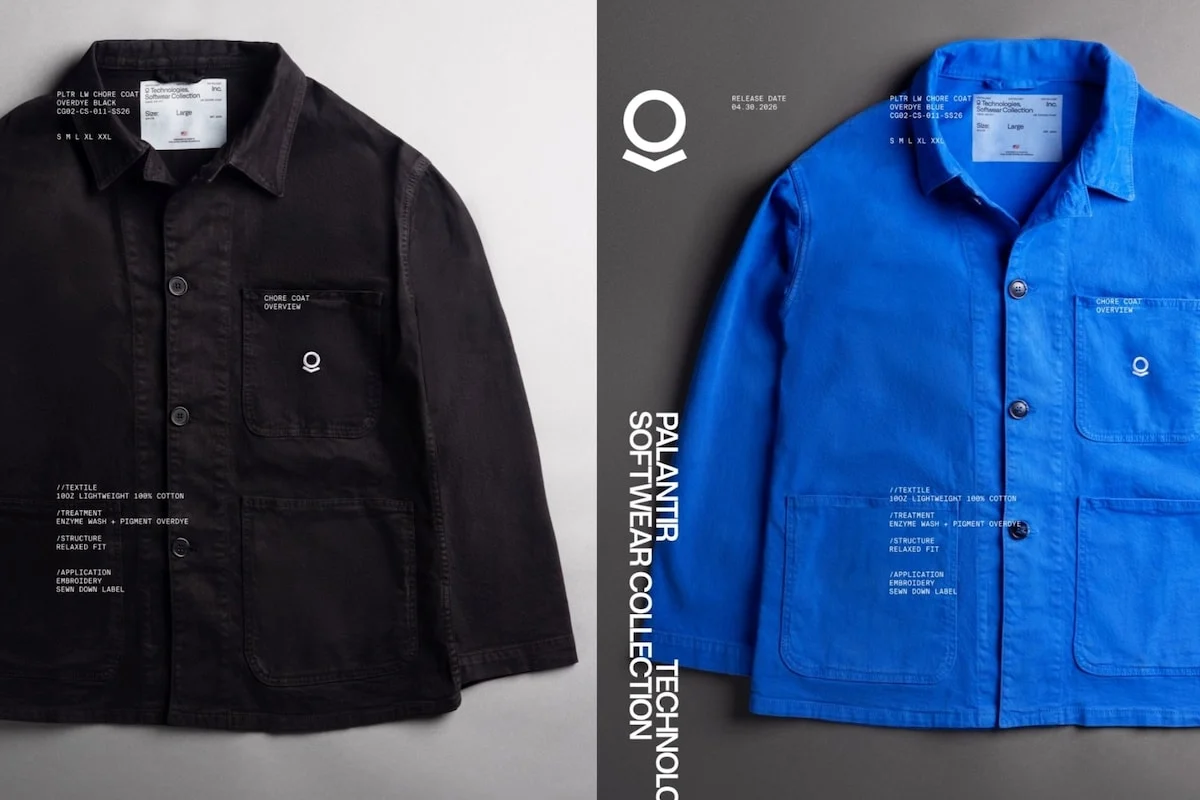
In a notable move reflecting this strategic embrace of aesthetics, Palantir announced the imminent release of its latest line of branded merchandise: a lightweight chore coat available in blue and black. The announcement, made by Eliano Younes, who oversees "vibes" at the US software company, promoted the jacket as "great for activities" and proudly "made in America." This claim, however, quickly drew scrutiny from menswear critic Derek Guy, who pointed out that the design is, in fact, modeled after traditional French workwear, such as those from brands like Vetra and Le Labourer. This discrepancy, while seemingly minor, highlights a broader tension between the company’s presented image and its underlying agenda.
The chore coat drop is not an isolated incident but rather a symptom of a burgeoning trend within the US tech industry: an overt obsession with "taste." This preoccupation gained significant traction around 2024, notably following Mark Zuckerberg’s highly publicized "swaggy glow-up," and has since become an explicit talking point among prominent figures at companies like OpenAI and venture capital firm a16z, with statements like "taste is a new core skill" circulating widely. As observed by Kyle Chayka in The New Yorker, this emphasis on taste is strategically logical for AI companies. Chayka posits that "AI companies need to associate themselves with taste precisely because their tools are not very palatable, much less cool, to anyone outside of Silicon Valley." He further coined the term "taste-washing" to describe this phenomenon: "an attempt to give anti-humanist technologies a veneer of liberal humanism." This analytical framework is particularly pertinent when examining Palantir’s engagement with consumer-facing branding.
The Controversial Foundations of Palantir’s Operations
To fully grasp the implications of Palantir’s "taste-washing" efforts, it is crucial to understand the company’s foundational activities and its deep entanglement with government and intelligence sectors. Founded in 2003 with significant early investment from the CIA’s venture capital arm, In-Q-Tel, Palantir’s core business involves developing sophisticated data analytics platforms for intelligence agencies, militaries, and law enforcement. Its software, designed to integrate and analyze vast datasets, has been deployed in numerous sensitive contexts, often raising significant ethical and human rights concerns.
Allegations of Harm and Surveillance
Palantir has faced persistent criticism for its alleged role in controversial government operations. Reports have linked Palantir’s technology to the creation of "kill lists" for the Israeli military, according to the Business & Human Rights Resource Centre, and it has been accused by a UN rapporteur of "enabling genocide" in Gaza. Furthermore, the company’s contracts with U.S. Immigration and Customs Enforcement (ICE) have drawn extensive condemnation, with investigations by outlets like The Guardian detailing how Palantir’s software allegedly facilitates the mining of U.S. citizens’ data, contributing to surveillance and enforcement activities that critics argue infringe upon civil liberties. These serious allegations underscore the profound real-world impact of Palantir’s technologies, making its foray into lifestyle branding particularly jarring for observers.
"The Technological Republic" Manifesto
Adding another layer of controversy, Palantir released a 22-point manifesto titled The Technological Republic in April 2026. This document, based on a book of the same name, articulates a vision that critics have widely characterized as "technofascist" and the "ramblings of a supervillain." The manifesto advocates for the United States to accelerate the "AI arms race," dismisses cultures it deems "dysfunctional and regressive," and champions the integration of technologies like Palantir’s into government to exert a new form of "hard power." This vision, as interpreted by many, carries a distinctly authoritarian and white supremacist undertone, advocating for a societal structure where technological prowess dictates national and global influence. The release of such a manifesto, articulating a bold and contentious ideological stance, just days before a consumer merchandise drop, highlights a strategic dissonance that speaks to the company’s broader aims of cultural shaping.
Expanding Influence: The UK Context
Palantir’s ambition for deep societal integration is not confined to the United States. The company has aggressively expanded its footprint within the United Kingdom government, securing deals reportedly worth over $600 million. These contracts span critical sectors, including the National Health Service (NHS), the military, and various local councils. Despite widespread public backlash and concerns raised by privacy advocates and parliamentary groups regarding data security and the ethical implications of handing sensitive public data to a private, US-based defense contractor, Palantir’s influence continues to grow. In April 2026, it was also reported that the company was poised to provide its spy technology to the Metropolitan Police for criminal investigations and to automate intelligence gathering, further embedding its systems into the fabric of UK public services. This strategic embedding of its software into national infrastructure mirrors, in a sense, its current attempts to embed its brand into popular culture.
The Strategic Purpose of Merch: Beyond Profit
Given Palantir’s substantial government contracts and its significant market valuation, the sale of chore coats, t-shirts, "Silicon Valley dropout" crew necks, and patches is clearly not driven by a need for public funding to sustain its operations. Instead, the primary motivation appears to be the accumulation of "cultural capital" and a sophisticated form of "whitewashing" – an attempt to sanitize its image and normalize its controversial influence over what critics describe as some of the worst atrocities of the 21st century.
This strategy is not without historical precedent. Fashion commentator and critic Chloe Iris Kennedy drew parallels to a December 2025 streetwear drop by Lockheed Martin, another prominent US defense firm. Kennedy observed that "in the early 2000s, camo print was strategically placed in the fashion zeitgeist as a means of aligning the western world with the war on terror." She argues that the contemporary approach is more direct: "Nowadays, war machines can simply release merchandise, label it gorpcore, and the public will willingly fund their acts of terror. This is the consequence of decades of denying the politics of fashion." This analysis suggests a deliberate effort to co-opt cultural trends to serve a strategic purpose, making the instruments and ideologies of power palatable, even fashionable.
The critical theorist Walter Benjamin, as early as 1935, identified aesthetics as a crucial element in the rise of fascist movements like the Nazi party and Italian Futurists. Benjamin argued that these movements used aesthetics to create an illusion that people could "express themselves" even as their fundamental rights were being systematically stripped away. Palantir’s current approach, whether consciously or unconsciously, echoes this historical manipulation, leveraging consumer culture to foster a sense of belonging or identity around a brand deeply intertwined with state power and surveillance.
Cultural Saturation and Normalization
The proliferation of Palantir’s brand extends beyond official merchandise. Social media platforms are rife with "starter packs" for individuals who "support the Thiel thing" (referencing Peter Thiel, a co-founder of Palantir and influential venture capitalist). There are The Devil Wears Prada-themed chore coat memes and even fabricated Palantir advertisements featuring popular celebrities like Sydney Sweeney, Olivia Rodrigo, Sabrina Carpenter, and Margaret Qualley. While the origins of these celebrity-fronted parodies are unclear, their existence contributes to a broader cultural saturation. Concurrently, there has been a noticeable increase in the depiction and aestheticization of weaponry across various cultural landscapes, from magazine covers and cult fashion collections to critically acclaimed films.
Even when the tone of these cultural references is ironic, their cumulative effect is profound. They serve to normalize Palantir’s brand and its military associations, making its activities, which are often considered highly abnormal and ethically questionable, appear less jarring or even unremarkable in the public consciousness. This process aligns with the phenomenon of "far-right slop" and "kitsch art" reportedly churned out by certain government factions, where repeated exposure, regardless of perceived quality or intent, diminishes critical engagement. The objective is not necessarily to cultivate genuine affection for Palantir’s merch or its specific design nuances, but rather to achieve "cultural saturation." Just as Palantir infiltrates national infrastructure with its software, each meme and merchandise drop aims to embed its presence deeper into collective awareness and, ultimately, into individual minds.
Broader Implications: The Future of Conflict and Consent
Palantir’s "taste-washing" strategy, coupled with its explicit ideological manifesto, signals a significant blurring of lines between civilian consumer culture, advanced technology, and military-industrial objectives. The company’s imperialist end goals, far from being covert, are articulated with remarkable clarity in its manifesto. Point six states: "National service should be a universal duty. We should, as a society, seriously consider moving away from an all-volunteer force and only fight the next war if everyone shares in the risk and the cost."
This statement offers a chilling context for Younes’s earlier description of the chore coat as "great for activities." The implication is stark: in a future envisioned by Palantir, where national service is universal and conflict is a shared burden, the uniform for "World War III" might very well be a "relaxed fit" workwear jacket of French inspiration, rebranded as American and enthusiastically adopted by a public desensitized by decades of cultural saturation. This scenario raises profound questions about the nature of informed consent, the erosion of democratic oversight, and the insidious ways in which powerful corporations can shape public perception and participation in their grand, often authoritarian, visions for the future. As technology continues to intertwine with every facet of life, understanding the strategic deployment of aesthetics becomes paramount in discerning the true intentions behind the seemingly innocuous.