



The opening week of the 61st Venice Biennale, an event widely recognized as the oldest and most prestigious international art exhibition, unfolded as a kaleidoscopic tapestry of audacious artistic expression, vibrant cultural gatherings, and palpable geopolitical tensions. From April 20 to November 24, 2024, the historic city of Venice transforms into a global stage for contemporary art, hosting official national pavilions and a sprawling array of collateral events across its labyrinthine canals, ancient churches, grand palazzi, and modern exhibition spaces. This year’s iteration, curated by Adriano Pedrosa under the theme "Stranieri Ovunque – Foreigners Everywhere," aimed to shine a spotlight on artists who are immigrants, expatriates, diasporic, queer, Indigenous, or outsiders within their own nations, reflecting a broader shift towards decolonizing and diversifying the art world’s narratives.
A Multiverse of Art and Unprecedented Crowds

The Biennale’s unique structure, featuring national pavilions in the Giardini and Arsenale, complemented by numerous independently organized collateral events scattered throughout the city and its surrounding islands, creates an unparalleled immersive experience. This year, the sheer scale and intensity of the opening week were remarkable. Water buses were perpetually filled with art enthusiasts, gallerists, critics, and collectors, navigating a relentless schedule of private viewings, live performances, and exclusive afterparties. The atmosphere was a potent mix of intellectual fervor and celebratory chaos, a hallmark of the Biennale’s opening.
Amidst this bustling cultural panorama, specific moments captured significant attention. A naked performer suspended from a colossal bell in the Giardini drew crowds, embodying the provocative spirit often found at the Biennale. Installations featuring faux babies adorned with sunglasses and QR-coded diapers offered a whimsical yet critical commentary on contemporary society and technology. A highlight for many was the appearance and performance of the legendary Cicciolina – former adult film star, Italian parliamentarian, and muse to artist Jeff Koons – who regaled attendees with her Italo Disco hits, blending pop culture with high art.
Despite logistical challenges, including long queues, strict guestlists, an unexpected storm, and the omnipresent Spritz, several exhibitions and events garnered significant praise. Björk, radiating joy in Bottega Veneta FW26, graced the opening party of the Icelandic Pavilion. The Vatican’s Holy See Pavilion, nestled within the 17th-century Giardino Mistico, presented a contemplative experience enhanced by a soundtrack featuring Brian Eno, FKA twigs, and Patti Smith. Elsewhere, Kelsey Lu delivered a clandestine performance at Palazzo Diedo, reportedly attended by Willem Dafoe, while the Asian Dope Boys collective brought their distinctive club culture rituals to the Kuboraum showcase. These diverse offerings underscored the Biennale’s commitment to presenting a wide spectrum of artistic practices and cultural dialogues.

Geopolitical Echoes and Widespread Protests
Beyond the artistic spectacles, the 61st Venice Biennale’s opening week was marked by the most significant protests in its recent history, underscoring the art world’s increasing entanglement with global political events. Hundreds of demonstrators poured onto the streets in solidarity with Palestine, calling for a ceasefire and condemning perceived complicity within cultural institutions. This grassroots activism, largely coordinated by groups like the Art Not Genocide Alliance (ANGA), which had previously called for a boycott of the Israeli pavilion, led to several national pavilions shutting their doors in solidarity. A poignant sign in front of the Japanese Pavilion, referencing artist Ei Arakawa-Nash’s much-photographed exhibit, declared, "the babies are on strike," symbolizing a collective refusal to proceed as usual amidst global suffering.
The tension was palpable even before opening day. The Biennale jury, tasked with awarding the prestigious Golden Lion prizes, resigned en masse, a clear response to the public and internal pressure surrounding the participation of Israel and the ongoing conflict. This unprecedented move highlighted the profound challenges facing international cultural events in an era of heightened geopolitical polarization. Russia’s pavilion, which has remained closed since the 2022 invasion of Ukraine, served as another stark reminder of the global conflicts casting a shadow over the art world. The convergence of parties, protests, and political statements created a complex and often contradictory environment, forcing participants to confront the ethical dimensions of art and its public display.

Featured Exhibitions: A Deeper Dive into the Biennale’s Core
The chosen theme, "Foreigners Everywhere," found diverse and compelling interpretations across the myriad exhibitions. It encouraged artists to explore themes of displacement, identity, migration, and the experience of being an "outsider," whether literally or metaphorically.
Florentina Holzinger, Austrian Pavilion: Seaworld Venice
Perhaps no pavilion generated as much fervent discussion and lengthy queues as the Austrian Pavilion, presenting Florentina Holzinger’s Seaworld Venice. Holzinger, known for her boundary-pushing performance art that often confronts taboos and physical limits, delivered an unforgettable spectacle. Social media quickly became saturated with clips of her naked performers, suspended from a giant bell and executing daring feats. Central to the installation was a tank of purified urine, sourced from two public toilets within the exhibit, which visitors were "encouraged" to use (with strict warnings against "number twos," humorously illustrated by a simulated "shit explosion" in a nearby tank). Beyond the visceral shock, the work probed questions of bodily fluids, environmental consumption, and the commodification of experience. Nude performers scaling weather vanes and navigating the waters on jet skis further amplified the sense of wild, unrestrained performance, blurring the lines between art, spectacle, and a raw engagement with the human condition and nature. The critical reception highlighted its audacious critique of societal norms and its powerful, if confrontational, physicality.

Maja Malou Lyse, Danish Pavilion: Things To Come
Maja Malou Lyse, the youngest artist to represent Denmark in Venice, presented Things To Come, an exhibition at the intersection of art, pornography, and cutting-edge sperm bank technology. In collaboration with the post-internet media platform DIS magazine, Lyse’s installation immersed visitors in a room of floor-to-wall screens. The central film explored how pornographic imagery, delivered via virtual reality equipment, could dramatically enhance sperm motility – a concept reportedly based on a study conducted by the world’s largest sperm bank. Given the documented global decline in male fertility rates, the work sparked crucial conversations about the complex relationship between media technologies, human reproduction, and survival. The accompanying soundtrack by Amnesia Scanner’s Ville Haimala provided an atmospheric backdrop, while Cicciolina’s impromptu afterparty further cemented the exhibition’s blend of serious inquiry and playful subversion. Lyse’s work deftly used humor and contemporary media to address urgent biological and societal concerns, fitting squarely within the Biennale’s forward-looking artistic agenda.
"Strange Rules," Palazzo Diedo
An undeniable standout among the collateral events was "Strange Rules" at Palazzo Diedo. Curated by Mat Dryhurst, Holly Herndon, and Hans Ulrich Obrist, this group exhibition delved into "Protocol Art" – a practice engaging with the unseen algorithms and underlying rules that govern cultural production, distribution, and perception in the digital age. The exhibition featured works by prominent digital media artists and thinkers, offering a sophisticated critique of our hyper-connected reality. Mat Dryhurst and Holly Herndon’s film projections of worms provided a metaphorical exploration of complex systems. Simon Denny’s futurist paintings, featuring the Italian "brainrot" character Bombardino Crocodillo, humorously commented on digital saturation and online culture, as previously noted in critical discourse. Trevor Paglen contributed a hypnotic multimedia work, while New Models and Joshua Citarella’s gift shop-style installation playfully mirrored the overwhelming content of contemporary social media feeds, offering a tangible representation of the "brainrot" phenomenon. The exhibition served as a critical examination of the invisible structures shaping our digital lives, resonating deeply with a generation immersed in online ecosystems.
Asian Dope Boys, Kuboraum Showcase
The Shanghai-based, multi-disciplinary collective Asian Dope Boys, renowned for their absurdist theatrics and expansive network of artists, musicians, and performers, delivered a captivating Venice takeover in collaboration with Berlin fashion label Kuboraum. Their showcase featured an array of live performances that were both provocative and profoundly moving. A particular highlight was Philippines-born Joshua Serafin’s futurist, non-human extravaganza, set to a compelling soundtrack by Görkem Şen and Pierre Bayet. Ziúr and choreographer Kianí del Valle (known for collaborations with artists like Bad Bunny and Billie Eilish) also contributed, blending experimental sound with dynamic movement. The closing performance by Indonesian choreographer Siko Setyanto was a powerful synthesis of ancient traditions and explosive contemporary expression, set against an electro-Gamelan music score. The Asian Dope Boys’ presentation exemplified the Biennale’s capacity to host cutting-edge, cross-cultural performances that challenge conventional artistic boundaries and offer fresh perspectives on global identity.

Jenna Sutela, Finnish Pavilion: Aeolian Suite
Finnish artist Jenna Sutela, celebrated for her work exploring alien languages, slime molds, and psychedelics, presented Aeolian Suite at the Finnish Pavilion. Drawing inspiration from the Italian theatrical tradition of Commedia dell’arte, the piece unfolded as an elemental drama. Its protagonists were a cast of fuzzy, endearing characters resembling wind muffs, each embodying one of Venice’s five winds: the trickster, the lovers, the sad clown, and the magician. Styled with elaborate hair-dos in collaboration with artist Sara Mathiasson, these characters inhabited a folkloric windscape of sound and movement. The composition was ingeniously crafted using meteorological data, musical instruments, and authentic wind recordings from Venice, Helsinki, and other global locations. Sutela’s work offered a poetic and multi-sensory exploration of interconnectedness, the unseen forces of nature, and the intricate relationship between technology and organic forms, earning high recommendations from critics for its originality and immersive quality.
Li Yi-Fan, Taiwanese Pavilion: Screen Melancholy
Li Yi-Fan’s Screen Melancholy at the Taiwanese Pavilion quickly became a word-of-mouth sensation, hailed by many attendees as a standout experience. The Amsterdam-based artist’s video work is a brilliant and genuinely humorous piece of meta-theater, combining traditional puppetry with performance lecture. Puppet-characters delivered insightful lectures on computer animation and the complexities of high-low image culture, spiraling into a captivating "Russian doll"-style montage of puppets manipulating progressively smaller versions of themselves within a shrinking palazzo. Accompanying the film were 3D-printed sculptures – disembodied hands, feet, and a head – echoing the forms of the digital performers. This created a particularly meta-commentary on the fluid boundaries between the puppet and the human, the digital and the physical, and the layers of mediation inherent in contemporary experience. Li Yi-Fan’s work resonated for its intellectual depth, comedic timing, and innovative use of narrative and form.
Natasha Tontey, LAS Art Foundation and Amos Rex: The Phantom Combatants and the Metabolism of Disobedient
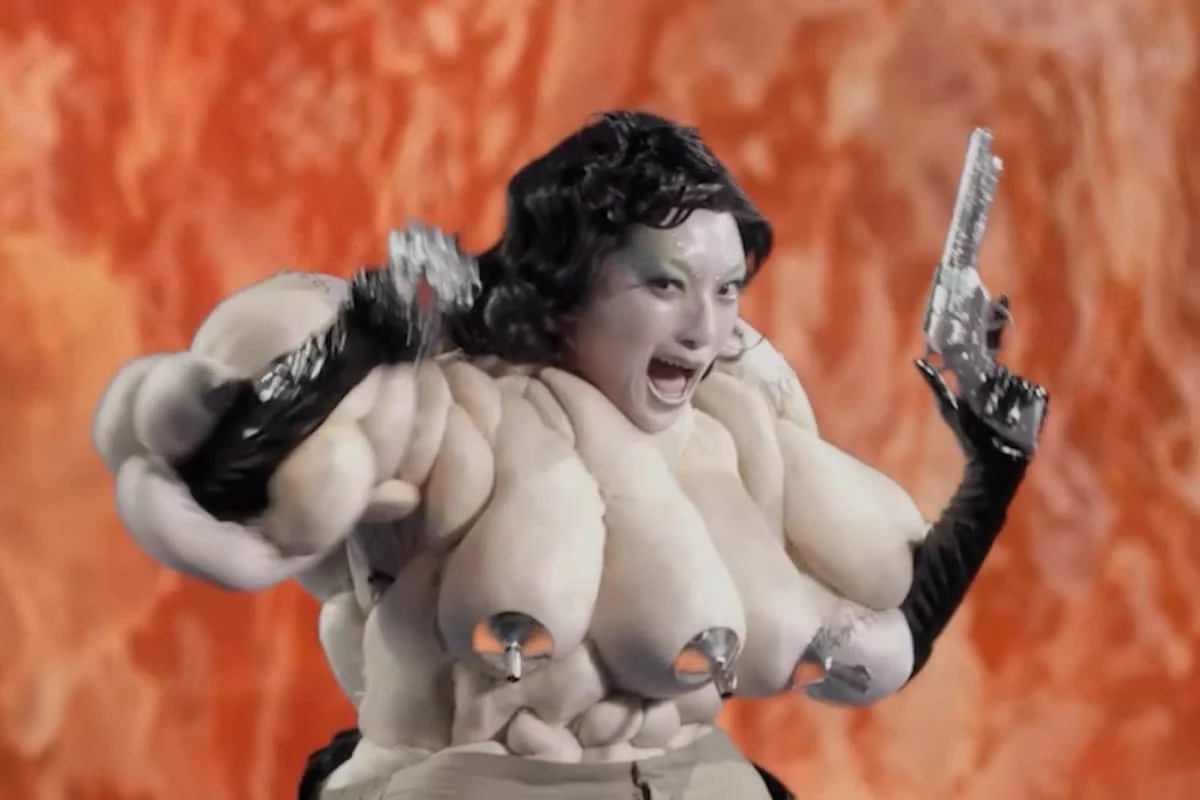
Multimedia artist Natasha Tontey presented an exhibition across two venues, LAS Art Foundation and Amos Rex, centered on a shapeshifting trickster figure. Tontey’s work, The Phantom Combatants and the Metabolism of Disobedient, reimagined the story of Len Karamoy, a female insurgent from Cold War-era Indonesia. Employing B-movie aesthetics and ritual mysticism, Tontey’s protagonist biohacked her body with fungi, black-market hormones, and hallucinogens, transforming into a mutant with exaggerated musculature and multiple breasts. This campy, psychedelic journey utilized speculative fiction as a powerful tool to challenge historical narratives and envision new, emancipatory futures. Tontey’s bold narrative questioned dominant power structures and explored themes of bodily autonomy, resistance, and the potential for radical transformation outside conventional societal norms.

Eva and Franco Mattes, Autotelic Foundation: Ragebait
Pioneers of the net art movement, Italian duo Eva and Franco Mattes staged their exhibition, Ragebait, across two distinct venues. The first, a private swimming pool on Giudecca, featured hyper-online TikTok Reels projected onto the water’s surface, evoking a modern-day Narcissus captivated by digital reflections. The second venue housed a physical reincarnation of the internet meme "Cursed Cat," a "lol-cat adjacent" character famous for its "angry as fuk" expression. Its presence was manifested through several physical sculptures made from wood, glass, and plastic, bridging the digital meme with tangible art objects. The exhibition’s official tote bag, featuring Cursed Cat, became ubiquitous throughout Venice, demonstrating how the artists consciously facilitated the meme’s continued spread, both online and offline. Ragebait offered a astute commentary on internet culture, virality, and the blurred lines between digital phenomena and physical reality, questioning the mechanisms of online engagement and the commodification of digital emotions.
The Biennale’s Enduring Relevance Amidst Evolving Challenges
The 61st Venice Biennale serves as a vital barometer for the global art world, reflecting not only current artistic trends but also the pressing social and political issues of our time. The opening week, with its blend of extravagant artistic displays and fervent political demonstrations, highlighted the complex role of cultural institutions in a world grappling with conflict and division. While the "Stranieri Ovunque" theme fostered a spirit of inclusivity and diverse perspectives, the protests underscored the persistent demand for ethical accountability and solidarity within the art community. The sheer volume of attendees, estimated to be in the tens of thousands during the preview week alone, further solidifies the Biennale’s status as a critical nexus for contemporary art, driving significant cultural tourism and economic activity for Venice.

As the exhibition continues through November, it is poised to sustain dialogues on identity, technology, environmental concerns, and geopolitical responsibility. The 61st Venice Biennale ultimately reaffirmed its position as a dynamic, sometimes chaotic, but always essential platform for artistic innovation and critical engagement, navigating the complexities of a rapidly changing global landscape.