











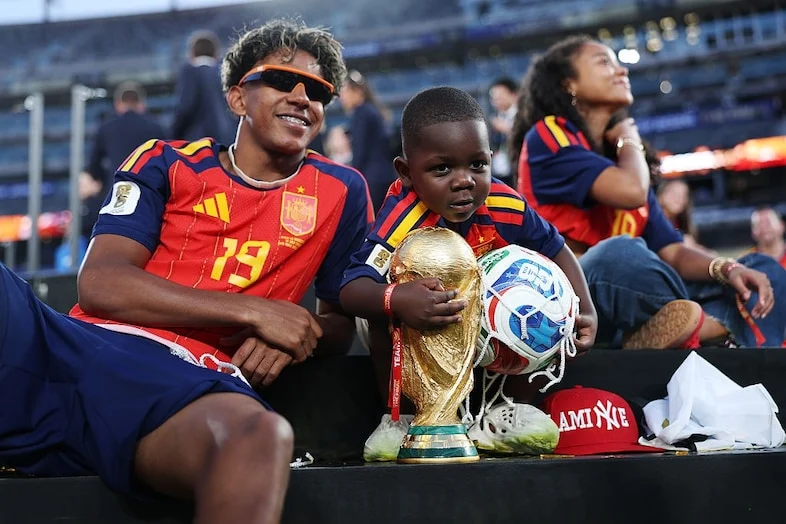
The curtains closed last night on a truly extraordinary World Cup, culminating in a tense final where Spain emerged victorious over Argentina with a decisive 1-0 scoreline. The much-anticipated clash, held at the colossal Lusail Stadium in Doha, marked the culmination of a tournament rife with unexpected turns, controversies, and moments of profound human connection. For Lionel Messi, widely regarded as one of football’s greatest, the final represented a poignant, and likely ultimate, opportunity to lift the coveted trophy in what many speculate will be his final World Cup appearance. Opposite him stood Lamine Yamal, the prodigious 18-year-old Spanish sensation, whose meteoric rise saw him face the legend he once posed with as a one-year-old for a UNICEF advertisement 18 years prior, a poignant symbol of football’s generational shifts. Spain’s triumph, secured by a singular, well-executed goal, brought an end to Argentina’s often-combative campaign, a result widely welcomed by many after their contentious victories in earlier rounds, particularly against England.
This World Cup will undoubtedly be remembered as much for its off-field narratives as its on-field heroics. From allegations of FIFA corruption and unprecedented political interference to a widely discussed and extravagant half-time show, the tournament captured global attention far beyond the traditional footballing sphere. As the dust settles, a retrospective look reveals a tapestry woven with moments of sporting brilliance, unexpected upsets, deep-seated political resonance, and heartwarming displays of camaraderie.
The Final Showdown: Spain’s Strategic Victory over Argentina
The final match between Spain and Argentina was a tightly contested affair, showcasing tactical discipline against Argentina’s renowned attacking prowess. Spain, under coach Luis de la Fuente, deployed a possession-based strategy, meticulously controlling the midfield and stifling Argentina’s creative outlets. The decisive goal came in the second half, a testament to Spain’s patient build-up and clinical finishing, denying Argentina a repeat of their previous World Cup triumph. The match stats reflected the intense battle, with Spain often holding the edge in possession (estimated around 60-65%) and creating several clear-cut opportunities, while Argentina struggled to convert their counter-attacks into meaningful threats.
The narrative surrounding Argentina throughout the tournament had grown increasingly complex. Their aggressive playing style, coupled with several incidents of perceived poor sportsmanship, particularly following their victories against England and in the quarter-final, had alienated a significant portion of the global audience. This sentiment was further exacerbated by the public endorsement from Israeli Prime Minister Benjamin Netanyahu and other leading Israeli politicians, drawing the team into a contentious geopolitical debate, especially given the ongoing conflict in Gaza. As a result, Spain’s victory, particularly with Lamine Yamal – a player who has publicly expressed solidarity with Palestine by displaying the Palestinian flag – becoming a key figure, carried additional symbolic weight for many observers.
Political and Ethical Undercurrents: A World Cup Beyond the Pitch
This tournament was marred by several external factors that cast a shadow over the beautiful game. Reports of alleged interference from former U.S. President Donald Trump, though unsubstantiated with specific details in public reporting, fueled discussions about the undue influence of politics on international sports. More concrete were the persistent accusations of FIFA corruption, a specter that has haunted the organization for years, particularly concerning the bidding processes for major tournaments. These allegations contributed to a pervasive sense of unease regarding the integrity of the event.
The half-time show, while visually spectacular, also drew criticism for its exorbitant cost and perceived detachment from the sporting context, becoming a talking point for its sheer scale and the mixed reactions it garnered from viewers globally. These elements collectively underscored a World Cup grappling with its identity amidst modern global challenges, where sport often intersects with power, money, and international relations.
Lamine Yamal: A Generational Talent and Symbol of Hope
Among the tournament’s most captivating narratives was the emergence of Lamine Yamal. At just 18 years old, Yamal not only held his own but thrived on the world stage, showcasing skill, maturity, and composure far beyond his years. His journey from a one-year-old photographed with Messi to facing him in a World Cup final became a powerful symbol of football’s cyclical nature and the passing of the torch.
Beyond his on-field brilliance, Yamal’s story was enriched by the heartwarming presence of his younger brother, Keyne. The three-year-old’s unbridled joy, captured repeatedly on screen as he cheered from the stands and then playfully ran onto the pitch after Spanish victories, resonated deeply with audiences worldwide. His post-match antics, kicking a ball around the hallowed turf, served as a poignant reminder of the pure, unadulterated love for the game. Yamal himself acknowledged the emotional impact, stating in an interview after Spain’s victory over Austria, "I am moved when I see my little brother this happy, as well as seeing my mum and friends living the life they always dreamed of." This personal dimension humanized the colossal stakes of the World Cup, grounding the spectacle in genuine familial emotion.
Cabo Verde’s Cinderella Story: The Underdogs Who Captured Hearts
One of the most inspiring tales of the tournament belonged to Cabo Verde. The small island nation off the coast of West Africa, with a population of just over half a million, defied all expectations to make a memorable run in the World Cup. Their 40-year-old goalkeeper, Vozinha (Josimar José Évora Dias), became an overnight sensation, transforming from a relatively unknown player who balanced football with day jobs as an electrician and bus driver into an international icon with over 29 million Instagram followers.
Cabo Verde’s team, largely composed of players who juggled professional football with other careers, displayed incredible resilience, tactical discipline, and a fearless spirit. They held their own against some of the highest-ranked teams in the world, earning draws and even securing an upset victory that propelled them further than many pundits predicted. Google searches for the country surged by over 5,000 percent during their campaign, reflecting the immense global interest and admiration they garnered. Their journey underscored the enduring appeal of the underdog narrative in sports, proving that passion and collective spirit can challenge even the most formidable opponents. Vozinha’s personal story, in particular, resonated as a testament to perseverance and the unexpected paths to global recognition.
The Haaland-Bellingham Bromance: A Display of Sporting Camaraderie
Amidst the fierce competition, moments of genuine friendship shone through, none more prominent than the "Haalingham" bromance between Norway’s Erling Haaland and England’s Jude Bellingham. Their bond, forged during their time together at Borussia Dortmund between 2020 and 2022, became a fan favorite, characterized by numerous clips of embraces, shared celebrations, and even affectionate gestures.
Their friendship reached a captivating peak when their respective nations met in the quarter-finals. Live television cameras captured the two rivals struggling to suppress grins as they playfully jostled for an incoming corner kick. This image of mutual respect and affection between world-class competitors, even in the heat of a high-stakes match, served as a powerful reminder of the bonds that transcend national rivalries and the fundamental spirit of sportsmanship. It highlighted the personal relationships that develop within the global football community, adding a layer of warmth to the often intense competitive environment.
England’s Bronze Medal Redemption and a Shared Act of Faith
The bronze final, often considered a consolation match, transformed into one of the tournament’s most compelling encounters: England versus France. Following their respective semi-final defeats – England to Argentina and France to Spain – both teams entered the match with a point to prove. What unfolded was a thrilling contest, with England dominating the pitch and securing a resounding 6-4 victory. Star forward Bukayo Saka was the undisputed hero, netting a magnificent hat trick, while Declan Rice, Ezri Konsa, and Jude Bellingham also contributed crucial goals.
Beyond the exhilarating scoreline, the match was distinguished by an extraordinary display of sportsmanship. Following the final whistle, several players from both teams – England’s Bukayo Saka, Eberechi Eze, Marc Guéhi, Trevoh Chalobah, and France’s Dayot Upamecano, Jean-Philippe Mateta, and Maxence Lacroix – gathered together on the pitch for a shared moment of prayer. This powerful image of unity and mutual respect, transcending national and religious differences, stood in stark contrast to some of the contentious moments observed elsewhere in the tournament. It offered a dignified and graceful conclusion to their World Cup journeys, earning widespread praise for embodying the highest ideals of competitive sport.
The South Korea-Mexico Love Affair: A Legacy of Gratitude
The World Cup also showcased the enduring power of international solidarity, exemplified by the unique bond between South Korean and Mexican fans. This special relationship, dating back to the 2018 World Cup, was rekindled during South Korea’s group-stage match against Czechia in Guadalajara. Multiple videos circulated showing South Korean fans being warmly embraced and celebrated by their Mexican hosts.
The genesis of this affection lies in the 2018 tournament, where South Korea’s shock victory over Germany in the group stage allowed Mexico to unexpectedly advance to the knockout rounds. Eight years later, the gratitude of Mexican fans remained palpable, as they welcomed and cheered for the South Korean team with genuine warmth. This heartwarming display of cross-cultural camaraderie underscored how a single sporting event can forge lasting connections and foster international goodwill, demonstrating the unifying potential of football.
Michel Kuka Mboladinga: A Silent Political Statement
Among the vibrant and often boisterous crowds, one fan stood out for his profound stillness and powerful message. Michel Kuka Mboladinga, a supporter of the Democratic Republic of Congo (DRC), captivated international attention by standing completely motionless, with one arm raised aloft, for the entire duration of every match his team played. This unique form of silent protest and tribute, which Mboladinga has maintained since 2013, gained global prominence during this World Cup – the first for the DRC since 1974.
Dressed in a suit adorned with the colors of the Congolese flag, Mboladinga’s act was a deliberate imitation of a statue of Patrice Lumumba, the revolutionary leader who played a pivotal role in freeing Congo from Belgian colonial rule and served as the country’s first prime minister. His dignified bearing and sustained stillness were not merely an eccentric fan display but a powerful piece of performance art, honoring Lumumba’s legacy and drawing attention to the DRC’s complex history and ongoing struggles. Mboladinga’s silent vigil became a potent symbol of national pride and historical remembrance on the global stage, intertwining sport with political commentary and cultural identity.
Enzo Fernández’s Red Card: A Moment of Retribution for Opponents
The tournament also had its share of contentious moments, and Enzo Fernández’s red card during the final against Spain was a notable one. The incident saw Fernández, an Argentine midfielder, receive a direct red card after a challenge that sent Spain’s Pau Cubarsí dramatically to the ground. This expulsion was a significant turning point in the match, leaving Argentina with ten men and altering their tactical approach for a crucial period.
For many observers who had grown critical of Argentina’s aggressive play and perceived lack of sportsmanship throughout the tournament, Fernández’s red card felt like a moment of poetic justice. It followed a controversial celebration after scoring against England in the semi-final, which was widely deemed provocative. The dismissal underscored the fine line between competitive intensity and excessive aggression, and for those critical of Argentina’s style, it provided a symbolic end to a contentious individual World Cup journey.
The Geopolitical Scorecard: Palestine Solidarity and Calls for Action
Perhaps one of the most significant and often overlooked narratives of this World Cup was its intersection with geopolitical tensions, particularly concerning the Israeli-Palestinian conflict. Argentina, partly due to President Javier Milei’s staunch alliance with Benjamin Netanyahu’s government, became widely perceived as a proxy for Israel, despite a recent Pew Research Center survey indicating that a majority of Argentinians hold negative views of Israel and that Latin America has a strong tradition of Palestine solidarity. Netanyahu himself, along with other prominent Israeli politicians, publicly endorsed Argentina, further cementing this perception.
In this context, the scenes of people in Gaza celebrating Spain’s victory carried immense symbolic weight. Their joy was particularly poignant given the devastating impact of the ongoing conflict, which has seen an estimated 566 Palestinian footballers killed, alongside the destruction of numerous stadiums and club headquarters. The tragic death of Mohammed al-Wahi, an aid worker organizing public World Cup screenings, due to an Israeli airstrike, further highlighted the human cost of the conflict amidst the global spectacle.
While Spain’s victory offered a symbolic moment of solidarity, Palestinian-led organizations such as BDS (Boycott, Divestment, Sanctions) and Lajee Celtic are actively campaigning for more tangible forms of football-related activism. These efforts include a significant campaign urging FIFA to ban Israel from international football, arguing that the sport’s governing body must uphold its values against human rights abuses. This World Cup, therefore, served as a stark reminder of how global sporting events can become platforms for political expression and catalysts for social justice movements.
A Lasting Legacy of Unpredictability and Impact
The 2026 World Cup will be etched in history not only for Spain’s hard-fought victory but for the unprecedented confluence of sporting drama, human stories, and profound geopolitical undercurrents. It was a tournament that challenged perceptions, sparked global conversations, and showcased the diverse ways in which football intersects with culture, politics, and personal narratives. From the rise of a new generation of stars like Lamine Yamal to the heartwarming resilience of underdogs like Cabo Verde, and from powerful acts of solidarity to contentious displays of sportsmanship, this World Cup has left an indelible mark on the global sporting landscape, setting a new benchmark for both excitement and complexity. The discussions and debates it ignited will resonate long after the final whistle, shaping future conversations about the role and responsibility of sport in an increasingly interconnected world.