










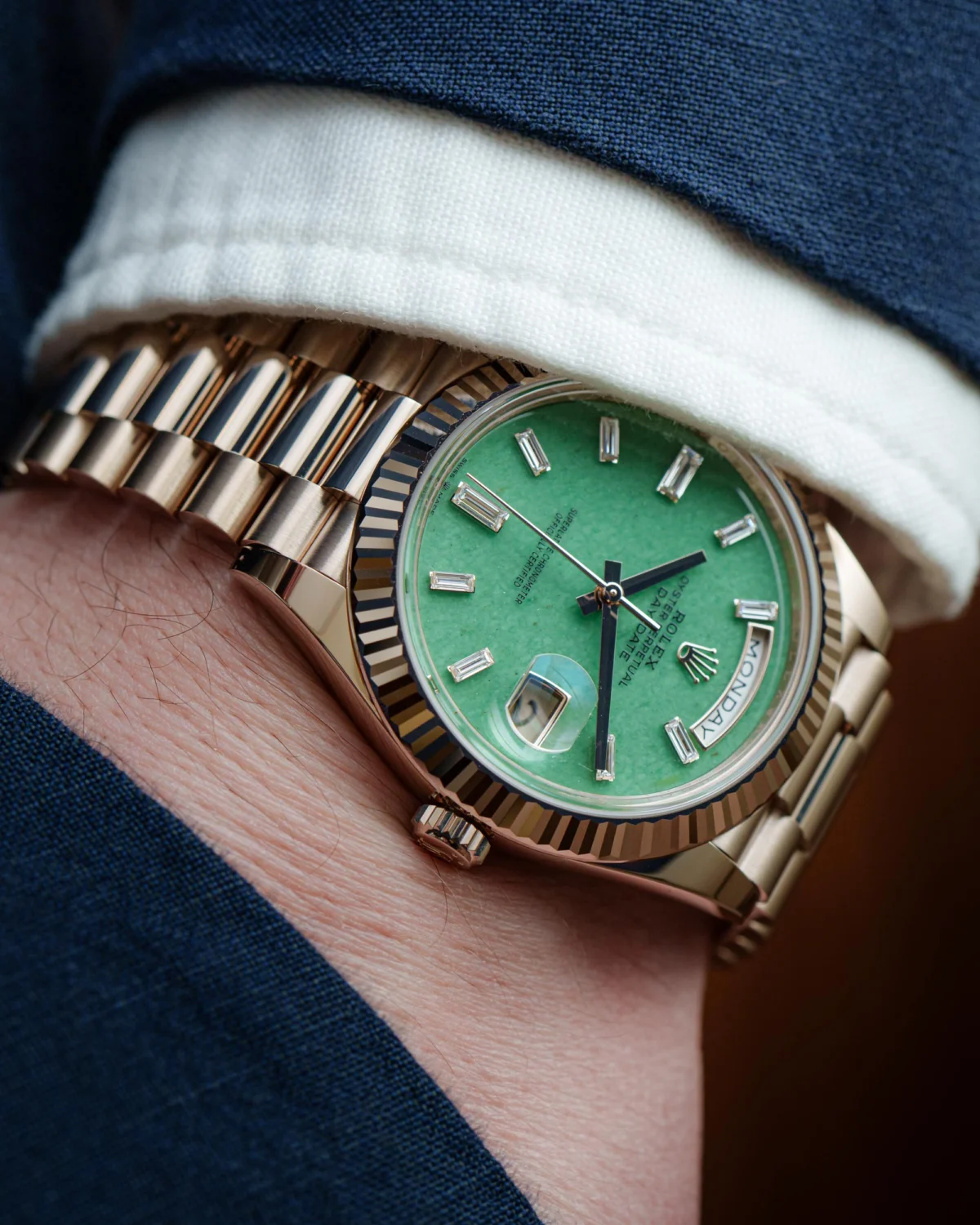
The world of luxury watchmaking witnessed a significant unveiling at Watches & Wonders Geneva 2026 as Rolex, the renowned Swiss maison, introduced a novel precious metal alloy: Jubilee gold. This exclusive 18-karat gold blend, developed and meticulously crafted within Rolex’s in-house foundry, represents a new aesthetic dimension to their already impressive palette of precious metals, which includes 18k yellow gold, 18k Everose gold, 18k white gold, and 950 platinum. The debut of Jubilee gold is intrinsically linked to a striking new iteration of the iconic Rolex Oyster Perpetual Day-Date 40, reference 228235 JG, a timepiece that immediately captures attention with its distinguished appearance and exclusive material.

The introduction of a proprietary gold alloy underscores Rolex’s long-standing commitment to innovation and vertical integration. The company’s control over its material production, from the melting of raw metals to the final polishing of watch components, allows for unparalleled consistency and the development of unique properties. This strategic approach not only ensures the highest quality but also provides a distinct competitive advantage in an industry where material exclusivity often translates to desirability and perceived value.
A New Hue: Understanding Jubilee Gold

Jubilee gold is characterized by its distinct "pale gold" hue, a shade that subtly evokes the warm patina of vintage gold alloys that have gracefully aged over time. This deliberate aesthetic choice appears to be a direct response to the burgeoning appreciation for vintage watch design and the enduring appeal of aged precious metals within the collector community. While Rolex remains characteristically discreet about the precise composition of this new alloy, its visual impact is undeniable, offering a nuanced alternative to the more saturated tones of traditional yellow and rose golds.
The naming of the alloy, "Jubilee gold," carries inherent significance within the Rolex lexicon. The term "Jubilee" is frequently associated with significant anniversaries and is also the name of a distinctive 5-link bracelet style often paired with models like the Rolex Datejust and certain GMT-Master II variants. This suggests that Rolex may be leveraging the term to allude to a sense of heritage and timelessness, perhaps even symbolizing a "vintage" gold aesthetic. While the exact rationale behind the naming was not extensively elaborated upon by Rolex representatives at the event, the connection to anniversary celebrations and established design elements within the brand’s history is a plausible interpretation, aligning with the alloy’s aged appearance.

The visual characteristics of Jubilee gold are best appreciated in person, as lighting conditions can significantly influence its perceived tone, a common phenomenon with all gold alloys. It occupies a unique position in the spectrum, offering a warmth that differentiates it from stark white gold while possessing a subtler intensity than traditional yellow gold, and a less rosy character than Everose gold. This sophisticated neutrality allows it to complement a wide range of dial colors and design elements, as demonstrated by its debut on the Day-Date 40.
The Day-Date 40: A Canvas for Innovation

The chosen platform for the debut of Jubilee gold is the Rolex Day-Date 40, reference 228235 JG. The Day-Date, often referred to by collectors as the "Rolex President," is a cornerstone of Rolex’s collection, celebrated for its sophisticated display of both the date and the full day of the week at the 12 o’clock position. This iconic complication, housed within a 40mm Oyster case, is exclusively manufactured in precious metals, reinforcing its status as a symbol of achievement and luxury.
The 40mm case of the Day-Date 40, a size that has become a benchmark for contemporary elegance, offers a substantial yet comfortable presence on the wrist. Its inherent water resistance, a testament to the robust Oyster case construction, provides peace of mind for wearers. The classic Day-Date aesthetic is further enhanced by the iconic Cyclops lens over the date window, facilitating effortless readability, and the meticulously crafted fluted bezel, a signature Rolex design element that adds a touch of refined brilliance.

Rolex’s decision to reserve the Day-Date exclusively for precious metal constructions serves to underscore its prestige. Unlike the Datejust, which often incorporates steel in its "Rolesor" configurations, the Day-Date guarantees that its wearer is adorned with an unequivocally precious timepiece. This exclusivity ensures that the Day-Date maintains its distinct status as a luxury statement piece, free from any ambiguity regarding its material composition.
Aesthetic Harmony: The Green Aventurine Dial and Diamond Hour Markers

Complementing the novel Jubilee gold case is a dial of remarkable beauty and sophistication. The reference 228235 JG features a captivating green aventurine dial, meticulously set with baguette-cut diamond hour markers. Aventurine, known for its shimmering, crystalline inclusions, provides a unique texture and depth that enhances the dial’s visual appeal. While the origin of aventurine used in watchmaking can vary, with some being naturally occurring and others synthetically produced, Rolex’s mastery lies in its ability to transform these materials into exquisite dials that exude luxury.
The deep green hue of the aventurine dial is described by Rolex as harmonizing perfectly with the subtle tones of Jubilee gold – "tender yellow, warm gray, and soft pink." This combination creates a striking visual synergy, where the vibrant green of the dial provides a rich backdrop for the sparkle of the diamonds and the understated warmth of the gold. The baguette-cut diamonds, precisely set, not only add a significant element of luxury but also maintain excellent legibility, a hallmark of Rolex’s commitment to functional elegance. This particular dial configuration, combining precious stones with a unique dial material, positions the watch firmly within the realm of high jewelry timepieces, a segment where the Day-Date has always excelled.

Technical Excellence: The Caliber 3255 Movement
At the heart of the Rolex Day-Date 40 Jubilee gold lies the Caliber 3255. This in-house developed and manufactured automatic movement is a testament to Rolex’s engineering prowess. Operating at a frequency of 4Hz, it offers a substantial power reserve of approximately 70 hours, ensuring reliable timekeeping for extended periods. The movement is certified as a "Superlative Chronometer," guaranteeing exceptional precision with an official tolerance of plus or minus two seconds per day, exceeding the standards of standard chronometer certifications.

The Caliber 3255 incorporates Rolex’s patented Chronergy escapement, crafted from nickel-phosphorus, which enhances efficiency and resistance to magnetic interference. Its paramagnetic blue Parachrom hairspring further contributes to its stability and accuracy in the face of environmental disturbances. While Rolex has gradually introduced display casebacks on select models, the Day-Date 40, in its current iteration, retains a solid gold caseback. This design choice, while perhaps less visually engaging than a sapphire crystal revealing the movement’s intricate workings, prioritizes the structural integrity and the preciousness of the case material. Owners may choose to personalize this solid caseback with engravings, adding a personal touch to this exceptional timepiece.
Market Context and Implications

The introduction of Jubilee gold and its debut on the Day-Date 40 is more than just a new product launch; it signifies a strategic move by Rolex to further differentiate its offerings and cater to evolving market demands. Historically, the Day-Date, while always a symbol of success, has sometimes been perceived by collectors as less of a traditional "watch enthusiast" piece compared to sports models like the Submariner or Daytona. Its identity was often rooted in its status as a luxury item, projecting wealth and prestige.
However, this perception has evolved. The Day-Date President is increasingly recognized not only as a status symbol but also as a technically superb and enduring timepiece. Its legibility, durability, and remarkable value retention in the secondary market contribute to its appeal among a discerning clientele. The introduction of a new, proprietary gold alloy like Jubilee gold, combined with a visually striking dial like green aventurine and diamond markers, further elevates its desirability, blending horological substance with high jewelry craftsmanship.

The limited initial production and "off-catalog" nature of the reference 228235 JG suggest that Rolex is positioning this model as an exclusive offering for its most valued clients. This strategy often creates an immediate surge in demand and a heightened level of interest, with pre-owned examples likely commanding significant premiums in the initial years following its release. This approach is typical of Rolex’s market management, carefully controlling supply to maintain desirability and long-term value perception for its most significant releases.
The price for the reference 228235 JG Rolex Day-Date 40 Jubilee Gold watch is set at $62,700 USD. This price point places it firmly within the ultra-luxury segment, reflecting the use of precious materials, intricate craftsmanship, and the inherent prestige associated with the Rolex brand. As Rolex continues to innovate and expand its collection, the introduction of Jubilee gold marks a notable chapter, promising to enrich the landscape of high-end watchmaking with its unique aesthetic and the enduring allure of the Rolex President. The future will undoubtedly see this new alloy integrated into other Rolex models, further solidifying its place in the brand’s storied history.