










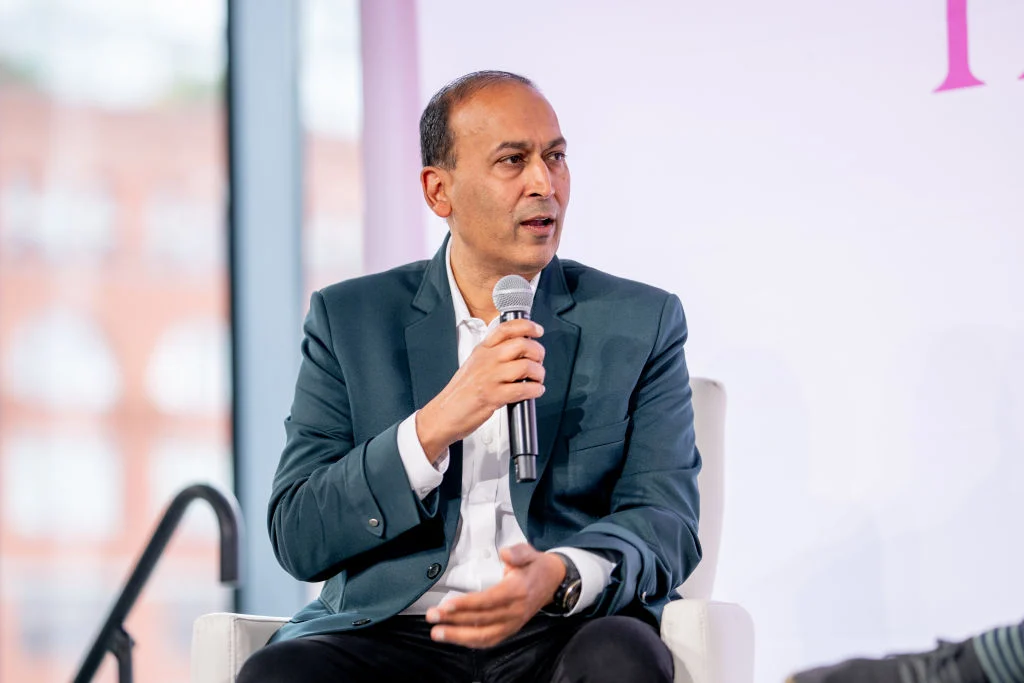
Poshmark, the leading social e-commerce marketplace for new and secondhand fashion, officially announced a significant leadership transition on Monday, marking the end of an era for the Silicon Valley mainstay. Manish Chandra, the visionary founder who guided the company from a California garage to a multi-billion-dollar global enterprise, is stepping down from his role as Chief Executive Officer. Succeeding him is Namsun Kim, a seasoned executive who has served as Poshmark’s Executive Chairman since April 2025 and currently holds the position of President of Investments at Naver, the South Korean internet conglomerate that acquired Poshmark in 2022.
The transition, effective immediately, represents a strategic pivot for the platform as it seeks to deepen its integration with its parent company and navigate an increasingly competitive global resale market. Chandra will not be exiting the company entirely; instead, he will transition to a seat on the Board of Directors, where he is expected to provide long-term strategic guidance while handing over the day-to-day operational reins to Kim.
A Legacy of Social Commerce: The Manish Chandra Era
The story of Poshmark is inextricably linked to Manish Chandra’s belief that shopping is fundamentally a social experience. Founded in 2011 alongside co-founders Tracy Sun, Gautam Golwala, and Chetan Pungaliya, Poshmark was born in a garage in Menlo Park, California. At a time when e-commerce was largely transactional and dominated by the search-and-buy models of Amazon and eBay, Chandra envisioned a "social commerce" platform where users could follow each other, "like" items, and build virtual closets that felt like a digital community.
Under Chandra’s fourteen-year tenure, Poshmark grew from a niche app for iPhone users to a massive ecosystem boasting over 150 million registered users across the United States, Canada, and Australia. His leadership oversaw several pivotal milestones that defined the company’s trajectory:
- The Rise of the Resale Economy: Chandra was a pioneer in the "recommerce" movement, capitalizing on the shift toward sustainability and the desire for unique, affordable fashion.
- Public Market Debut: In January 2021, Poshmark went public on the Nasdaq (POSH), with shares soaring more than 140% on their first day of trading, valuing the company at over $7 billion at its peak.
- The Naver Acquisition: In late 2022, amid a cooling market for tech stocks, Chandra navigated a $1.2 billion deal to be acquired by Naver. This move was designed to provide Poshmark with the technological resources of a global search and AI giant while giving Naver a significant foothold in the North American retail sector.
In a heartfelt farewell message sent to the Poshmark community on Monday, Chandra expressed profound gratitude for the journey. "Leading this company has been the greatest honor of my professional life," Chandra wrote. "Every success we’ve achieved, every challenge we’ve overcome, has been because of you. It’s been the privilege of a lifetime witnessing each of you grow, and it has truly inspired me every single day."
The New Leadership: Who is Namsun Kim?
Namsun Kim’s appointment as CEO signals a move toward tighter operational synergy between Poshmark and Naver. Kim is a high-profile figure within the Naver hierarchy, serving as the President of Investments. His background is rooted in high-level finance and strategic acquisitions, having played a critical role in Naver’s international expansion strategies.
Since April 2025, Kim has occupied the role of Executive Chairman at Poshmark, a position that allowed him to shadow Chandra and gain an intimate understanding of the company’s internal culture and user base. Chandra noted that the two have been working closely since the beginning of the year to ensure the leadership handoff is "as smooth as possible."
Industry analysts suggest that Kim’s primary objective will be to leverage Naver’s advanced technological stack—specifically in the realms of Artificial Intelligence (AI) and search optimization—to enhance Poshmark’s user experience. Naver is often referred to as the "Google of South Korea," and its expertise in live-stream shopping and image-recognition technology is expected to be integrated more aggressively into the Poshmark app under Kim’s direction.
Strategic Context: The State of the Fashion Resale Market
The leadership change comes at a critical juncture for the fashion resale industry. While the market continues to grow, it is facing headwinds from a variety of directions. According to industry reports from ThredUp and GlobalData, the global secondhand apparel market is projected to reach $350 billion by 2027. However, competition has intensified significantly since Poshmark’s inception.
Poshmark currently competes in a crowded field that includes:
- Depop: A Gen-Z favorite known for its streetwear and vintage aesthetic, now owned by Etsy.
- ThredUp: A managed marketplace that handles logistics and photography for sellers, appealing to those seeking convenience.
- Vinted: A European powerhouse that has been aggressively expanding its global footprint.
- The RealReal: A luxury-focused consignor that caters to high-end authenticated goods.
Furthermore, traditional retailers like Zara, H&M, and Lululemon have launched their own in-house resale programs, threatening to siphon off supply and demand from third-party marketplaces. By appointing a CEO with deep ties to Naver’s investment and technology arms, Poshmark appears to be positioning itself to out-innovate its rivals through superior search algorithms and personalized discovery features.
Chronology of Poshmark’s Evolution
To understand the weight of this CEO transition, one must look at the timeline of Poshmark’s development over the last decade and a half:
- 2011: Poshmark is founded in Silicon Valley with a focus on mobile-first social shopping.
- 2017: The company raises $87.5 million in Series D funding led by Temasek, signaling its status as a "unicorn."
- 2019: Poshmark expands beyond apparel into the "Home" category, allowing users to sell decor and linens.
- January 2021: The company goes public on the Nasdaq at $42 per share.
- October 2022: Naver announces its intent to acquire Poshmark for $17.90 per share in an all-cash deal valued at approximately $1.2 billion.
- January 2023: The acquisition is finalized, and Poshmark is delisted from public markets to operate as a private subsidiary of Naver.
- April 2025: Namsun Kim is appointed Executive Chairman, beginning the formal transition period.
- August 2025: Manish Chandra steps down; Namsun Kim becomes CEO.
Financial and Operational Data
While Poshmark is now a private entity under Naver, its historical data provides a clear picture of the scale Kim is inheriting. At the time of its acquisition, Poshmark had facilitated over $8 billion in gross merchandise value (GMV) since its founding. The platform’s "social" aspect remains its strongest moat; users spend an average of over 25 minutes per day on the app, a metric that rivals major social media platforms like Instagram or TikTok.
The acquisition by Naver was initially met with skepticism by some market analysts who questioned the high premium paid during a period of economic uncertainty. However, Naver’s most recent quarterly earnings reports have highlighted Poshmark as a key driver of its "Commerce" segment growth. The integration of Naver’s "Smart Lens" technology—which allows users to search for items using photos—has already seen early implementation on the platform, reportedly increasing user engagement.
Official Responses and Industry Reaction
The announcement has garnered reactions from across the tech and retail sectors. Navin Chaddha, Managing Director at Mayfield Fund and an early investor in Poshmark, has previously lauded Chandra for his "unwavering commitment to the community." While Mayfield has not issued a new formal statement regarding the CEO change, the sentiment among early backers is one of respect for Chandra’s ability to navigate the company through an IPO and a successful exit.
Internal sentiment at Poshmark remains focused on the "Posh Love" culture that Chandra cultivated. In his email to users, Chandra emphasized that the community’s trust was the company’s greatest asset. For the millions of "Poshers" who rely on the app for supplemental income or full-time businesses, the primary concern will be whether Kim maintains the platform’s user-friendly fee structure and community-centric features.
Broader Impact and Future Implications
The transition from a founder-CEO to a corporate-parent CEO often marks a shift from "visionary growth" to "operational efficiency." Under Namsun Kim, Poshmark is likely to see several strategic shifts:
1. Enhanced AI Integration:
Using Naver’s hyper-scale AI, "HyperCLOVA X," Poshmark could introduce more sophisticated virtual stylists, automated listing descriptions, and highly personalized "Feed" algorithms that better predict what a user wants to buy before they search for it.
2. Global Synergies:
Naver owns other social and commerce entities globally. There is potential for Poshmark to integrate with Naver’s search engine in Asia or collaborate with other subsidiaries to create a cross-border resale network, allowing a user in New York to easily purchase a vintage item from a seller in Seoul.
3. Streamlined Logistics:
One of the perennial challenges for Poshmark has been shipping costs and logistics. With Kim’s background in investments, the company may look toward strategic partnerships or acquisitions in the logistics tech space to reduce friction for sellers.
4. Maintaining the "Social" in Social Commerce:
The greatest challenge for Kim will be maintaining the "soul" of Poshmark. Chandra was a fixture at "PoshFest," the company’s annual user conference, often taking selfies with hundreds of sellers. As a corporate executive from a parent company, Kim will need to work hard to build that same level of rapport with a community that prides itself on personal connections.
Conclusion
The departure of Manish Chandra as CEO of Poshmark marks the conclusion of one of Silicon Valley’s most successful founder journeys of the last decade. By turning the act of cleaning out a closet into a social network, Chandra redefined the retail landscape and proved the viability of the circular economy.
As Namsun Kim takes the helm, the focus shifts to the future of Poshmark as a global tech powerhouse. With the backing of Naver’s resources and Kim’s strategic oversight, Poshmark is well-positioned to defend its market share against rising competitors. However, the true test of Kim’s leadership will be whether he can harness the power of Korean technology without losing the American community spirit that Chandra spent fourteen years building. For now, the "Poshmark community" watches closely as a new chapter begins for the platform that turned millions of closets into storefronts.