











The modern global fashion industry is trapped in a multi-billion-dollar paradox. In developed markets across the United Kingdom, Europe, and the United States, major apparel retailers are drowning in billions of dollars worth of unsold inventory, excess seasonal stock, and minor-defect consumer returns. To protect brand equity and prevent market cannibalization, these companies have traditionally avoided reselling surplus goods in their core regions at deep discounts. Instead, vast quantities of brand-new apparel are routinely funneled into secondhand clothing markets in emerging economies, particularly across Sub-Saharan Africa.
However, this legacy pipeline has created a profound environmental and economic crisis. Approximately 30% to 40% of all secondhand clothing imports arriving in emerging markets are deemed completely unusable upon arrival due to severe wear, damage, or lack of local demand. These unsellable textiles frequently end up in massive open-air landfills, contributing significantly to environmental degradation and overwhelming local municipal waste management systems.
Simultaneously, consumers in developing economies possess a strong, unfulfilled appetite for authentic, high-quality branded apparel from global giants such as Zara, Calvin Klein, Tommy Hilfiger, Levi’s, and ASOS. Local populations lack the disposable income to support full-price retail footprints for these brands, leaving a gaping void in the retail landscape. Enter the global recommerce market, a rapidly expanding sector projected by industry analysts to surge past $350 billion by 2027. Amid this structural inefficiency, a new breed of technology-driven startups is emerging to arbitrage the gap between Western surplus and developing-world demand, transforming what was once treated as industrial waste into accessible retail treasure.
The Genesis of FARO and the $6 Million Funding Breakthrough
At the forefront of this circular economy movement is FARO, a South African recommerce upstart that officially launched its operations in 2023. Founded by a seasoned team of retail and tech veterans—including David Torr, Will McCarren, Chris Makhanya, and Amber Penney-Young, who collectively bring operational pedigree from industry heavyweights like Amazon, Jumia, Superbalist, and Zumi—FARO set out with a clear mandate: make global fashion affordable across Africa while drastically curbing textile waste.
The company’s growth trajectory has captured significant attention from international and regional venture capitalists. FARO recently closed a $6 million funding round to accelerate its physical and technological expansion. The investment was led by high-profile executive JP Zammitt, president of Bloomberg, alongside prominent venture capital firms including Presight Capital, Gharage Ventures, and E4E Africa. A roster of notable angel investors also participated in the round, featuring Mato Perić (MPGI), Leonard Stiegeler (Pulse), Oliver Merkel (Flink), Vikram Chopra (Cars24), Tushar Ahluwalia (Razor Group), Sudeep Ramnani (885 Capital), and Kresten Buch (88mph).
This fresh capital injection is designed to fuel the startup’s ambitious roadmap, which aims to scale its physical retail footprint from a handful of initial locations to 1,000 stores globally over the next decade, targeting high-growth emerging markets across Africa, South America, Asia, and the Middle East.
The Operational Mechanics of Off-Price Recommerce
FARO’s business model addresses the foundational inefficiencies of traditional fashion supply chains. Major apparel brands frequently face a dilemma with customer returns that feature minor, easily fixable defects—such as a missing button, a loose thread, or a broken zipper. Because the labor cost to manually inspect, repair, and process these items in high-wage Western markets is prohibitively expensive, many traditional retailers choose to incinerate or discard perfectly functional garments.
FARO intercepts this inventory at the source. Through direct partnerships with major fashion conglomerates and online giants like ASOS, Boohoo, G-Star, Jack & Jones, and Levi’s, the startup acquires bulk overstock and customer returns at ultra-low wholesale prices, sometimes paying as little as £1 per garment.
Once secured, these items are shipped to FARO’s specialized processing facilities in South Africa. Equipped with industrial laundries, steam-finishing tunnels, and supported by affordable local labor, the startup meticulously refurbishes, cleans, and tags the apparel. The resulting inventory is split strategically: roughly 40% consists of reconditioned customer returns, while the remaining 60% comprises pristine factory overstock.
Rather than utilizing dynamic pricing algorithms to maximize short-term profits on rare or high-demand items, FARO operates on a strict, transparent fixed-margin model. The company targets a sustainable 45% gross margin after accounting for all direct operational expenses, including processing, logistics, and swing tags. Crucially, when operational efficiencies push margins beyond this threshold, management reinvests the surplus directly into lowering prices for the consumer.
Brick-and-Mortar Resilience Over E-Commerce Hurdles
While many modern retail startups prioritize digital-first e-commerce strategies, FARO has deliberately chosen a brick-and-mortar retail model, a decision dictated by the unique structural realities of African consumer markets.
E-commerce expansion across the African continent has historically faced steep headwinds, including fragmented logistics infrastructure, low population density outside urban centers, and high last-mile delivery costs. Although established digital platforms like Takealot and Jumia have successfully carved out market shares, they face mounting pressure from ultra-cheap, cross-border fast-fashion juggernauts such as Shein and Temu. These digital low-cost platforms increasingly threaten the dominance of traditional local retailers and appeal heavily to price-sensitive demographics.
Furthermore, off-price inventory—by its very nature—consists of unique, single-item pieces and variable sizes resulting from consumer returns and fragmented overstock lots. Digitizing, photographing, cataloging, and maintaining real-time online inventory databases for thousands of unique, low-cost items is economically unviable.
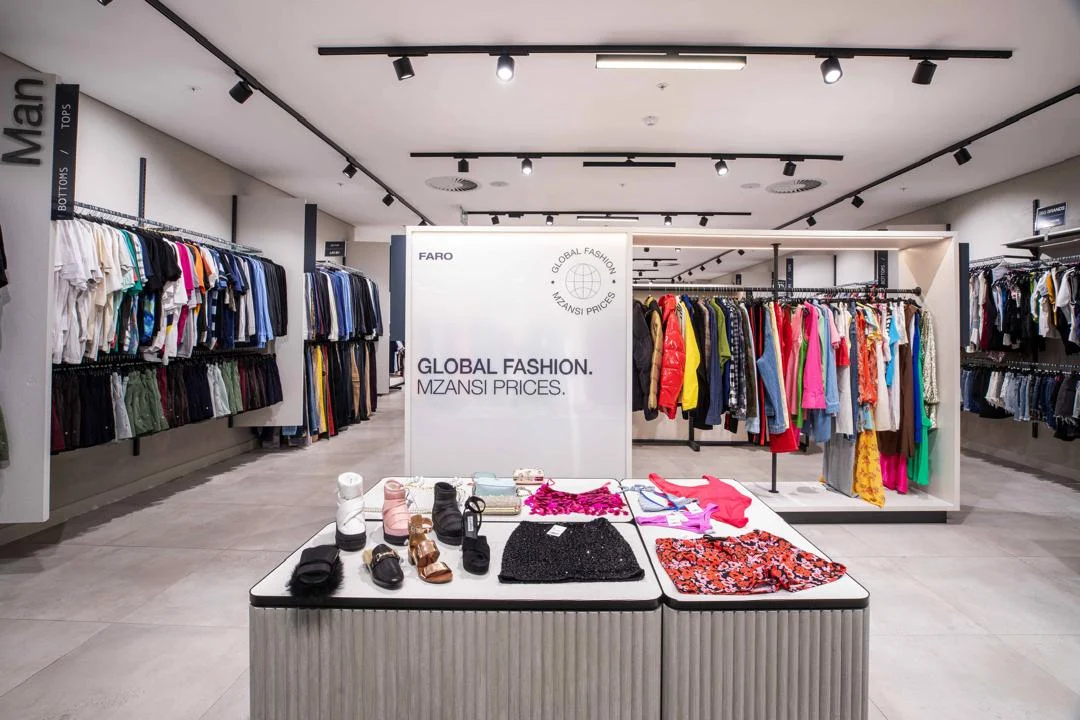
Recognizing this, FARO focuses exclusively on physical retail distribution within South Africa, a market uniquely suited for the strategy due to its highly developed commercial infrastructure, which boasts over 2,000 modern shopping centers. By placing its stores in accessible urban hubs and formal retail mid-market centers, FARO provides an experiential shopping environment where status-conscious, aspirational buyers can physically browse and discover branded goods at discounts of up to 70% off original retail prices.
Leveraging Artificial Intelligence to Streamline Legacy Workflows
While FARO’s consumer-facing strategy relies on physical storefronts, its backend operations are deeply rooted in cutting-edge technological innovation. The global off-price retail sector—typified by legacy giants like TJX—has historically relied on outdated, highly manual supply chain management systems. Planners and buyers across the fashion industry routinely spend countless hours manually handling massive, complex manifests and inventory spreadsheets in Microsoft Excel.
Co-founder and co-CEO David Torr highlights that this administrative burden represents one of the industry’s most significant hidden inefficiencies. Major fashion brands often employ thousands of corporate headquarters staff whose primary function is data manipulation and manual procurement analysis.
To solve this, FARO is actively developing and deploying proprietary, AI-powered software agents designed to decompose complex buyer workflows into automated micro-tasks. According to Torr, the startup has already implemented its first automated buying models. Where human analysts previously required hours or days to evaluate inventory manifests, assess demand profiles, and make purchasing decisions, FARO’s AI systems execute the same tasks in a matter of seconds with significantly higher accuracy rates.
Looking ahead, the company plans to integrate personalized, data-driven shopping tools into its ecosystem. Customers will soon be able to register specific brand preferences or clothing items of interest, receiving automated notifications when matching products are in transit to a local FARO store. This technological integration aims to bridge the gap between traditional off-price retail discovery and modern customer engagement.
A Rapid Chronology of Growth and Strategic Expansion
FARO’s rapid ascent underscores the immediate market demand for its hybrid model. The enterprise began operations in early 2023 with a modest, experimental pop-up store in South Africa. The test exceeded all internal forecasts, generating $100,000 in revenue within its first month of operation.
Relying on traditional retail benchmarks, the founding team initially projected that they would need to open at least seven distinct brick-and-mortar locations to reach an annual revenue run rate of $2 million. Instead, fueled by intense consumer demand and high inventory turnover, FARO achieved $2.3 million in annual revenue operating out of just four physical stores, delivering a staggering 20-fold revenue growth rate during its inaugural year.
Building on this momentum, leadership has outlined aggressive scaling targets for the upcoming fiscal cycle, aiming for a fivefold increase in business volume. However, company executives acknowledge that scaling the model toward the ultimate goal of 1,000 stores will require careful localization.
Consumer behavior, fashion preferences, and brand affinities vary dramatically across different global regions. A retail pricing architecture and brand mix that achieves high conversion rates in South Africa will not necessarily resonate with consumers in Kenya, Nigeria, or nascent markets outside the continent. Consequently, FARO’s expansion strategy is contingent on developing region-specific price profiles and curating tailored brand selections that align with local economic conditions and cultural tastes.
Broader Industry Implications and the Future of Recommerce
The rise of ventures like FARO signals a broader structural shift in how the global fashion industry addresses the compounding crises of overproduction and textile waste. As regulatory scrutiny increases around corporate environmental, social, and governance (ESG) practices, traditional apparel brands are facing mounting pressure to account for their end-of-life inventory rather than outsourcing disposal to developing nations under the guise of secondhand charitable donations.
By converting industrial liabilities into affordable retail assets, FARO’s model demonstrates that environmental sustainability and commercial profitability are not mutually exclusive. If the startup successfully executes its blueprint over the coming decade, it could fundamentally rewrite the playbook for inventory liquidation, proving that technology-enabled recommerce holds the key to solving fashion’s most intractable global supply chain failures.