









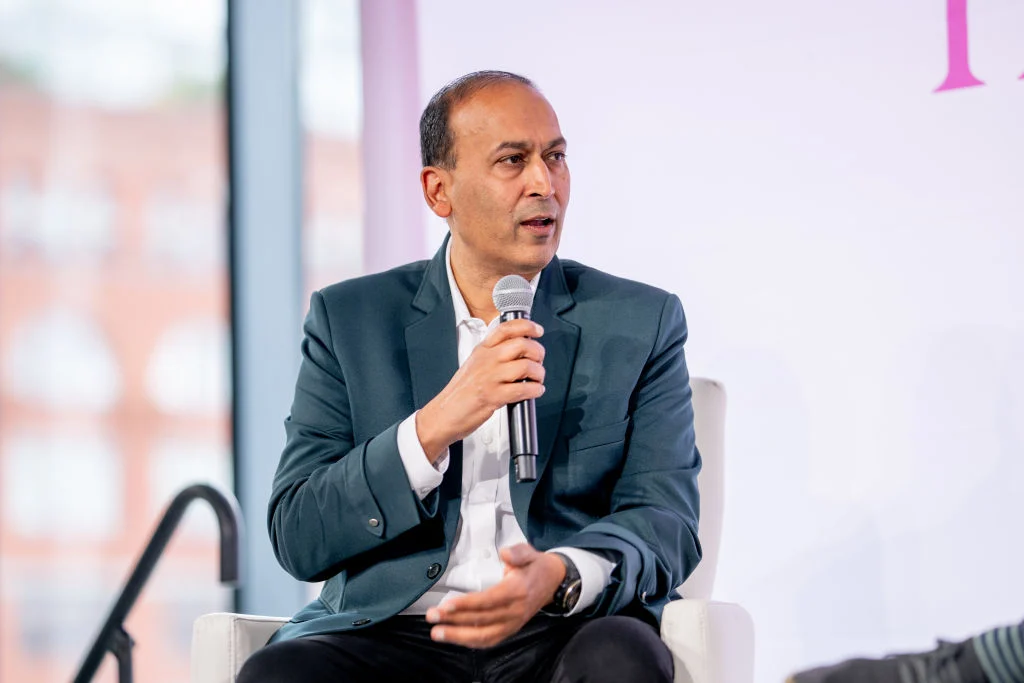
The fashion resale landscape reached a significant turning point on Monday as Poshmark, the social commerce pioneer, announced a major leadership transition marking the end of an era for its founding team. Manish Chandra, who has led the company since its inception in a Silicon Valley garage nearly 15 years ago, will officially step down from the chief executive role to join the company’s board of directors. Succeeding him is Namsun Kim, a seasoned executive from Poshmark’s parent company, Naver, who has served as Poshmark’s executive chairman since April 2024. This leadership change comes at a pivotal moment for the resale giant as it seeks to deepen its integration with Naver’s technological infrastructure and expand its footprint in the increasingly competitive global circular economy.
The Architect of Social Commerce: Manish Chandra’s Legacy
Manish Chandra founded Poshmark in 2011 alongside co-founders Tracy Sun, Gautam Golwala, and Chetan Pungaliya. At the time, the concept of "social commerce"—combining the inventory-driven model of eBay with the community-driven engagement of Instagram—was largely unproven. Chandra’s vision was to humanize the e-commerce experience, allowing users not just to buy and sell clothes, but to "follow" each other’s closets, attend virtual "Posh Parties," and build personal brands within the platform.
Under Chandra’s decade-and-a-half tenure, Poshmark grew from a niche startup into a dominant force in the secondary market. The company successfully navigated multiple stages of the corporate lifecycle, including a high-profile initial public offering (IPO) in January 2021, where shares debuted at $42, valuing the company at over $3 billion. However, as the post-pandemic e-commerce boom leveled off, Chandra orchestrated a strategic exit for the company’s public shareholders. In late 2022, Poshmark was acquired by the South Korean internet titan Naver in a deal valued at approximately $1.2 billion.
By the time of this leadership transition, Chandra had scaled the platform to a staggering 150 million registered users across the United States, Canada, and Australia. His move to the board of directors signifies a shift from day-to-day operational management to a long-term advisory role, ensuring that the "community-first" ethos he instilled remains a core part of the company’s DNA.
The Succession Strategy: Who is Namsun Kim?
The appointment of Namsun Kim as CEO reflects a deliberate effort by Naver to align Poshmark more closely with its broader corporate strategy. Kim is a heavyweight within the Naver ecosystem, currently serving as the President of Investments for the South Korean conglomerate. His background is rooted in high-level finance and strategic growth, having played a central role in Naver’s global acquisition strategy, including the very deal that brought Poshmark into the Naver portfolio.
The transition has been described by insiders as a highly structured process rather than a sudden departure. Chandra noted in his communications that he and Kim have been working closely since the beginning of 2025 to ensure a seamless handoff. Kim’s previous role as executive chairman provided him with a months-long "deep dive" into Poshmark’s internal operations, community dynamics, and technical hurdles. His leadership is expected to focus on leveraging Naver’s advanced artificial intelligence (AI) and search capabilities to enhance Poshmark’s discovery algorithms—a move that analysts believe is necessary to maintain a competitive edge against rivals like Depop and Vinted.
A Chronology of Poshmark’s Evolution
To understand the weight of this leadership change, one must look at the trajectory of Poshmark over the last 14 years:
- 2011: Poshmark is founded in Menlo Park, California. The initial focus is exclusively on an iOS app, betting early on the "mobile-first" revolution.
- 2012–2017: The company secures significant venture capital backing from firms like Mayfield Fund, Menlo Ventures, and Inventus Capital. It introduces features like "Posh Parties" and expanded categories including men’s and kids’ fashion.
- 2019: Poshmark begins its international journey, launching in Canada, marking its first step toward becoming a global marketplace.
- January 2021: Poshmark goes public on the Nasdaq (POSH). The stock surges 141% on its first day of trading, reflecting investor enthusiasm for the resale sector during the COVID-19 pandemic.
- October 2022: Naver announces its intent to acquire Poshmark for $17.90 per share in cash. The deal is positioned as a way for Naver to gain a foothold in the U.S. retail market.
- January 2023: The acquisition is finalized, and Poshmark becomes a private subsidiary of Naver.
- April 2025: Namsun Kim is appointed Executive Chairman, beginning the formal transition period.
- August 2025: Manish Chandra officially steps down as CEO, with Kim assuming the title.
Official Statements and Community Reaction
In a poignant farewell email sent to the Poshmark user base, Chandra emphasized the emotional connection he felt toward the community he helped build. "Leading this company has been the greatest honor of my professional life," Chandra wrote. "Every success we’ve achieved, every challenge we’ve overcome, has been because of you. It’s been the privilege of a lifetime witnessing each of you grow, and it has truly inspired me every single day."
The response from the "Poshmark community"—a group of sellers who often rely on the platform for their primary income—has been a mix of apprehension and cautious optimism. While Chandra was seen as a relatable founder who frequently attended "PoshFest" (the company’s annual creator conference), Kim represents the corporate and technological might of Naver. The challenge for the new CEO will be to maintain the "human touch" of the platform while implementing the rigorous data-driven changes required to scale in a crowded market.
Supporting Data: The Resale Market Context
The leadership change at Poshmark does not occur in a vacuum. The global secondhand apparel market is projected to reach $350 billion by 2028, according to industry reports from ThredUp and GlobalData. This growth is being driven by several macroeconomic factors:
- Sustainability Trends: Younger consumers, particularly Gen Z and Millennials, are increasingly prioritizing "circular" fashion over "fast" fashion due to environmental concerns.
- Inflationary Pressures: As the cost of new goods rises, the value proposition of high-quality secondhand items becomes more attractive to middle-income households.
- Technological Integration: The rise of AI-driven image recognition and personalized search has made navigating massive inventories of one-of-a-kind items significantly easier.
Poshmark’s 150 million users place it in a dominant position, but it faces stiff competition. Platforms like Depop have captured a younger, trend-focused demographic, while The RealReal dominates the luxury consignment space. By installing Namsun Kim—a specialist in investment and growth—Naver is signaling that it intends to aggressively defend and expand Poshmark’s market share through capital injection and technical refinement.
Broader Impact and Future Implications
The appointment of a Naver veteran as CEO suggests that the "integration phase" of the 2022 acquisition is moving into a more aggressive "growth phase." Industry analysts expect to see several key shifts under Namsun Kim’s leadership:
1. Enhanced AI and Search Capabilities
Naver is often referred to as the "Google of South Korea." Its expertise in search engine technology and generative AI could be transformative for Poshmark. We are likely to see improved "Smart Pricing" tools for sellers and more accurate "Visual Search" for buyers, allowing users to find specific items simply by uploading a photo.
2. Global Synergies
Naver owns other social and commerce platforms globally, including the Japanese marketplace Yahoo! Japan (through a joint venture) and the storytelling platform Wattpad. Kim is uniquely positioned to find synergies between these disparate platforms, potentially creating a cross-border resale network that allows a seller in Los Angeles to easily reach a buyer in Seoul or Tokyo.
3. Operational Efficiency
As a private subsidiary under a larger corporate umbrella, Poshmark will likely focus on profitability and operational lean-ness. While Chandra’s era was defined by community building and user acquisition, Kim’s era will likely be defined by monetization strategies, advertising products for sellers, and logistics optimization.
4. Preservation of the "Social" in Social Commerce
The biggest risk for the new administration is the potential alienation of the core user base. If the platform becomes too automated or "corporate," it risks losing the social engagement that differentiates it from Amazon or eBay. Kim’s decision to keep Chandra on the board suggests an awareness of this risk, keeping the founder close enough to act as a "cultural North Star."
As Manish Chandra moves to his new office in the boardroom, the transition marks more than just a change in personnel; it signifies the maturation of the social commerce industry. Poshmark is no longer a scrappy startup operating out of a garage; it is a vital component of a global tech conglomerate’s strategy to redefine how the world shops. For the 150 million "Poshers" who use the app, the hope is that Namsun Kim can provide the technological engine to propel the community into its next decade of growth without losing the personal connections that made the platform a household name.