







The international fashion community has officially decamped from Italy to France, marking the transitional changeover day that carries editors, buyers, and top-tier models from the runways of Milan to the scheduled presentations of Paris Fashion Week. As the French capital inaugurates its calendar with LVMH Prize laureate Julie Kegels, the global style industry pauses to evaluate the lasting commercial and aesthetic impacts of the Italian showcases. While major headlines initially focused on maximalist statements—such as Prada’s extensive skirt catalog—a deeper examination of the Milanese schedule reveals a complex landscape defined by rebellious tailoring, archival revivals, and a surprising resurgence of heritage utility.
Milan Fashion Week SS27, which concluded on September 27, served as a crucial bellwether for the luxury sector’s direction heading into the late 2020s. Against a backdrop of shifting creative directorships and evolving consumer demographics, Italian houses demonstrated a concerted effort to balance commercial viability with conceptual disruption.
Jil Sander: The Triumph of Structural Minimalism
Under the creative direction of Simone Bellotti, who assumed the role one year prior, the Jil Sander house cemented its renewed status as a pillar of refined modernism. Initially regarded as an understated presence within the contemporary luxury market, Bellotti’s SS27 collection positioned the brand firmly back into the upper echelon of critical acclaim.
Bellotti’s approach this season relied heavily on the architectural dichotomy between surface simplicity and intricate internal engineering. While garments appeared effortless and fluid in their initial visual impression, close inspection revealed highly complex patterning. Techniques involving precise pinching, gathering, and strategic tucking allowed the designer to construct specific, unyielding silhouettes without sacrificing the house’s signature lightweight drape. Industry analysts have noted that Bellotti’s measured stewardship is successfully re-establishing Jil Sander’s historical positioning as a masterclass in intellectual luxury.
Fendi and the Mirrored Avant-Garde
Fendi transformed its presentation space into a stark, immersive environment inspired by Italian sculptor Luciano Fabro’s Cubo di Specchi (Cube of Mirrors). The mirrored enclosure forced the audience into an introspective dialogue, reflecting both their own images and warped perspectives of the garments as they moved through the space.
The collection itself was characterized by jarring, sophisticated juxtapositions. Drawing on a soundtrack that blended Adriano Celentano’s linguistic experiment Prisencolinensinainciusol with Raffaella Carrà’s Rumore, the house paired stilettos with ribbed socks, oversized 18th-century-style frock coats with baggy denim, and delicate camisoles with heavy cheetah-print chokers. Front-row attendees, including actors Rachel Zegler, Iris Law, and Maisie Williams, contributed to the palpable energy of the event, which underscored Fendi’s ongoing efforts to bridge classical Roman tailoring with contemporary youth culture codes.
MM6 Maison Margiela: Thirty Years of Subversive Design
Approaching its milestone 30th anniversary next year, MM6 Maison Margiela demonstrated that the diffusion label retains the experimental, mischievous ethos of its parent house. The presentation began with a literal breakthrough: two staff members clad in traditional white lab coats tore open the heavy paper entry sealing the runway.
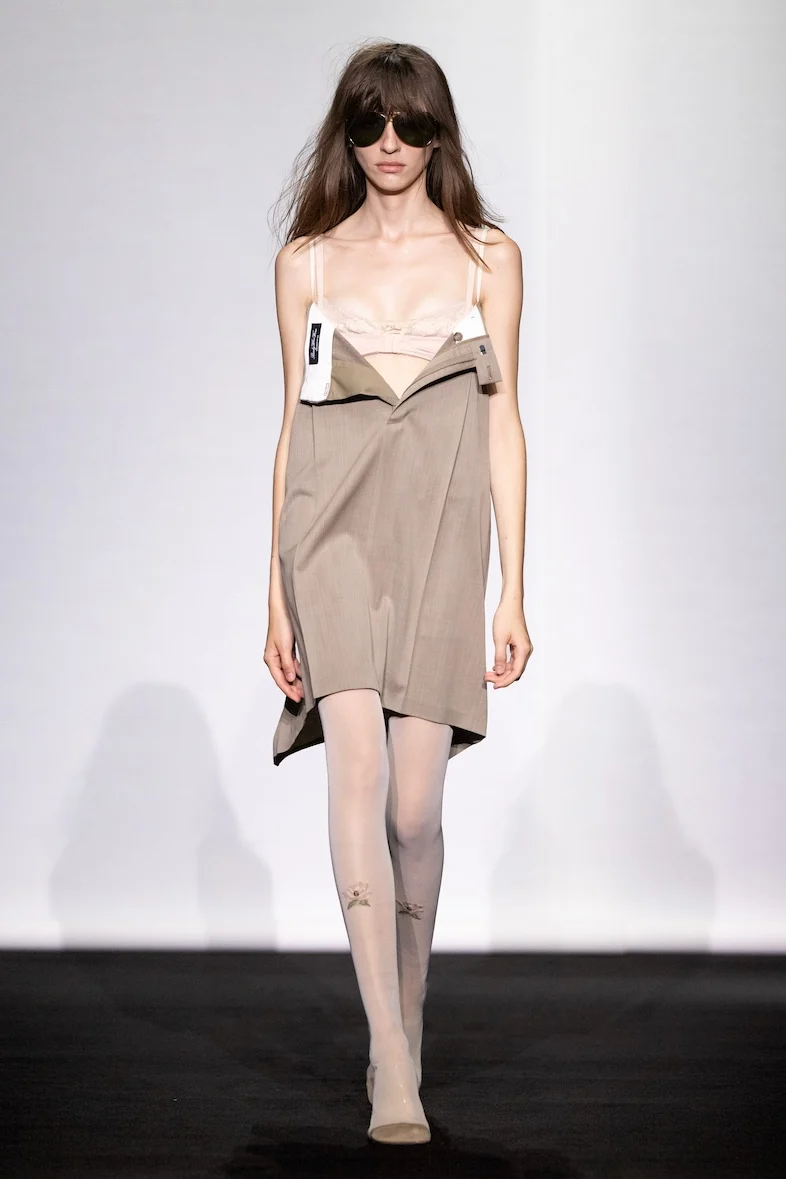
The collection relied on a topsy-turvy sartorial logic, subverting standard garment classifications. Trousers were inverted to function as mini-dresses with fully unzipped flies exposing underlying undergarments; traditional shirts were repurposed as dresses, and jackets were styled as skirts. This conceptual deconstruction aligns with a broader contemporary movement seen across European design incubators. A standout commercial element was the footwear collaboration with Havaianas, which featured platformed flip-flops elevated by tiered foam soles and asymmetrical toe-cutting—a product anticipated to dominate summer retail markets.
Armani Transitions Into a New Era
The shadow of the late founder Giorgio Armani, who passed away at the age of 91, remained a guiding force for the brand, which continues to uphold its foundational commitment to sharp, fluid tailoring. Under the creative direction of Silvana Armani, the mainline Emporio and Giorgio Armani offerings leaned heavily into 1980s power-dressing silhouettes. Double-breasted suits featured dramatic shoulder pads and were frequently styled bare underneath, creating an aesthetic that bridged daytime executive wear with late-night club culture.
Simultaneously, a significant structural transition is underway at the more accessible Emporio Armani label. Eschewing a traditional runway show this season, the brand released a clean, comprehensive lookbook to mark the conclusion of a chapter. SS27 represents the final collection designed collaboratively by Leo Dell’Orco and Silvana Armani. Beginning next season, former Versace designer Dario Vitale—who recently departed Versace following the Prada Group acquisition—will assume creative leadership of the label, signaling a forthcoming strategic realignment.
Dolce & Gabbana Bridges Sicilian Heritage and Cinematic Pop Culture
Dolce & Gabbana continued its extensive cultural dialogue with Sicily, building upon the momentum of its high-profile Alta Moda presentation held earlier this summer in the historic amphitheater of Taormina, accompanied by a performance from Jennifer Lopez.
Transporting this Mediterranean narrative to the Milanese runway for its STRAVAGANZA SICILIANA collection, the brand paired traditional southern Italian craftsmanship with unexpected pop culture signifiers. Jennifer Lopez reappeared in the front row, drawing international media attention by wearing a 1920s-inspired three-piece suit and flat-cap ensemble that invited immediate comparisons to Cillian Murphy’s character in the television series Peaky Blinders. The cross-cultural pastiche reinforced Dolce & Gabbana’s mastery of theatrical spectacle.
Max Mara and the Gen-Z Renaissance
Max Mara is currently experiencing an unexpected demographic shift, gaining substantial traction among Generation Z consumers through secondhand platforms such as Vinted and Depop. This renewed interest from younger demographics has amplified visibility for the brand’s core runway presentations.
British designer Ian Griffiths utilized the SS27 platform to refine the house’s foundational concept of "utility luxe." The collection was grounded in earthy beige palettes and military-inspired silhouettes, featuring oversized utility pockets on cotton gilets, upright popped collars, and waists cinched with heavy leather belts. Concurrently, Max Mara’s experimental subsidiary, Sportsmax, addressed the pressing reality of climate change through pragmatic garment engineering. Responding to the increasingly severe European summer heatwaves, the brand introduced a dedicated climate-conscious capsule centered on sleeve-removed outerwear, merging seasonal wearability with conceptual tailoring.
Tod’s: Heritage Craftsmanship Meets Athletic Precision
Celebrating over a century of leatherworking heritage since its origins as a 1920s Italian shoe cobbler, Tod’s anchored its SS27 presentation in uncompromising material quality while injecting a distinct athletic dynamism.
The collection emphasized a masculine energy through boxy suit jackets paired with coordinated shorts, punctuated by bold, color-blocked accents of coral, mustard, and crimson. Designed for the modern executive with an active lifestyle, the presentation drew a discerning front-row audience, including industry veteran Anna Wintour, as top models Awar Odhiang and Mariacarla Boscono demonstrated the collection’s effortless transition from leisure to executive authority.
Broader Implications for the Global Luxury Market
The collections presented during Milan Fashion Week SS27 indicate a bifurcated market strategy across legacy Italian houses. On one hand, brands are leaning heavily into archival codes, heritage tailoring, and reliable craftsmanship to satisfy an increasingly risk-averse core clientele. On the other hand, the incorporation of disruptive styling, humorous accessories—such as MM6’s platform flip-flops—and cross-generational marketing strategies demonstrate an aggressive pursuit of younger consumers accustomed to digital-first storytelling.
As the fashion calendar shifts definitively to Paris, the critical reception of these Italian collections establishes a high benchmark for conceptual depth and commercial adaptability that the French houses must now address.