










The Princess of Wales made a significant public appearance on Wednesday evening, joining King Charles III and Queen Camilla at St. James’s Palace for a reception marking the 125th anniversary of Cancer Research UK. The event served as a high-profile tribute to the nation’s leading oncology charity, an organization that has remained at the forefront of global efforts to prevent, diagnose, and treat cancer since its inception. The gathering brought together a distinguished assembly of pioneering scientists, dedicated clinicians, long-term donors, and cancer survivors, all of whom have contributed to the charity’s legacy of transforming survival rates over the past century and a quarter.
For Catherine, the engagement carried a profound sense of personal and symbolic resonance. Her attendance comes during a period where the Royal Family has faced its own highly publicized health challenges, with both the King and the Princess having shared their respective cancer diagnoses and treatment journeys with the public over the past year. This shared experience has notably shifted the narrative of royal patronage from one of traditional support to one of lived empathy, highlighting the universal nature of the disease and the critical importance of the research funded by organizations like Cancer Research UK.
A Symbolic Debut in Rodarte
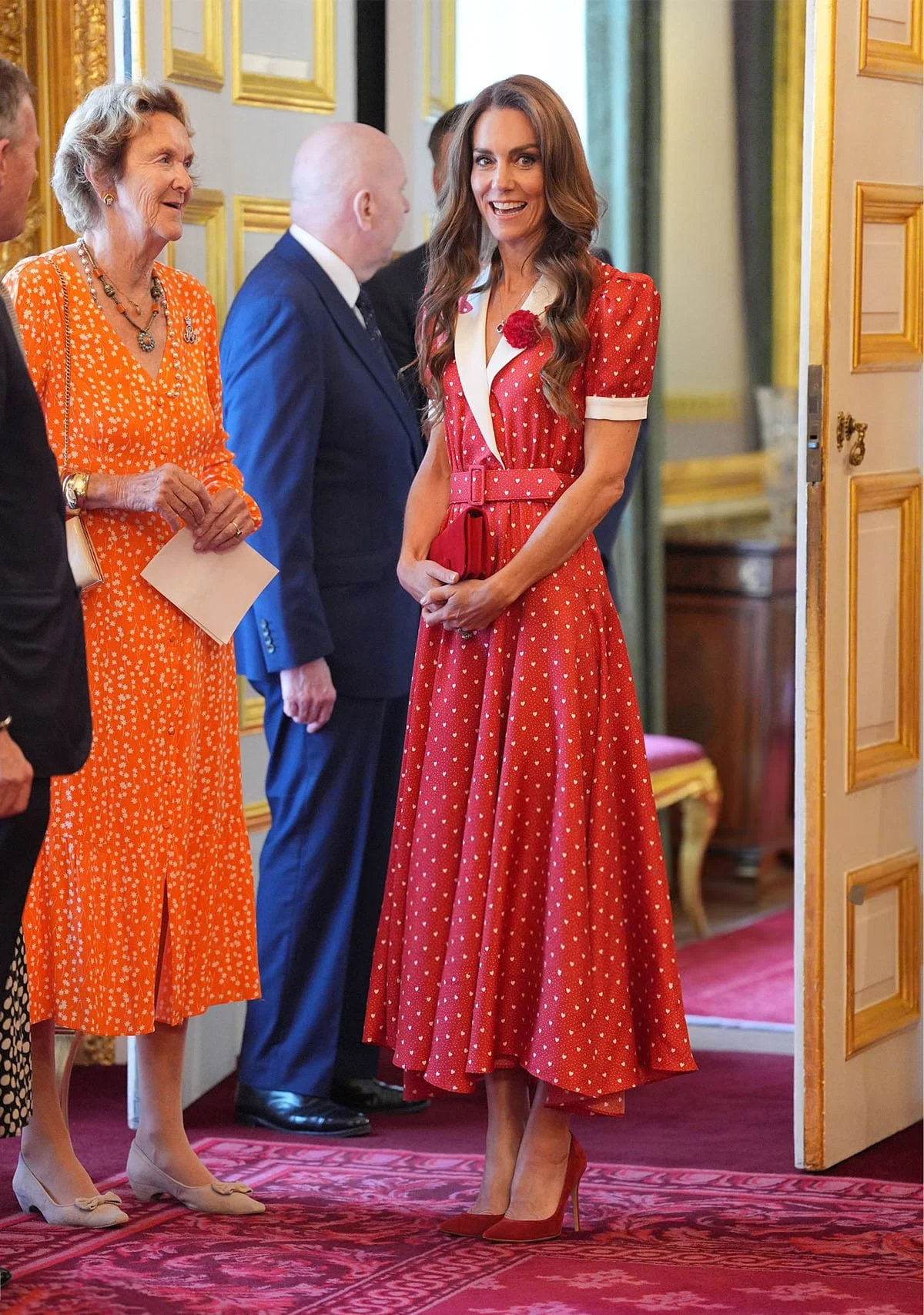
The Princess of Wales utilized the occasion to debut a new ensemble that balanced professional decorum with a sense of optimistic vitality. She selected a red midi dress from the American luxury label Rodarte, a brand known for its romantic and ethereal aesthetic. The garment featured a delicate print of scattered dots and heart motifs, accented by a sharp, contrasting white Chelsea collar and matching cuffed sleeves. A coordinated belt cinched the waist, while a floral corsage detail at the neckline added a touch of vintage-inspired femininity.
Fashion analysts noted that the silhouette bore a striking resemblance to the designs of Alessandra Rich, a label the Princess frequently favors for its "ladylike" mid-century charm. However, the choice of Rodarte—a brand helmed by sisters Kate and Laura Mulleavy—marked a subtle expansion of her wardrobe. The choice of vibrant red was widely interpreted as a deliberate nod to the "Red" branding of Cancer Research UK, as well as a symbol of strength and resilience.
To complete the look, the Princess adhered to her signature monochromatic styling, pairing the dress with red suede pumps by Gianvito Rossi and a matching Miu Miu clutch. Her jewelry choices were equally intentional, featuring a ruby pendant necklace and ruby and diamond earrings, stones often associated with vitality and passion. Despite the inclement London weather, the brightness of the attire provided a stark visual contrast to the grey evening, reinforcing a message of hope and forward-looking determination.
The 125-Year Legacy of Cancer Research UK
The reception celebrated a milestone that traces its roots back to the late 19th and early 20th centuries. Cancer Research UK was formed through the eventual merger of the Imperial Cancer Research Fund (founded in 1902) and the Cancer Research Campaign (founded in 1923). Together, these institutions have spearheaded some of the most significant breakthroughs in oncological history.
In the 125 years since the earliest foundations of the charity were laid, cancer survival in the United Kingdom has doubled. In the 1970s, just one in four people survived the disease for ten years or more; today, that figure has risen to two in four. The charity’s work has been instrumental in the development of over 50 of the world’s most widely used cancer drugs, including Tamoxifen for breast cancer and Cisplatin for various solid tumors.
During the reception, King Charles III, who serves as the patron of Cancer Research UK, spent time conversing with lead researchers about the charity’s current "Grand Challenge" initiatives. These are international collaborations designed to tackle the most complex hurdles in cancer research, such as understanding how inflammation triggers cancer or developing ways to manipulate the microbiome to improve treatment efficacy. The King’s ongoing involvement underscores the monarchy’s long-standing commitment to British scientific excellence and public health.
Chronology of the Evening and Royal Interaction
The evening commenced with a private briefing for the Royal Family, where they were updated on the latest advancements in early detection technologies. Following this, the King, Queen, and Princess entered the State Rooms of St. James’s Palace to meet with guests.
- Opening Remarks: The Chief Executive of Cancer Research UK, Michelle Mitchell, delivered a speech outlining the charity’s vision for the future, aiming for a world where three in four people survive cancer by 2034.
- Scientific Showcase: The royals viewed a series of exhibits detailing the evolution of radiotherapy and the move toward "personalized medicine," where treatments are tailored to the genetic makeup of an individual’s tumor.
- Survivor Dialogue: A pivotal moment of the evening involved the Princess of Wales speaking with a group of young cancer survivors. Witnesses noted the Princess’s attentive and warm engagement as she listened to their stories of recovery and the impact of clinical trials funded by the charity.
- The Toast: The event concluded with a formal toast by King Charles, honoring the "relentless spirit" of the researchers and the "courageous heart" of the patients.
Supporting Data: The State of Cancer Research in the UK
The importance of the 125th-anniversary event is underscored by the current statistics surrounding cancer in the United Kingdom. According to data provided by Cancer Research UK:
- Every two minutes, someone in the UK is diagnosed with cancer.
- There are approximately 375,000 new cancer cases in the UK every year.
- Cancer Research UK currently funds around 50% of all publicly funded cancer research in the UK.
- The charity invests over £400 million annually into various research projects, ranging from basic laboratory science to large-scale clinical trials involving thousands of patients.
The charity also highlighted the economic impact of its work, noting that for every £1 invested in cancer research, the UK economy receives a return of approximately £2.80 in health and economic benefits. This data reinforces the role of the charity not just as a medical lifeline, but as a pillar of the UK’s global standing in the life sciences sector.
Official Responses and Strategic Implications
In a statement released following the event, Michelle Mitchell, Chief Executive of Cancer Research UK, expressed gratitude for the royal support. "To have His Majesty the King, Her Majesty the Queen, and the Princess of Wales join us to celebrate 125 years of progress is a testament to the importance of our mission," Mitchell stated. "Their support helps shine a light on the vital work of our scientists and the bravery of our patients. While we have made incredible strides, the challenge remains urgent, and we are more determined than ever to find cures for all cancers."
The presence of the Princess of Wales was particularly noted by industry analysts as a powerful tool for public engagement. "The ‘Kate Effect’ extends far beyond fashion," noted Dr. Elizabeth Thorne, a public health analyst. "When a senior royal of her generation aligns so closely with a cause, especially one she has navigated personally, it reduces the stigma surrounding the disease and encourages the public to engage with screening programs and charitable giving."
Broader Impact and Future Outlook
The 125th-anniversary reception at St. James’s Palace marks a transitional phase for both the charity and the Royal Family. For Cancer Research UK, the focus now shifts toward the next quarter-century, with a heavy emphasis on "liquid biopsies" (blood tests that can detect cancer at its earliest stages) and the integration of Artificial Intelligence in diagnostic imaging.
For the monarchy, the event solidified their role as "Advocates-in-Chief" for national health. The visible unity of the King, Queen, and Princess of Wales at an event dedicated to cancer research sends a clear message of stability and continuity. It suggests that despite their personal health trials, the work of the Crown remains steadfastly focused on issues that affect the wider population.
As the Princess of Wales continues her gradual return to a full schedule of public duties, her choice to prioritize an organization like Cancer Research UK signals a long-term commitment to health advocacy. The event was not merely a celebration of past achievements but a call to action for the future, ensuring that the next 125 years of research are as transformative as the last. Through the lens of royal patronage, the fight against cancer remains a top national priority, buoyed by scientific progress and a visible, empathetic leadership.