










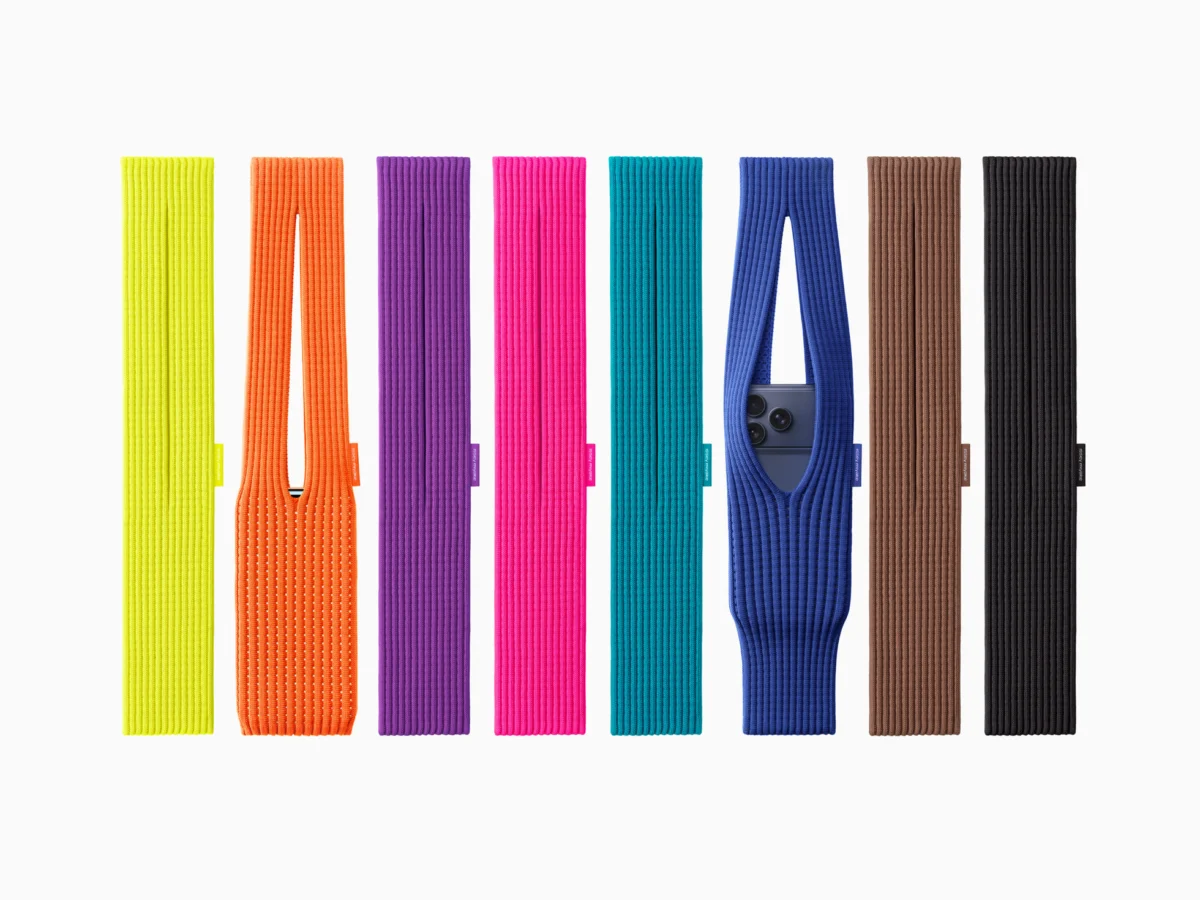
Apple Inc. has expanded its high-end accessory lineup with the introduction of the iPhone Pocket, a limited-edition fabric sling designed in collaboration with the renowned Japanese fashion label Issey Miyake. Priced at $149.95 for the short variant and $229.95 for the crossbody version, the product represents another foray by the technology giant into the luxury fashion and lifestyle market. The release follows a series of high-priced lifestyle items from Apple, including its $19 polishing cloth and various proprietary leather and woven fine-fabric accessories, prompting renewed industry discussion regarding the convergence of consumer electronics and high fashion.
Main Facts and Product Specifications
The iPhone Pocket is constructed from a single piece of fabric, utilizing a ribbed mesh structure that incorporates the signature pleating techniques established by the Issey Miyake fashion house. According to product specifications provided by Apple, the textile is engineered to stretch, allowing users to partially view the smartphone display while the device remains secured inside the enclosure.
The product is available in two distinct configurations:
- Short Size ($149.95): Available in a wider range of colors, designed to be attached to larger handbags or carried independently as a micro-pouch.
- Long Crossbody Size ($229.95): Available in a limited color palette, engineered to be worn across the torso as a wearable strap and enclosure system.
The collaboration marries Apple’s hardware dimensions with the avant-garde textile engineering philosophy historically championed by Issey Miyake.
Chronology and Historical Context

The conceptual roots of the iPhone Pocket extend back to the late 1990s, when visionary Japanese fashion designer Issey Miyake developed the APOC (“A Piece Of Cloth”) concept. Introduced in 1997, APOC aimed to create garments from a continuous, seamless tube of fabric using industrial knitting technology, thereby minimizing textile waste and showcasing a technology-forward approach to apparel design.
Miyake’s minimalist and functional aesthetic previously intersected with Apple’s corporate history through his relationship with Apple co-founder Steve Jobs. In the 1980s, during a visit to Sony facilities in Japan, Jobs admired the uniformity of corporate dress codes and sought to implement a similar standard for Apple employees. While Apple employees ultimately rejected the uniform proposal, Jobs commissioned Miyake to design a personal wardrobe staple. This collaboration resulted in the iconic black mock-neck sweaters worn by Jobs during numerous keynote presentations, cementing a subtle aesthetic link between the fashion label and the Silicon Valley corporation.
Although Issey Miyake passed away in August 2022, the design house bearing his name has continued to explore boundary-pushing textiles, culminating in this official, albeit indirect, retail partnership with Apple.
Market Context and Contemporary Trends
The launch of the iPhone Pocket arrives amid a broader macroeconomic and cultural shift toward minimalist travel and accessory-layering. With the widespread adoption of contactless payment systems, digital identification, and smart-lock residential access, consumers increasingly rely solely on smartphones for daily navigation, diminishing the necessity of traditional, bulky wallets and handbags.
Consequently, the fashion and accessories market has seen a surge in ultra-minimalist carrying solutions. Miniature bags, such as micro-totes popularized by brands like Telfar, Baggu, Lululemon, and Trader Joe’s, have dominated retail spaces. Concurrently, the popularity of decorative charm accessories—exemplified by the viral craze surrounding Pop Mart’s Labubu art toys and the custom accessorization of insulated drinkware—has established a consumer appetite for items designed exclusively to embellish other personal items.
Apple’s pricing strategy places the iPhone Pocket firmly within the luxury designer goods category rather than standard consumer electronics protection. By pricing the crossbody version at nearly $230, the product competes directly with entry-level offerings from established contemporary leather goods and designer diffusion lines.

Industry Analysis and Consumer Implications
Market analysts note that Apple’s continued expansion into fashion-adjacent accessories serves multiple strategic purposes. First, high-margin, low-production-cost soft goods generate substantial revenue per square foot in Apple retail locations, capitalizing on the brand’s fervent consumer base. Second, limited-edition collaborations with heritage design houses elevate Apple’s brand positioning from a purely utilitarian hardware manufacturer to a lifestyle curator.
However, the pricing and form factor have drawn scrutiny from tech commentators and fashion critics alike. The reliance on an open-mesh textile to carry an expensive flagship smartphone raises practical questions regarding device security, weather resistance, and long-term structural elasticity. Furthermore, the positioning of the short variant as a secondary attachment for larger bags aligns with niche micro-accessory trends that may experience rapid cyclical obsolescence.
Official Distribution and Availability
The iPhone Pocket is available exclusively through select Apple retail channels and the official Apple online store as a limited-edition release. Given its positioning as a designer collaboration, restocking schedules remain unconfirmed, and availability is expected to be restricted by geographic region.