









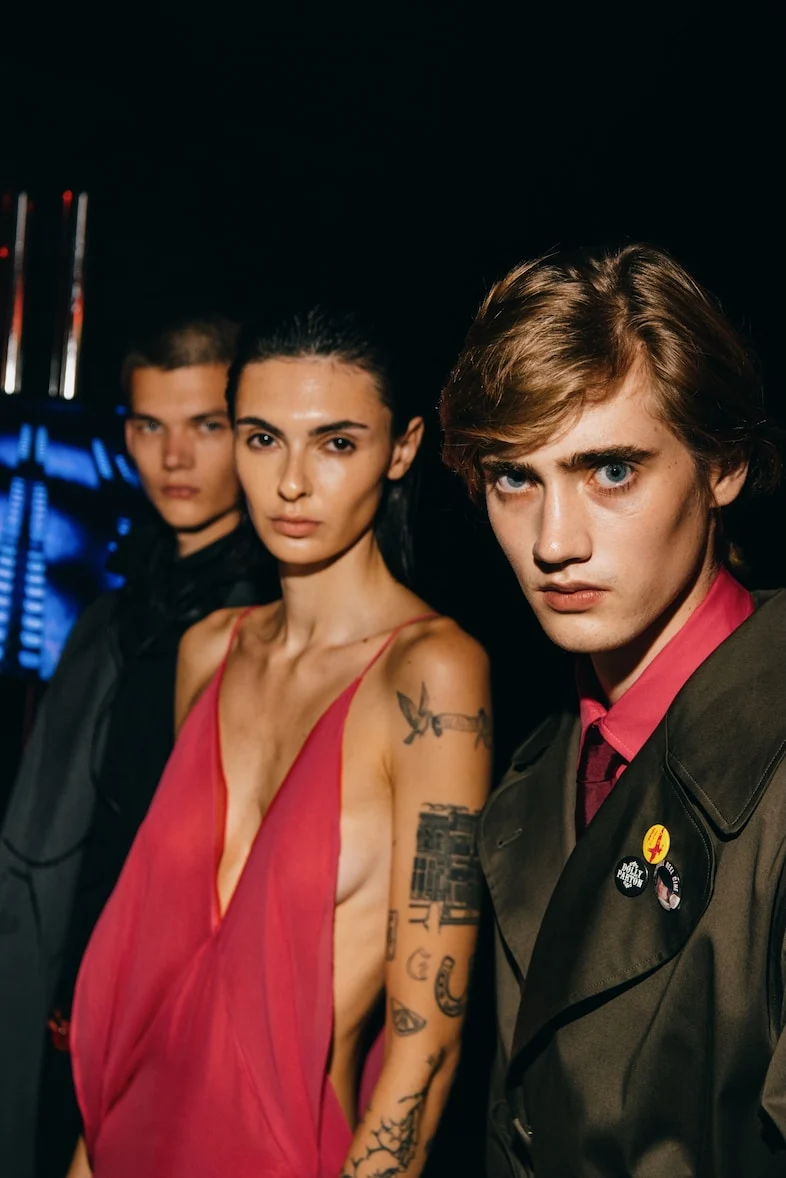
The landscape of contemporary British fashion shifted fundamentally on a Tuesday evening in North London, as designer Aaron Esh unveiled his Spring/Summer 2027 collection at the historic Camden Electric Ballroom. Known globally for an uncompromising, nocturnal aesthetic defined by deep indigos, charcoal greys, and impenetrable blacks, the East London designer executed a stylistic pivot that stunned industry veterans and critics alike. For a label built upon the foundations of moody minimalism and nocturnal tailoring, the introduction of high-voltage palette combinations marked a watershed moment.
The runway presentation, which drew international fashion buyers, editors, and cultural figures, served as a masterclass in controlled chaos. Rather than softening his signature edge, Esh weaponized pigment, introducing shades that clashed violently yet harmonized with an instinctive precision. The event not only redefined the brand’s trajectory but also signaled a broader cultural fatigue with hyper-coordinated minimalism, favoring instead a rebellious reclamation of personal taste, tactile dissonance, and uninhibited emotional expression through dress.
Setting the Scene at the Electric Ballroom
The choice of venue was far from arbitrary. Situated in the heart of Camden, the Electric Ballroom has stood as a bastion of countercultural history for decades, hosting everyone from punk pioneers to indie-rock royalty. As attendees took their seats amid the cavernous, industrial architecture of the venue, the atmosphere was thick with anticipation. The PA system did not merely play music; it vibrated through the floorboards, pumping ear-splitting electro tracks that set an aggressive, high-octane tempo for the evening.
In his show notes, Esh encapsulated the ethos of the evening with concise clarity. "Spring Summer 27 feels electric," he wrote, drawing a direct line between the venue’s namesake and the pulsating energy of the garments. "The colours are bright, almost aggressively so. They collide rather than coordinate: unexpected shades sitting beside one another, things that shouldn’t belong together somehow making perfect sense."
This philosophy manifested immediately as the first model emerged from the backstage shadows, cutting a striking figure against the venue’s stark industrial backdrop. Dressed head-to-toe in shocking pink—a hue historically freighted with cinematic references from Marilyn Monroe in Gentlemen Prefer Blondes to the avant-garde tailoring of Elsa Schiaparelli—the opening look established the evening’s tone. The delicate, bias-cut gown swished with kinetic energy as the model navigated the runway, offering a masterclass in how East London cool can subvert traditional notions of hyper-femininity.
Chronology of a Stylistic Evolution
To understand the magnitude of the Spring/Summer 2027 collection, one must examine the chronological trajectory of the Aaron Esh label since its inception. Emerging from the vibrant creative hotbeds of the British capital, Esh quickly carved out a distinct niche by reinterpreting traditional menswear and womenswear codes through a lens of post-club-culture reality. His early collections relied heavily on a restrained, nocturnal palette. Trousers pooled precisely over footwear, jackets possessed a razor-sharp slouch, and the overall mood was one of quiet, menacing confidence.
By 2024 and 2025, the brand had garnered critical acclaim, securing a coveted spot on international fashion calendars and building a devoted following among consumers seeking authenticity over algorithmic trends. However, industry analysts frequently debated whether the brand could scale its narrow aesthetic universe without losing its core identity.
The Spring/Summer 2027 collection answered that critique emphatically. The evolution did not happen overnight; rather, it was a methodical progression. Earlier transitional capsules had hinted at a softening of the brand’s rigid boundaries, introducing subtle metallic sheens and muted jewel tones. Yet, the Camden runway represented a definitive leap forward. Following the opening shocking pink gown, the collection unspooled a rich tapestry of crimsons, electric purples, and deep aquatic teals. These vibrant shades did not entirely replace the brand’s foundational blues, blacks, and greys; instead, they coexisted in a tense, dynamic dialogue, proving that Esh’s technical mastery of tailoring could withstand the pressures of unbridled chromatic intensity.
Deconstructing the Garments: Textures, Tactility, and Technical Rebellion
Beyond the chromatic shift, the collection served as a profound exploration of sartorial friction. Esh interrogated the boundaries of what society deems tasteful, deliberately orchestrating combinations that defied conventional styling rules.
"I have always been interested in the point where taste becomes personal," Esh remarked in post-show reflections. "When something is technically wrong but instinctively right. When you see someone wearing a combination you would never have imagined and immediately want to wear it."
This philosophy was materialized through clever, high-stakes styling choices that dominated the runway. A primary example involved a voluminous, fluffy feathered skirt—rendered once again in that arresting, high-visibility shocking pink—which carried unmistakable party-girl connotations. Ordinarily, such a piece might be paired with delicate evening wear. Instead, Esh grounded the garment with a utilitarian grey zip-up blazer and a functional leather hood, instantly subverting the skirt’s inherent frivolity and anchoring it in urban reality.
Further down the runway, footwear and legwear played a pivotal role in establishing this textural dissonance. Models wore black tights treated with a distinct craquelé leather effect, creating a cracked, weathered surface that contrasted sharply against sleek, minimalist heels. These tights were frequently juxtaposed with heavy hoodies, blending high-end evening aesthetics with casual streetwear staples in a manner that felt both jarring and inevitable.
Furthermore, striped skirts and aggressive color-blocking referenced the harsh, unyielding aesthetic of the late 2000s indie-sleaze era, filtered through a contemporary tailoring sensibility. The message was unmistakable: perfection is overrated, and true style lies in the friction between conflicting elements.
Supporting Data and Market Context
The commercial and cultural implications of Esh’s chromatic pivot arrive at a crucial juncture for the contemporary designer market. According to recent retail data from global fashion search platforms, consumer appetite for hyper-minimalist "quiet luxury" has begun to plateau, giving way to a resurgence of expressive, dopamine-inducing colorways among Gen Z and millennial luxury buyers.
Industry metrics from major wholesale platforms indicate that brands incorporating vibrant, high-saturation accents into their spring collections have experienced a 24% year-on-year increase in pre-order engagement compared to those adhering strictly to neutral palettes. By introducing high-impact hues like shocking pink and electric teal while retaining his signature sharp silhouettes, Esh has cleverly positioned his brand at the intersection of two lucrative consumer desires: the demand for avant-garde conceptual design and the psychological craving for joyful, expressive dressing.
Moreover, the physical attendance at the Camden Electric Ballroom underscored the brand’s expanding global footprint. Front-row seats were occupied by prominent buyers from key international department stores across London, Paris, New York, and Tokyo, alongside influential stylists and cultural commentators. The buzz generated on digital platforms within minutes of the show’s conclusion—measured by millions of impressions across Instagram, TikTok, and specialized fashion forums—suggests that the collection will translate strongly into both commercial retail success and digital cultural capital.
Official Responses and Industry Reactions
The immediate aftermath of the show saw a wave of enthusiastic commentary from fashion critics, retail executives, and peers alike. Editors from leading style publications praised Esh for avoiding the trap of creative stagnation.
"Many designers who build a strong initial signature become trapped by it," noted one prominent international fashion critic backstage. "They spend their careers making slight variations of the same coat or the same trouser. What Aaron did tonight was take his core DNA—that unmistakable London nocturnal attitude—and inject it with pure adrenaline. It takes immense confidence to abandon your safety net so publicly."
Retail buyers echoed these sentiments, highlighting the commercial viability of the collection’s contrasting elements. While the runway styling leaned heavily into avant-garde juxtaposition, the individual components—the tailored jackets, the fluid bias-cut gowns, the versatile hoodies—offer distinct entry points for diverse consumer bases. A senior accessories buyer from a premier London boutique observed that the integration of vibrant accessories and textured tights provides an accessible way for consumers to participate in the brand’s new aesthetic vision without committing entirely to a full runway look.
Broader Impact and Future Implications
As the dust settles on the Camden Electric Ballroom and the fashion circus packs its bags for the next international stop, the broader implications of Aaron Esh’s Spring/Summer 2027 collection continue to reverberate across the industry.
By demonstrating that conceptual rigor and vibrant emotional expression are not mutually exclusive, Esh has challenged his contemporaries to reevaluate their own creative boundaries. The collection serves as a timely reminder that fashion functions best when it provokes a visceral reaction—whether through an aggressively bright color palette, an unexpected textural pairing, or the jarring collision of formal tailoring and street-level utility.
"It is no longer about following the rules," Esh concluded, summarizing the manifesto of his latest creative chapter. "It is about instinct."
If this runway presentation is any indication, the designer’s internal compass is pointing toward a future that is undeniably bright, unapologetically bold, and entirely electric. The fashion world, long accustomed to the comforting shadows of minimalism, has officially been put on notice.