










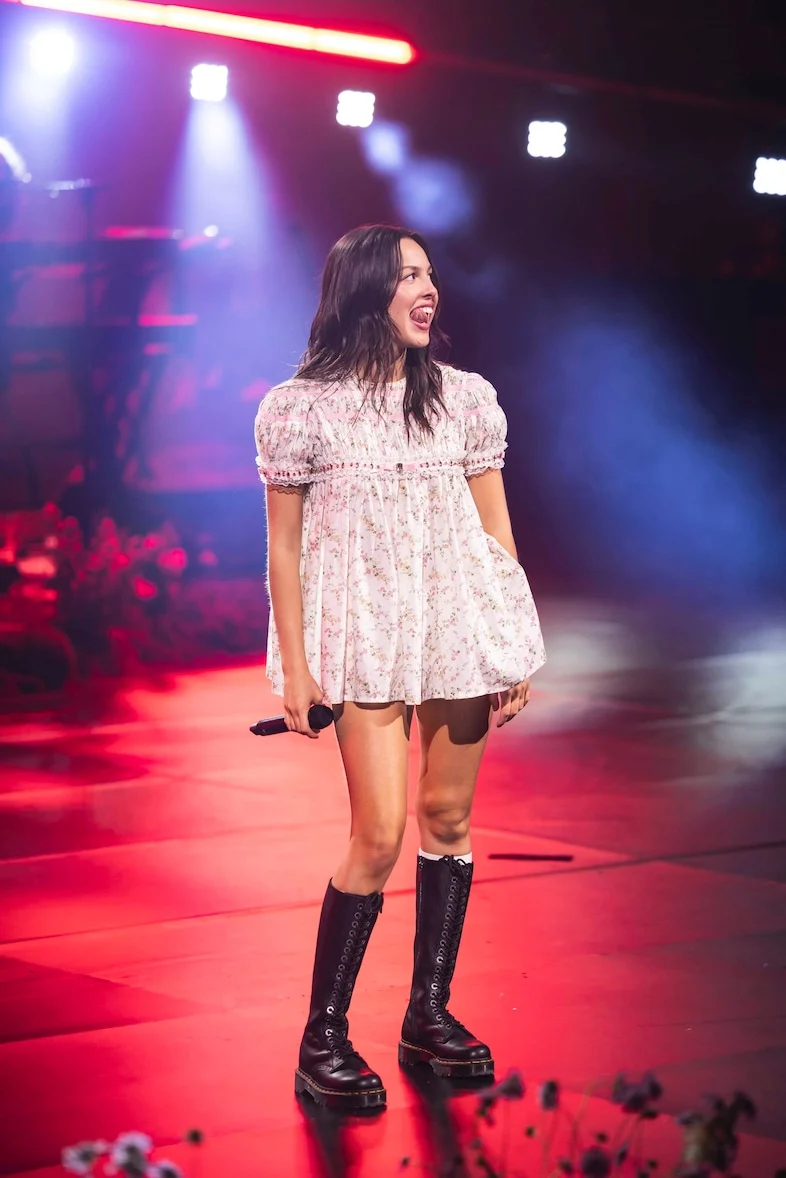
In an era marked by pressing global crises including widespread conflict, humanitarian emergencies, escalating income disparity, and the rise of extremist political ideologies, public discourse recently converged on a seemingly incongruous focal point: a dress worn by Grammy-winning artist Olivia Rodrigo. The garment, a romantic, floaty design from Chloé’s Fall/Winter 2024 collection by creative director Chemena Kamali, ignited a fervent debate across social media platforms following Rodrigo’s appearance at Spotify’s Billions Club event in Barcelona. This incident has prompted a broader examination of contemporary celebrity scrutiny, the historical context of fashion, and the selective nature of public outrage in the digital age.
The Genesis of the Controversy: A Night in Barcelona
The incident unfolded during Spotify’s exclusive Billions Club event, held at Barcelona’s historic Teatro Greco. This gathering celebrates artists who have achieved the monumental milestone of one billion streams on the platform, a testament to their global reach and commercial success. Olivia Rodrigo, whose discography boasts multiple tracks surpassing this benchmark, was a prominent attendee and performer. For her appearance, Rodrigo chose a distinctive babydoll-style dress, characterized by its ethereal fabric, delicate silhouette, and a design that evokes a sense of youthful femininity.
Almost immediately following images and videos of Rodrigo in the dress circulating online, a vocal segment of social media users initiated a wave of criticism. The central accusations posited that the dress was "infantilising," that it "sexualised children’s clothes," and, in more extreme instances, was even perceived as "promoting paedophilia." Others framed the choice as emblematic of a perceived "sexy baby" aesthetic, a trend they argued was particularly prevalent among "white girls" in contemporary popular culture. This latter critique, as the original article correctly noted, overlooked Rodrigo’s mixed-race heritage, highlighting a quickness to generalize and stereotype in online commentary.
Dissecting the Garment: Chloé’s Design and Rodrigo’s Aesthetic
To understand the context of the dress, it is crucial to examine its origins. The garment is a creation of Chemena Kamali, the recently appointed creative director for the venerable French fashion house Chloé. Kamali presented her highly anticipated debut collection for Chloé during Paris Fashion Week in March, an event Olivia Rodrigo notably attended, signaling her early appreciation for Kamali’s vision for the brand.
Chloé has, for decades, been synonymous with a particular brand of sophisticated yet free-spirited femininity. Founded by Gaby Aghion in 1952, the label championed ready-to-wear luxury and a bohemian elegance that stood apart from the more rigid couture of its time. Throughout its history, under the creative direction of influential designers such as Martine Sitbon, Stella McCartney, Phoebe Philo, and Clare Waight Keller, Chloé has consistently cultivated an aesthetic rooted in soft lines, romantic silhouettes, and an understated, natural charm. Kamali’s Fall/Winter 2024 collection, from which Rodrigo’s dress originates, was widely interpreted by fashion critics as a return to the brand’s quintessential romanticism and a celebration of feminine grace, often incorporating floaty fabrics, delicate lacework, and designs that suggest movement and lightness.
Olivia Rodrigo’s personal style and artistic persona have consistently interwoven themes of girlhood, adolescence, and the tumultuous journey of coming-of-age. Her music, characterized by raw emotion and relatable narratives of young love, heartbreak, and self-discovery, resonates deeply with a demographic navigating similar experiences. This artistic alignment naturally extends to her fashion choices, which frequently feature a blend of nostalgic references, punk-rock edge, and playful, youthful elements. Therefore, Rodrigo’s selection of a Chloé dress that embodies romantic, ethereal femininity, a brand known for its floaty designs, appears entirely consistent with her established artistic identity and stylistic preferences. It represents a synergy between an artist and a brand that aligns with her narrative, rather than a departure into a controversial aesthetic.
The Babydoll Dress: A History of Evolution and Reinterpretation
Central to the debate is the specific silhouette of the dress—the babydoll. The perception that this style is inherently infantile or designed for children is, historically, inaccurate. The babydoll dress emerged not from children’s wear, but from pragmatic adult fashion.
Its origins can be traced back to the 1940s, specifically during World War II. Fabric rationing, a critical measure during wartime to conserve resources for military use, necessitated designers to create garments that required less material. The babydoll style, with its shorter hemline and often loose, flowing cut, was a practical solution to these restrictions. It was a silhouette designed for adult women, prioritizing economy of fabric while still offering a fashionable option.
The style gained significant mainstream cultural prominence in 1956 with the release of Elia Kazan’s controversial film Baby Doll, starring Carroll Baker. Baker’s character, a child-bride named Baby Doll Meighan, famously wore the short, gathered nightgowns that lent the dress its enduring name. The film, which explored themes of innocence, sexuality, and exploitation, was scandalous for its time and contributed to the babydoll dress’s association with a certain provocative, albeit complex, femininity. It was a garment worn by an adult character grappling with adult themes, not a child.
Decades later, in the 1990s, the babydoll dress experienced a powerful resurgence, particularly within the grunge and alternative music scenes. It became a hallmark of the "Kinderwhore" aesthetic, a subversive fashion movement embraced by female rock musicians such as Courtney Love of Hole and Kim Gordon of Sonic Youth. This iteration of the babydoll dress was anything but innocent; it was a deliberate act of sarcastic hyper-femininity. These artists used the seemingly sweet, childlike dress to juxtapose with their raw, aggressive music and unapologetically feminist stances, challenging patriarchal expectations of female performance and sexuality. It was a commentary on societal perceptions of women, rather than an endorsement of infantilization. Rodrigo, in her own career, has frequently incorporated nods to the fashion of both the 50s and 90s, demonstrating an awareness and appreciation for these historical precedents.
This historical trajectory demonstrates that the babydoll dress, far from being exclusively children’s attire, possesses a rich and varied history of adult interpretation, often imbued with layers of social commentary, rebellion, and evolving perceptions of femininity.
The Echo Chamber of Online Outrage: Social Media’s Amplifying Effect
The rapid spread and intensity of the criticism against Rodrigo’s dress underscore the profound impact of social media in shaping public discourse. Platforms like X (formerly Twitter) and Instagram facilitate instantaneous reactions, allowing sentiments, both positive and negative, to proliferate globally within minutes. This environment often prioritizes speed over nuance, leading to a phenomenon where initial, sometimes misinformed, reactions can quickly coalesce into widespread "outrage cycles."
In such a landscape, the context and history of a fashion choice can be easily overlooked in favor of immediate emotional responses. Algorithms often amplify content that generates high engagement, regardless of its accuracy or constructive nature, inadvertently fueling moral panics. The "sexy baby" aesthetic, for instance, has become a recurring point of contention in online discussions about female celebrities, particularly those who are young and popular. While genuine concerns about the sexualization of youth are valid and important, the application of this critique often lacks discernment, conflating intentional artistic expression or a playful aesthetic with harmful intent or consequence.
Broader Implications: Gendered Scrutiny and Selective Outrage
The controversy surrounding Olivia Rodrigo’s dress is not an isolated incident but rather fits into a long-standing pattern of intense, often gendered, scrutiny directed at female celebrities and their sartorial choices. From Victorian-era debates over ankle exposure to modern-day discussions about red carpet attire, women in the public eye have consistently been subjected to a level of critique regarding their appearance that their male counterparts rarely experience.
This disproportionate focus on female bodies and clothing often serves as a proxy for broader societal anxieties about femininity, sexuality, and cultural change. When a young, successful woman like Rodrigo wears a dress that some perceive as "infantilizing" or "sexualizing," it can trigger a moral panic that projects complex social issues onto a single garment. This phenomenon distracts from more systemic problems and diverts attention from genuinely problematic instances of exploitation or harmful representation.
The original article astutely highlights a stark irony in the public’s selective outrage. While a floaty dress worn by a 23-year-old artist garners accusations of "promoting paedophilia," other forms of media consumption that involve genuine allegations of abuse or degradation often proceed with far less public condemnation. The example of the Michael Jackson biopic is particularly salient. Despite long-standing, well-documented allegations of child abuse against the late artist—allegations that the film notably sidesteps or ignores—the movie has achieved significant commercial success, grossing hundreds of millions worldwide. This discrepancy points to a societal cognitive dissonance, where the abstract or indirect "offense" of a dress can provoke more fervent public outcry than the consumption of content linked to actual, grave accusations.
Furthermore, the article draws a crucial distinction between Rodrigo’s "playful, retro femininity" and genuinely provocative or exploitative media. It references a scene in the new season of Euphoria featuring Sydney Sweeney in a "sexy baby" scenario, depicting her in nappies and sucking a dummy. This Euphoria scene, as the original author argues, might be viewed as "ragebait" that "celebrates female degradation," pushing boundaries in a way that is distinct from Rodrigo’s artistic expression. The key difference lies in intent, context, and the power dynamics at play. Rodrigo’s performances are not typically explicit or provocative, nor are they geared towards the male gaze in an exploitative manner. Her work, both musically and stylistically, is largely about internal experience and self-expression.
Statements from Related Parties and Expert Analysis (Inferred)
While Olivia Rodrigo or Chloé have not issued direct statements regarding the controversy, one can infer the perspective of those involved and expert commentators:
- Chloé and Chemena Kamali: The brand’s design philosophy, as expressed through their collections and public statements, consistently emphasizes romanticism, femininity, and a celebration of the female form with elegance. Kamali’s vision for the house is about re-establishing its core identity, which aligns with the dress’s aesthetic. They would likely view the garment as a sophisticated interpretation of historical fashion trends, designed for an adult woman.
- Olivia Rodrigo’s Stylist/Team: Her styling choices are carefully curated to reflect her artistic identity and the themes of her music. Her team would likely assert that the dress was chosen as an expression of her personal style, consistent with her exploration of girlhood and coming-of-age, and was never intended to be provocative in an inappropriate manner.
- Fashion Historians/Critics: Many would likely contextualize the babydoll dress within its historical evolution, emphasizing its origins as an adult garment and its various reappropriations through the decades. They might also highlight Chloé’s consistent aesthetic and Rodrigo’s authentic alignment with it.
- Cultural Commentators/Sociologists: These experts might analyze the incident as a manifestation of a recurring moral panic, where anxieties about female sexuality and youth are projected onto public figures. They could discuss the role of social media in amplifying these reactions and the disproportionate scrutiny faced by women in the entertainment industry.
Conclusion: Reclaiming Perspective in the Digital Age
The outcry over Olivia Rodrigo’s Chloé dress serves as a potent reminder of the complexities inherent in public interpretation of celebrity image and fashion in the digital era. It highlights how quickly a piece of clothing can become a canvas for societal anxieties, moral judgments, and misdirected outrage. When the historical context of a garment, the established aesthetic of a fashion house, and the consistent artistic identity of a performer are overlooked, nuanced discussion is replaced by often superficial and damaging critiques.
Ultimately, Olivia Rodrigo, at 23, is an artist who demonstrably controls her image and enjoys expressing herself through fashion that resonates with her artistic themes. The dress, a "fairly short" floaty design, is an adult garment from a respected fashion house, chosen to reflect her authentic style. To interpret such a choice as "promoting paedophilia" or inherently "sexy baby" may say more about the observer’s projections and biases than about the artist’s intent or the garment itself. In a world grappling with genuinely urgent and profound issues, a critical reassessment of where public outrage is directed is not merely advisable but essential. Saving outrage for matters of true consequence allows for more meaningful engagement with the challenges facing society, rather than expending it on misinterpretations of celebrity fashion.