









In an era increasingly defined by digital convenience, where the ubiquity of smartphone cameras allows virtually anyone to emulate the raw realism of a Sean Baker film, Cornish filmmaker Mark Jenkin has consistently carved a distinctive path by embracing the tactile aesthetics of old technology. His latest feature, Rose of Nevada, a hypnotic blend of horror and time-travel melodrama, further solidifies his reputation as a master of analog filmmaking, drawing both critical acclaim and a growing, unexpectedly youthful fanbase. Currently on a comprehensive Q&A tour across the UK, Jenkin’s work stands as a potent counter-narrative to the prevailing digital "Netflix-ification" of cinema, proving that deliberate artistic constraints can unlock profound storytelling.
The Enduring Allure of Analog Filmmaking
Jenkin’s idiosyncratic approach to filmmaking is rooted in his steadfast reliance on a 1976 wind-up Bolex camera and scratchy 16mm film. This commitment to vintage equipment is not merely nostalgic but forms the very bedrock of his eerie, esoteric aesthetic. The Bolex, with its mechanical limitations, necessitates a unique visual grammar; it cannot handle shots longer than 27 seconds before requiring manual cranking. This constraint forces Jenkin to eschew conventional, often "lazy" coverage in favour of purposeful close-ups and an inherent spontaneity that imbues his films with a raw, immediate energy. Beyond the visual, Jenkin’s methodology extends to sound, with no audio recorded on set. Instead, the entire soundscape is meticulously crafted in post-production, a technique that creates a deliberate "Lynchian disconnect" – a sense of unsettling artificiality that deepens the film’s atmospheric tension. This blend of vintage technique and modern artistic sensibility was first showcased in his 2019 debut feature, Bait, which garnered instant cult success and earned him a BAFTA. Its impact was such that even legendary director Quentin Tarantino lauded Jenkin, affectionately dubbing him "the Bait guy." Had Tarantino encountered Jenkin today, he might well have called him "the Bolex guy," a testament to the camera’s profound influence on his distinct cinematic voice.
Jenkin’s commitment to analog filmmaking resonates with a broader cultural phenomenon. While digital technology has democratized access to filmmaking, a growing contingent of artists and audiences are rediscovering the unique textures and tangible qualities of film. This analog revival, mirroring trends in music (vinyl records) and photography, underscores a desire for authenticity and a rebellion against the often sterile perfection of digital media. For Jenkin, the deliberate friction of film, its grain, imperfections, and the finite nature of its takes, imbues his work with an almost organic quality, fostering a deeper connection with the material world portrayed on screen.
From Cult Following to Wider Recognition
The success of Bait was a pivotal moment, challenging Jenkin’s own preconceptions about his audience. He initially anticipated attracting an older demographic, keen to reminisce about the "good, old days of shooting on film." However, the reality proved strikingly different. "It was young people with 35mm cameras," Jenkin recalls, "They’d come up to me afterwards and ask about Super 8 and 16mm." This unexpected engagement from a younger generation, often found congregating on platforms like Letterboxd – a social media network for film enthusiasts – highlights a vibrant, discerning segment of cinephiles hungry for unique cinematic experiences beyond mainstream offerings. Jenkin finds this immensely encouraging. "It’s always flattering when the younger generation, who are always going to be cooler than you, are interested in what you’re doing," he states. "Every day, we’re told cinema’s dead, but there’s a whole younger generation that gather on Letterboxd that studios and filmmakers can’t ignore anymore. That’s so exciting." This burgeoning community, deeply engaged with film history and diverse cinematic styles, represents a crucial demographic for independent filmmakers like Jenkin, demonstrating that a commitment to distinct artistic vision can still find a passionate audience.
Following Bait, Jenkin continued to refine his craft with Enys Men (2022), a folk horror film that further showcased his mastery of atmosphere and unconventional narrative. His current tour for Rose of Nevada reflects his firm belief in the communal, immersive experience of cinema. A self-professed advocate for the theatrical setting, Jenkin is often spotted as an audience member at 35mm repertory screenings at institutions like BFI Southbank. The anticipation for Rose of Nevada is particularly high, partly due to its departure from his previous work: unlike the black-and-white Bait, Rose of Nevada is shot in colour and features bona fide movie stars, George MacKay and Callum Turner, signaling a potential expansion of his audience while retaining his signature artistic integrity.
The Narrative Canvas of Rose of Nevada
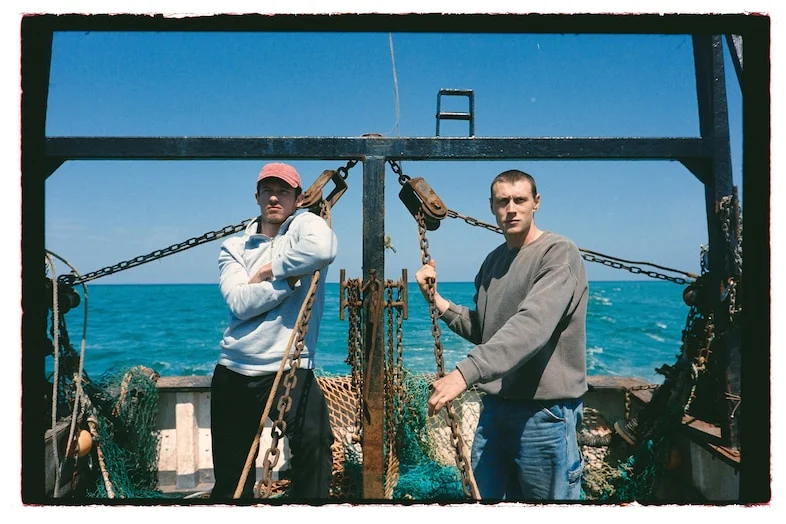
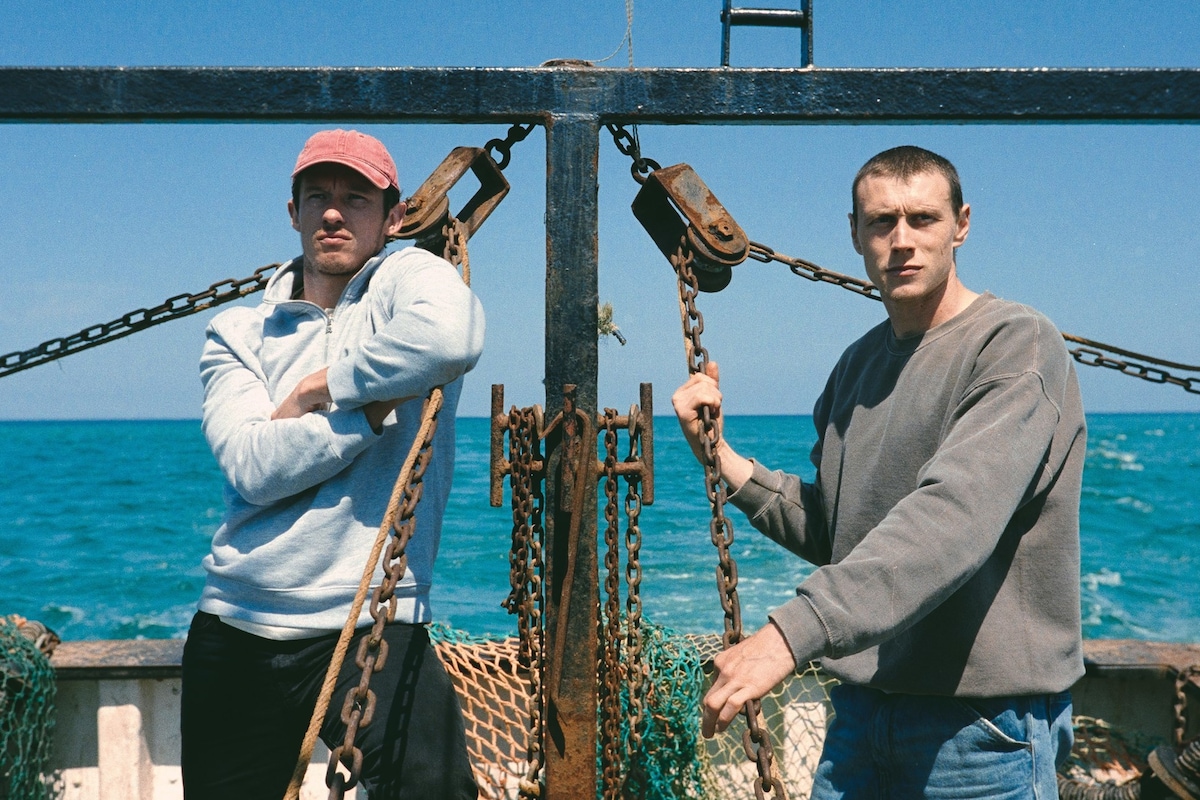
Rose of Nevada plunges audiences into a ghostly mystery interwoven with a time-travel melodrama, all rendered through Jenkin’s distinctive Bolex-shot imagery. The film introduces Nick (George MacKay), a struggling family man seen early on at a food bank, reflecting contemporary socio-economic challenges. Liam (Callum Turner), meanwhile, arrives in a Cornish fishing village without a job or home, a character whose rootlessness mirrors the broader economic anxieties of the region. The village itself, visually depicted with Jenkin’s stark, poetic realism, clearly "has seen better days," an assertion that becomes literalized with the spooky arrival of a boat long believed to be lost.
Ignoring an ominous inscription – "GET OFF THE BOAT NOW" – carved into the vessel’s wood, Nick and Liam embark on a fishing trip that unexpectedly transports them 30 years back in time. They return to the harbour not in 2023, but in 1993, a past where the fishing industry thrives and the building that was once a food bank now bustles as a post office. This narrative device, while central to the plot, serves as a poignant lens through which Jenkin explores deeper societal themes.
Austerity, Social Critique, and Unspoken Intentions
Jenkin, who serves as the film’s sole writer, director, cinematographer, editor, and composer, is notably reticent about elaborating on his precise artistic intentions, mirroring the interpretive freedom championed by his cinematic idol, David Lynch. However, he is explicit in his avowal that Rose of Nevada is not a romanticization of the past. "There’s no better time to be alive in terms of standard of living, life expectancy, tolerance, and the acceptance of difference," he asserts, while immediately qualifying, "Obviously, there’s still so far to go. Austerity did so much damage. I wanted to illustrate that without it being a political statement."
Despite his disinclination to offer definitive interpretations, the film’s portrayal of the socio-economic landscape of 2023 Cornwall, particularly the opening scene depicting Nick at a food bank, functions as a powerful, albeit subtle, political statement. The contrast with 1993, where the food bank has been replaced by a thriving post office, speaks volumes about contemporary challenges. Jenkin is vocal about this specific issue: "Food banks are good and serve a purpose. But the normalisation of food banks is bad. It’s fucking insane that we’re the sixth-biggest economy in the world, and people are relying on food banks. The film flags up that in some ways we’re going backwards." This statement resonates with recent data from organizations like the Trussell Trust, which reported distributing nearly 3 million emergency food parcels between April 2022 and March 2023, a staggering 37% increase from the previous year, highlighting the profound impact of rising living costs and the lingering effects of austerity measures in the UK. Rose of Nevada thus uses its time-travel premise to draw a stark, implicit comparison between two eras, allowing audiences to reflect on the trajectory of societal welfare and economic stability without didacticism.
Character Dynamics and Actor-Director Synergy
The contrasting reactions of Nick and Liam to their temporal displacement form the emotional core of the film. Stranded in 1993, Nick is distraught by the sudden distance from his 2023 family, embodying the anxieties of a man tethered to his present responsibilities. Liam, conversely, readily embraces the past, seamlessly inserting himself into a new household and effectively usurping a dead man’s life. This dynamic is perfectly served by the casting. George MacKay, known for thoughtful, sensitive roles in films like The Beast and The End, brings a profound gravitas to Nick. Callum Turner, whose charismatic presence has even led to speculation about him being the next James Bond, imbues Liam with a rock star energy, making his quick adaptation both thrilling and unsettling.
Interestingly, Jenkin initially envisioned MacKay in the role of Liam. However, a personal meeting reshaped this decision. MacKay recounts, "When I [eventually] met Mark, we didn’t talk about the film once. We talked about our lives. At the end of that, he said I’d be more right for Nick. And it felt right, because Nick behaves the way he does because he’s trying to do what’s best for his family. I haven’t had a role where that’s been at the character’s core before." This collaborative, character-driven approach is a hallmark of Jenkin’s process.
Both MacKay and Turner, already admirers of Bait and Enys Men, were keen to immerse themselves in Jenkin’s idiosyncratic methods. The Bolex-enforced rule of one or two takes per shot presented a unique challenge, pushing the actors to deliver focused, immediate performances. While MacKay prepared meticulously and adhered to his initial ideas, Turner would occasionally explore new interpretations, sometimes requesting a third attempt – earning him the playful moniker "Three-take Turner!" from MacKay. "You develop a real trust in Mark," MacKay explains. "If he’s happy with the first take, you move on. The sparsity of the writing allows for multiple interpretations to be projected onto it, rather than for you to offer a number of definitive interpretations of a line. I knew that a level of neutrality to the delivery would leave it more open to a number of interpretations." Yet, MacKay reiterates the unavoidable social commentary, stating, "The film begins with my character coming into a food bank. It’s set in a world that’s real. That in itself is a political statement: that’s where things are in some places in the UK." MacKay, now 34 and a father of two, notes a profound personal maturation that informs his performance. "In the last few years, I’ve got my own family," he shares. "I’ve matured so much. I just know more. Being a father of two has taught me things about myself. The things I’m still concerned by are no longer that of those younger characters." This personal evolution undoubtedly enriches his portrayal of Nick, a man grappling with his responsibilities in a disorienting reality.
The Art of Unsettling Ambiguity
Jenkin’s cinematic philosophy is deeply influenced by David Lynch’s refusal to overtly explain his films, a stance Jenkin passionately advocates for. He notes that Lynch "realised you can unsettle an audience with sound in a way you can’t do with visuals." While a jump scare might elicit a fleeting reaction, visual terror is often quickly rationalized by the brain. Sound, however, can create a more prolonged, subconscious unease. Jenkin cites Lynch’s technique of layering multiple audio tracks, sometimes with one subtly reversed, creating a disquieting sense that "something’s not right" without the audience consciously knowing why.
He offers an example from his own work, Enys Men, where the ticking clocks in a cottage are deliberately rendered either too quick or too slow, subtly distorting the perception of time. Jenkin also recounts a striking incident during the post-production of Rose of Nevada. A nearly finished version of the film featured his own temporary voice for Callum Turner’s dialogue. "Callum came in one day, did his dialogue, we dropped it in, and it changed the entire film," Jenkin marvels. "It changed George’s performance. [People thought] we recut it. I was like: ‘No, all we did was replace my voice with Callum’s.’ How the fuck does that happen? It’s supernatural." This anecdote underscores his profound belief in the inexplicable power of cinema. "It’s the greatest art form we’ve ever invented, because it’s so keyed into how our minds and subconscious work. But it’s so sophisticated, I don’t understand how it works."
For Jenkin, the refusal to explain is not an act of obfuscation but an essential component of cinematic longevity. Reflecting on David Lynch’s enduring legacy, Jenkin notes that because Lynch didn’t explain the meaning of Twin Peaks, "it will play forever… He leaves us to work it out. That’s what I want to do with my films. A film falls to pieces if you explain the meaning. You kill it. If you don’t understand a film in the moment, it carries on once you leave the cinema." This philosophy ensures his films remain active, evolving entities in the minds of their viewers, sparking ongoing discussion and personal interpretation.
Broader Impact and Future Horizons
Mark Jenkin’s work with Rose of Nevada and his previous films represents a significant voice in contemporary independent cinema. His steadfast commitment to analog techniques and a highly personal, auteurist vision offers a vital alternative to the often homogenized landscape of digital blockbusters and streaming content. By demonstrating that technical limitations can foster immense creativity, and that social commentary can be woven into narrative rather than overtly stated, Jenkin is not only making compelling films but also influencing a new generation of filmmakers and film enthusiasts. His success highlights the enduring power of the theatrical experience and the hunger for unique, artistically driven storytelling. As Rose of Nevada embarks on its cinematic release, followed by its availability on BFI Blu-ray and BFI Player this summer, it promises to further cement Mark Jenkin’s place as a singular talent who is both deeply rooted in cinema’s past and boldly shaping its future.