







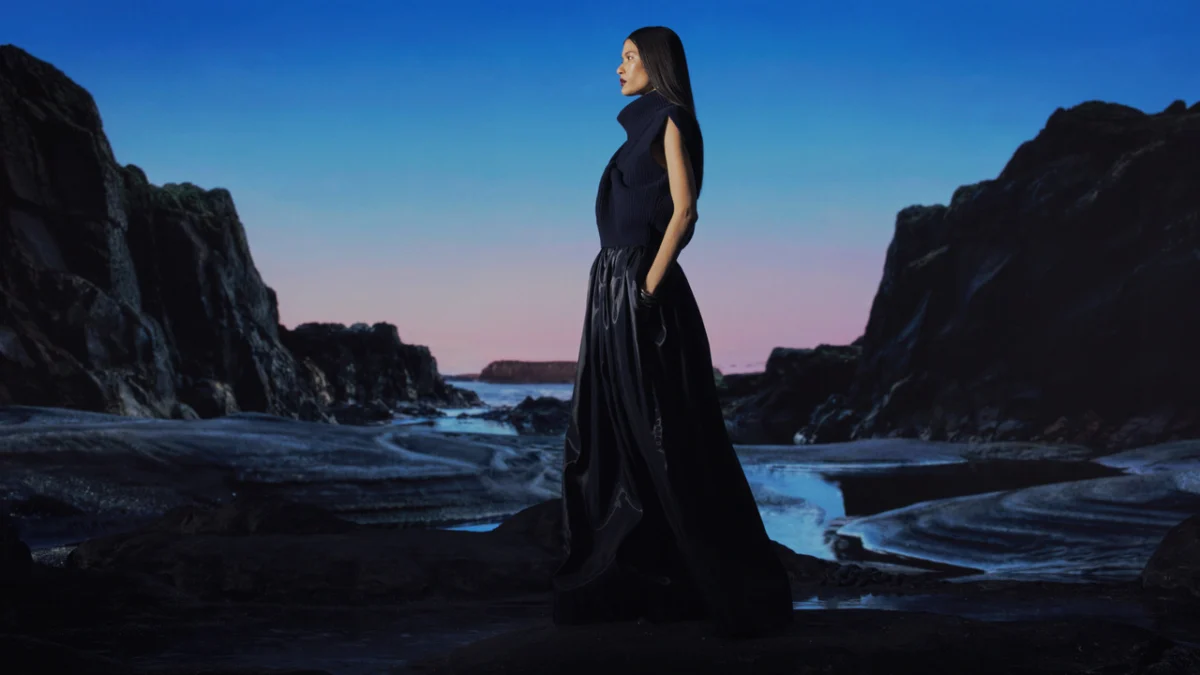
On Saturday, designer Kate Barton unveiled her latest collection at New York Fashion Week, introducing a sophisticated technological layer to the traditional runway experience. In a strategic collaboration with Fiducia AI, Barton integrated a multilingual artificial intelligence agent—developed using IBM watsonx on the IBM Cloud—to transform how attendees interact with her designs. This initiative represents a significant shift in the luxury fashion landscape, moving beyond aesthetic presentation toward an interactive, data-driven consumer experience that bridges the gap between physical garments and digital accessibility.
The activation served as a functional "portal" into Barton’s creative world, allowing guests to use a visual AI lens to identify specific pieces from the collection in real-time. Beyond simple identification, the system provided photorealistic virtual reality try-ons and responded to inquiries via voice and text in multiple languages. This integration aims to solve a long-standing challenge in high-fashion presentations: the disconnect between the fleeting moment of a runway show and the consumer’s ability to engage deeply with the craftsmanship and utility of the items on display.
The Intersection of Haute Couture and High-Performance Computing
The partnership between Kate Barton and Fiducia AI was built on the robust architecture of IBM’s enterprise-grade AI and data platform. Ganesh Harinath, the founder and CEO of Fiducia AI, emphasized that the project was a "production-grade activation" rather than a mere marketing gimmick. To achieve the level of responsiveness and visual fidelity required for a New York Fashion Week (NYFW) presentation, the team utilized IBM watsonx, IBM Cloud, and IBM Cloud Object Storage.
According to Harinath, the primary challenge of the project lay not in the tuning of the AI models themselves, but in the complex orchestration of various technological components. The visual AI lens had to be trained to recognize the unique textures, silhouettes, and avant-garde structures characteristic of Barton’s work. By leveraging IBM watsonx, the developers were able to create a system capable of detecting garments from the new collection and providing instantaneous, context-aware information to users.
This technological stack allowed for a seamless multilingual interface, ensuring that the global audience of NYFW could interact with the collection regardless of their native language. The inclusion of photorealistic virtual try-ons further pushed the boundaries of traditional retail, offering a glimpse into a future where the "try-before-you-buy" model is entirely digitized and accessible from anywhere in the world.
A Chronology of Innovation: Barton’s Progressive Tech Integration
Kate Barton’s decision to incorporate AI into her 2025 presentation is not an isolated event but the latest step in a clear trajectory of technological experimentation. Barton has consistently positioned herself as a designer who views technology as a fundamental tool for storytelling rather than an external additive.
During the previous fashion season, Barton collaborated with Fiducia AI to experiment with AI models, testing the waters for how synthetic intelligence could complement human design. Those early experiments focused on the conceptual side of fashion, exploring how AI could assist in the visualization of complex forms. The 2025 presentation marks a transition from conceptual experimentation to functional, consumer-facing application.
This evolution mirrors the historical adoption of digital tools within the fashion industry. Barton noted that the current skepticism surrounding AI resembles the early days of the internet, when luxury brands were hesitant to establish a web presence for fear of "cheapening" their image. Just as the question shifted from "should we be online?" to "is our online presence effective?", Barton suggests the fashion industry is currently navigating a similar transition with artificial intelligence.
Market Context and the Growth of AI in Fashion
The integration of AI into NYFW comes at a time of rapid growth for the fashion technology sector. According to recent industry data, the global market for AI in fashion is projected to grow at a compound annual growth rate (CAGR) of over 35% through 2030. While many brands have utilized AI for backend operations—such as supply chain optimization, inventory management, and trend forecasting—Barton’s use of the technology is part of a smaller, more visible trend of "Front-End AI" designed to enhance the customer journey.

Market analysts suggest that the fashion industry is currently divided into two camps: those using AI "quietly" to improve internal efficiencies and those using it "publicly" to redefine the brand experience. Barton addressed this divide, noting that many brands remain cautious about public AI usage due to potential reputational risks, including concerns over intellectual property, the loss of human touch, and the "uncanny valley" effect of digital avatars.
However, the collaboration with IBM Consulting highlights the potential for AI to become a "growth engine" for the industry. Dee Waddell, Global Head of Consumer, Travel, and Transportation Industries at IBM Consulting, noted that when product intelligence and real-time engagement are connected, AI provides a measurable competitive advantage. By providing consumers with immediate, personalized data and the ability to visualize themselves in the garments, brands can significantly reduce the friction inherent in luxury retail.
Addressing the Ethical and Creative Implications of Automation
Central to Barton’s philosophy is the belief that technology should heighten craft rather than replace it. In her discussions with TechCrunch, she was adamant that the goal of using AI was to create a sense of curiosity and to "expand the world around the clothes." She emphasized that the "real and the unreal" can coexist in a way that makes the viewer take a "double take," challenging their perceptions of what is possible in garment construction and presentation.
Barton’s stance reflects a broader industry discourse regarding the role of the human creator in the age of generative AI. "If the technology is used to erase people, I am not into it," she stated, emphasizing that audiences are sophisticated enough to distinguish between genuine innovation and the use of technology to avoid the costs of human labor.
The designer argues for a future where there is "clear discourse, clear licensing, clear credit, and a shared understanding that human creativity is not an annoying overhead cost." This perspective is crucial as the industry grapples with the ethics of AI-generated designs and the potential displacement of traditional artisans. For Barton, the most exciting future for fashion is one where tools are used to "deepen storytelling" and "bring more people into the experience" without "flattening" the individuals who manufacture the clothing.
The Roadmap to 2030: Normalizing the Intelligent Runway
As the fashion world looks toward the future, experts like Ganesh Harinath predict that the use of AI in fashion will be fully normalized by 2028. By 2030, the expectation is that AI will be embedded into the operational core of the entire retail sector, moving from a novel feature to a standard requirement for any competitive brand.
The differentiator in the coming years will not necessarily be the existence of the technology itself—as much of it already exists—but the ability of brands to assemble the right partners and operationalize these tools responsibly. The collaboration between Kate Barton, Fiducia AI, and IBM serves as a blueprint for this type of strategic partnership. It demonstrates that when a designer’s creative vision is supported by enterprise-grade cloud infrastructure and sophisticated AI orchestration, the result is a more immersive and inclusive fashion ecosystem.
The TechCrunch event scheduled for October 13-15, 2026, in San Francisco, is expected to further showcase these advancements, as the intersection of Silicon Valley innovation and New York creative industries continues to blur. As fashion presentations evolve, the focus is shifting toward "product intelligence"—the idea that a garment is no longer just a physical object, but a data-rich asset that can be interacted with, customized, and experienced across multiple dimensions.
Ultimately, Kate Barton’s Saturday presentation was more than a display of new clothing; it was a statement on the inevitability of technological integration in high fashion. By embracing AI as a tool for craft and storytelling, Barton is helping to define a new era of "intelligent fashion"—one where the human element remains at the center, empowered by the limitless possibilities of the digital portal. The success of this activation suggests that while the industry may have been slow to start its digital transformation, the move toward an AI-integrated future is now well underway, promising a more interactive, global, and personalized experience for fashion enthusiasts worldwide.