










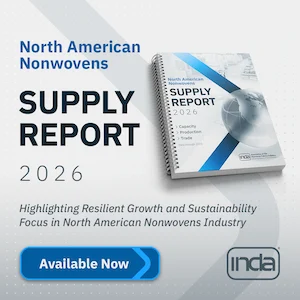
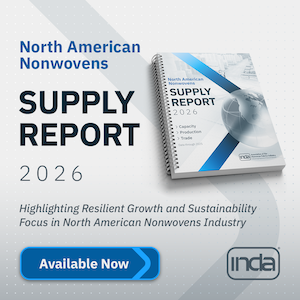
CARY, N.C. — INDA, the Association of the Nonwoven Fabrics Industry, has officially released its 13th annual North American Nonwovens Supply Report, providing a comprehensive and data-driven analysis of an industry navigating a complex intersection of geopolitical pressure and technological evolution. Released on April 15, 2026, the report serves as the definitive benchmark for the nonwovens sector, detailing how the industry performed throughout 2025 and setting the stage for strategic planning through the remainder of the decade. The findings illustrate a sector that, while facing a cooling of production output, remains fundamentally robust, driven by long-term investments in sustainability and capacity expansion across the North American continent.
The 2026 report arrives at a critical juncture for manufacturers, suppliers, and end-users. Following the unprecedented volatility of the early 2020s, the nonwovens market has transitioned into a phase characterized by "cautious optimism." However, this optimism is tempered by significant external variables, most notably global trade uncertainties, fluctuating tariff structures, and heightening geopolitical tensions that have forced a re-evaluation of supply chain logistics. According to the report, these factors contributed to a second consecutive year of slowed production growth in 2025, as industry leaders adopted a "wait-and-see" posture regarding capital expenditures and international trade commitments.
A Chronology of Resilience: From Pandemic Surge to Strategic Stabilization
To understand the current state of the North American nonwovens industry, one must look at the trajectory of the last several years. The industry experienced a historic surge between 2020 and 2022, driven primarily by the global demand for Personal Protective Equipment (PPE), disinfectant wipes, and medical filtration media. This period saw record-breaking production levels and rapid-fire capacity additions.
By 2023 and 2024, the market entered a period of "normalization." The "Global Nonwoven Markets Demand Report," published by INDA in November 2024, signaled that while the post-pandemic "sugar high" had subsided, the baseline demand for nonwoven products had shifted permanently higher. However, 2025 introduced new complexities. The 13th annual supply report highlights that the production slowdown observed last year was not necessarily a sign of waning demand, but rather a strategic pause. Manufacturers were forced to navigate a high-interest-rate environment and the specter of new trade barriers, leading to a focus on operational efficiency over raw volume.
As the industry enters 2026, the narrative has shifted from crisis management to "strategic evolution." The current report notes that while production output moderated in 2025, the industry did not retreat. Instead, it pivoted toward high-value sectors, including durable goods and sustainable materials, ensuring that the infrastructure remains ready for the next wave of economic expansion.
Comprehensive Data and Methodology: Inside the 2026 Report
The 13th annual North American Nonwovens Supply Report is the result of exhaustive primary research conducted by INDA’s market intelligence team. The findings are based on extensive producer surveys and in-depth interviews with key executives and stakeholders across the supply chain. This methodology ensures that the data captures not just the "what" of the industry’s performance, but also the "why."
The report covers the full spectrum of nonwoven production, including:
- Composites and Roll Goods: Detailed tracking of the base materials used in everything from construction to hygiene.
- Capacity and Operating Rates: An analysis of how much the industry can produce versus how much it is currently producing, providing a vital indicator of market health.
- Regional Trade Flows: Specific data regarding the movement of goods between the United States, Canada, and Mexico, highlighting the integrated nature of the North American market under modern trade agreements.
A key takeaway from the data is the continued investment in capacity. Despite the production slowdown, companies are still installing new lines and upgrading existing facilities. This suggests a firm belief in the long-term viability of the North American market, particularly as "near-shoring" becomes a dominant strategy for companies looking to insulate themselves from trans-oceanic shipping disruptions and political instability in distant manufacturing hubs.
Navigating Geopolitical Headwinds and Trade Uncertainty
One of the most significant sections of the 2026 report focuses on the impact of global trade policy. The nonwovens industry is highly sensitive to fluctuations in the cost of raw materials—specifically polymers and fibers—many of which are subject to international trade disputes. The report indicates that the "wait-and-see" environment of 2025 was largely a response to shifting tariff regimes and the uncertainty surrounding international trade agreements.
Geopolitical tensions have also influenced the sourcing of machinery and specialized components. As North American producers seek to reduce reliance on certain overseas markets, there has been a notable shift toward domestic sourcing and regional partnerships. This move toward a more self-reliant North American ecosystem is expected to be a defining trend of the late 2020s.
The Sustainability Mandate: Innovation and Environmental Stewardship
Sustainability is no longer a peripheral concern for the nonwovens industry; it is now a central pillar of corporate strategy. The 2026 report underscores a clear trend toward the development of sustainable and durable products. This shift is driven by both consumer demand and increasing regulatory pressure regarding single-use plastics and waste management.
Innovation in 2025 and early 2026 has focused on:
- Biodegradable Fibers: The integration of natural and compostable materials into traditional nonwoven structures.
- Recycled Content: Increasing the percentage of post-consumer and post-industrial recycled materials in roll goods.
- Durable Applications: A move toward nonwovens used in long-term applications, such as automotive components, geotextiles for infrastructure, and high-performance building materials.
Tony Fragnito, INDA President and CEO, emphasized this transition in his remarks on the report’s release. "We are seeing a clear shift toward sustainable, durable products, alongside continued innovation to meet evolving demand across North America," Fragnito stated. He noted that the industry’s resilience is tied to its ability to adapt to these environmental priorities while maintaining the high performance standards required by medical and industrial end-users.
Leadership Perspectives: Analysis from INDA Executives
The 2026 report is viewed as an essential tool for benchmarking and decision-making. Mark Snider, INDA’s Chief Market and Industry Analyst, highlighted the importance of industry participation in gathering this data. "Strong participation from suppliers is essential to our mission of enhancing the quality and depth of our industry data and insights," Snider said. "As global supply chain pressures intensify, this report examines the key dynamics shaping the market and influencing future direction."
The report’s findings suggest that while the "operating rates"—the ratio of actual production to total capacity—may have dipped slightly in 2025 due to the cautious market environment, the underlying infrastructure is more advanced than ever. The industry is utilizing more automated processes and AI-driven quality control, which allows for greater flexibility in responding to sudden market shifts.
Regional Dynamics: The North American Integration
A unique aspect of the INDA report is its holistic view of North America as a unified trading bloc. The 2026 data shows that the synergy between the United States, Canada, and Mexico remains a cornerstone of the industry’s strength.
- United States: Remains the primary hub for high-tech nonwoven innovation and large-scale capacity for hygiene and medical sectors.
- Mexico: Continues to grow as a vital manufacturing center, particularly for automotive nonwovens and consumer products, benefiting from its proximity to U.S. markets and competitive labor costs.
- Canada: Plays a crucial role in specialized industrial applications and the supply of raw wood pulp and other bio-based materials essential for sustainable nonwoven production.
The report suggests that the integration of these three markets provides a buffer against global shocks. When one region faces labor shortages or localized disruptions, the others often provide the necessary slack to keep the overall supply chain moving.
Future Outlook: Strategic Implications for 2027 and Beyond
Looking ahead, the 13th annual North American Nonwovens Supply Report paints a picture of an industry poised for a rebound. The "wait-and-see" period of 2025 has allowed companies to clean up their balance sheets, optimize their supply chains, and invest in the next generation of manufacturing technology.
As trade policies stabilize and the industry’s sustainability initiatives begin to reach scale, INDA anticipates a return to more robust production growth. The demand for nonwoven materials in filtration—both for air and water—is expected to be a major growth driver as global environmental standards tighten. Furthermore, the aging population in North America will continue to drive steady demand for hygiene and medical nonwoven products.
For stakeholders, the report serves as a reminder that while short-term headwinds are inevitable, the structural importance of nonwoven fabrics to modern life ensures long-term stability. From the masks that protect healthcare workers to the filters that ensure clean air in homes and the materials that make vehicles lighter and more fuel-efficient, nonwovens remain an indispensable part of the industrial landscape.
The full 13th annual North American Nonwovens Supply Report is available to participating producers at no cost, while INDA members receive an Executive Summary as a benefit of their membership. For those looking to navigate the complexities of the 2026 market, the report provides the data-driven foundation necessary to turn "cautious optimism" into actionable strategy. Detailed information regarding the report and other market intelligence products can be found on the INDA website, which continues to serve as the primary resource for the nonwovens industry worldwide.