









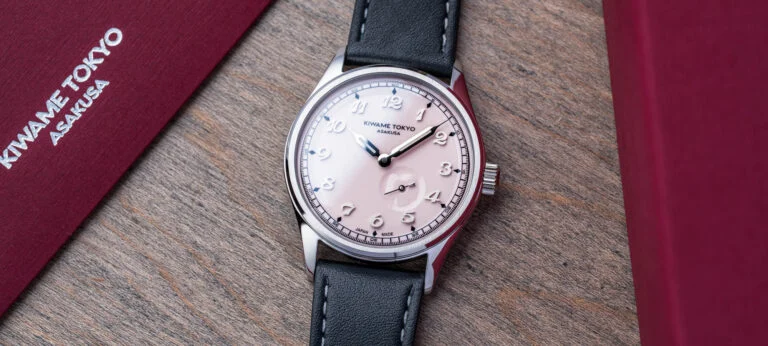
The emergence of Kiwame Tokyo in the global horological landscape has been marked by a rapid, consistent pattern of commercial success, with the brand’s latest offerings frequently achieving "sold-out" status shortly after market entry. Since its inception just last year, the brand has navigated a path defined by accessible pricing and a distinct aesthetic identity rooted in its home base of Asakusa. The Kiwame Tokyo Kubo, particularly the Sakura edition, represents a strategic shift for the manufacturer, moving beyond the functional, conservative designs of its debut releases toward a more nuanced, identity-driven design language that characterizes the brand’s ongoing maturation.

Chronology of Brand Development and Market Entry
Kiwame Tokyo entered the market with a series of watches that emphasized build quality and value proposition, quickly establishing a foothold among entry-level luxury collectors. The initial product releases—the Iwao and the Mune—were praised for their technical reliability and clean, minimalist aesthetics. However, industry observers noted a certain homogeneity in these early models, as the brand leaned heavily on standardized case designs.
The chronology of these releases highlights a deliberate pace:

- 2025 (Q3): Debut of the brand with the Iwao, establishing the signature stainless steel case architecture.
- 2026 (Q1): Introduction of the Mune model, which expanded on the brand’s identity with minor adjustments to the 12-hour marker and handset.
- 2026 (Q3): Release of the Kubo model, marking the first significant deviation in case geometry and dial complexity.
- 2026 (Q4): Subsequent launch of the Yane model, which further refined the brand’s design lexicon, signaling a broader creative evolution.
The Kubo model, specifically, served as a bridge between the company’s foundational designs and its more adventurous future iterations. By reducing the case size to 37mm in diameter with a 10.7mm profile and 45mm lug-to-lug distance, Kiwame Tokyo addressed consumer demand for more compact, versatile timepieces.
Technical Specifications and Design Philosophy
The Kubo collection is defined by a departure from the larger, more utilitarian footprints of its predecessors. While the case retains the polished and brushed finish transitions that have become a hallmark of the brand, the reduction in size—achieved in part by adjusting the water resistance from 100 meters to 30 meters—reflects a pivot toward a dress-watch profile.

The movement powering the Kubo is the Miyota 82S5, a Japanese-made automatic caliber. Operating at a frequency of 21,600 vibrations per hour (vph), the movement is a workhorse in the mid-range horological sector, known for its longevity and ease of service. While factory-regulated to an accuracy of -20/+40 seconds per day, the brand’s choice to use a solid, engraved caseback rather than an exhibition back maintains a sense of mystery and emphasizes the exterior craftsmanship over the industrial movement.
The dial design of the Kubo represents a notable investment in artisanal detailing. The Sakura edition, in particular, incorporates a recessed small seconds sub-dial at the base, which provides the model its name—Kubo, translating to "a hollow or recessed space." The inclusion of an embossed cherry blossom motif within this sub-dial, combined with applied Breguet numerals and a lacquer-like finish, demonstrates an effort to integrate Japanese cultural symbolism into a modern, minimalist framework.

The Role of Limited Production and Market Demand
One of the most compelling aspects of the Kiwame Tokyo narrative is the velocity at which its inventory is depleted. In an industry where many brands face challenges with inventory turnover, Kiwame has managed to sustain high demand without resorting to aggressive or high-expenditure marketing campaigns.
Market analysts suggest that this phenomenon is driven by a combination of factors:

- Scarcity Economics: The brand’s "batch release" strategy limits the number of units available at any given time, fostering a sense of urgency among collectors.
- Cultural Resonance: By grounding its design elements in local history, such as the Kaminarimon gate of Asakusa—represented in the counterbalance of the hands—the brand creates an emotional connection with enthusiasts of Japanese watchmaking.
- Value-to-Price Ratio: At a retail price point of $630 USD, the Kubo is positioned in a highly competitive bracket, offering high-end finishing techniques—such as lacquer dials and applied numerals—that are rarely found at this price point.
Industry Implications and Future Outlook
The transition observed from the early Iwao models to the more complex Kubo and the subsequent Yane suggests that Kiwame Tokyo is actively refining its brand identity. The introduction of the blue "Tetsukon" and pink "Sakura" colorways alongside the original "Usuki" (creamy white) indicates that the brand is moving toward a strategy of color-based storytelling.
However, the brand’s approach to certain technical features, such as the application of luminescent material, has been a point of critical discussion. While the use of lume is intended to enhance functionality, the current implementation—which is reportedly modest in brightness—suggests that the brand may still be balancing the aesthetic desire for clean, dress-style dials with the practical requirements of a daily-wear watch.

The decision to sacrifice 70 meters of water resistance in exchange for a slimmer profile is a calculated risk. It prioritizes style and wearability for the office or formal environments over the "go-anywhere, do-anything" (GADA) versatility that the Iwao and Mune models provided. For Kiwame, this represents a segmenting of its portfolio, allowing the brand to appeal to a wider range of collectors with varying functional needs.
Official Response and Upcoming Releases
While representatives from Kiwame Tokyo have maintained a relatively low profile regarding their corporate strategy, the brand has confirmed that the high demand for the Kubo has necessitated a return to production. Following the initial sell-out of the current batch, a new series is scheduled for pre-order in October 2026. This move is expected to alleviate some of the pressure on the secondary market and allow the brand to continue its expansion into international markets.

The success of the Kubo serves as a case study in the current state of micro-brand horology. By successfully bridging the gap between traditional Japanese design motifs and accessible, modern manufacturing, Kiwame Tokyo has carved out a niche that emphasizes character and intentionality. As the brand continues to develop its design language, the challenge will be to maintain the quality and exclusivity that have defined its initial years while scaling production to meet the growing global interest. For now, the Kubo remains a significant indicator of the brand’s potential to evolve into a permanent fixture within the entry-level luxury market.