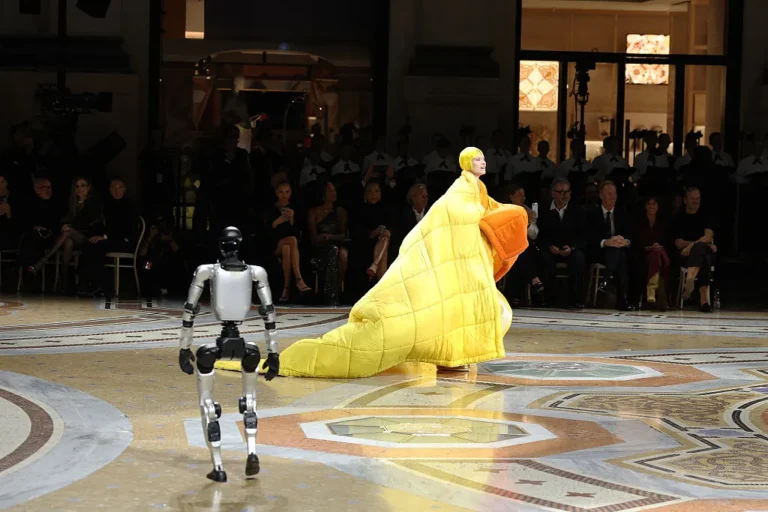







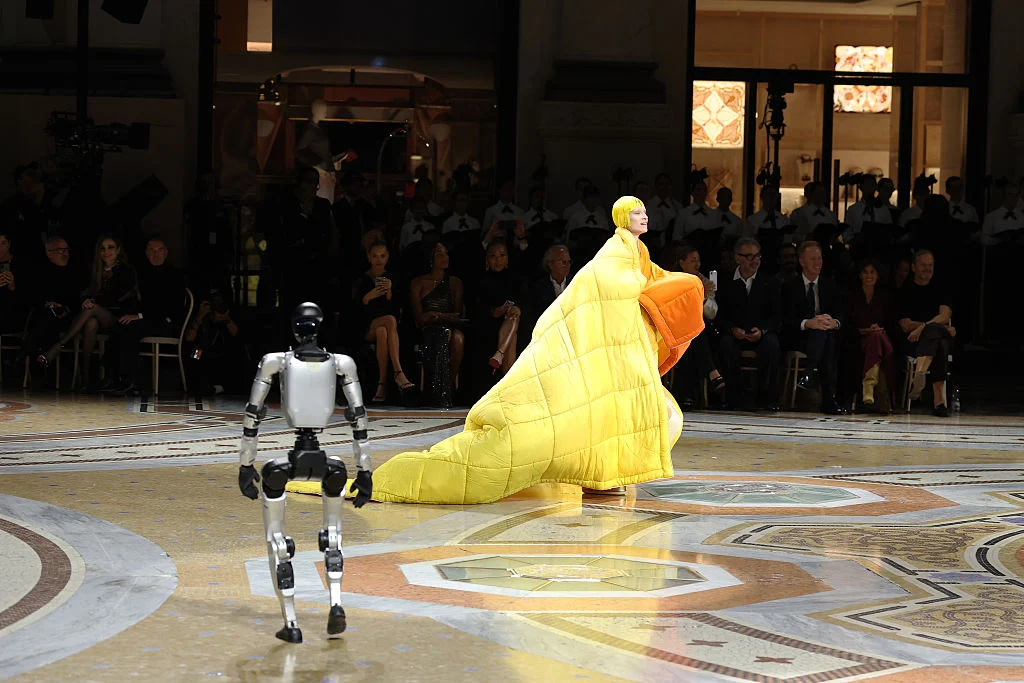
The grand finale of Vogue World’s Milan edition this past week featured an unexpected and polarizing spectacle: a troupe of unclad humanoid robots marching down the historic cobblestones of the Galleria. Billed ostensibly as a tribute to Italian craftsmanship and the enduring value of the human touch in an increasingly automated world, the inclusion of these machines instead sparked a global conversation about the uneasy marriage between high fashion and Silicon Valley. Manufactured by the Chinese robotics firm Unitree, the mechanical performers waived their arms, attempted rudimentary dance routines to Gigi D’Agostino’s “L’Amour Toujours,” and inadvertently upstaged the entire sartorial collection they were meant to complement. As fashion critics and industry insiders watched from the front rows, the visibly pained expression of Valentino creative director Alessandro Michele quickly went viral, serving as an unintended emblem for an industry—and a public—grappling with the rapid, often jarring acceleration of technological integration.
This striking moment highlights a broader, multi-year strategic pivot by Condé Nast and Vogue editor-in-chief Anna Wintour. As Vogue World prepares to bring its fifth annual traveling spectacle to San Francisco next year, the publication’s deepening financial and cultural alignment with the tech elite has moved from the boardroom to the runway. Sponsored in part by Meta Glasses with supplementary support from OpenAI, the Milan event underscored the commercial imperatives driving legacy media outlets to court the world’s most affluent technology titans. Yet, arriving amid a persistent global cost-of-living crisis and rising anxieties regarding artificial intelligence, labor displacement, and digital surveillance, the deployment of naked humanoid robots has laid bare a profound cultural disconnect between the custodians of luxury culture and the broader populace.
Anatomy of a Traveling Spectacle: Background and Evolution
Launched five years ago, Vogue World was conceived as a multi-format cultural hybrid designed to adapt to the modern media landscape. Moving fluidly between a traditional runway presentation, a star-studded celebrity showcase, a theatrical variety hour, and a high-yield advertising platform, the event has established a tradition of staging high-profile productions in major global capitals. Prior to its arrival in Milan, the traveling extravaganza made stops in New York, London, Paris, and Hollywood, cementing its status as one of the fashion industry’s premier marketing vehicles.
Each iteration typically anchors itself to the cultural heritage of its host city. The Milan showcase was heavily marketed as an ode to Italian artisanal mastery, celebrating the tactile, labor-intensive traditions of European tailoring and design. This thematic foundation made the mid-show pivot to "The Age of Intelligence" act particularly jarring. Rather than reinforcing the narrative of human craftsmanship, the unannounced integration of Unitree’s autonomous machines introduced a discordant note that overshadowed the garments themselves. Industry observers noted that in the days following the event, public discourse centered almost exclusively on the robotic performance rather than the physical collections presented by participating Italian houses.
A Decade-Long Convergence: The Chronology of Tech and Fashion
The friction observed in Milan is not an isolated occurrence, but rather the latest milestone in a decade-long courtship between the fashion establishment and the technology sector. The institutional bridge-building can be traced back significantly to 2015, when Apple’s then-Chief Design Officer, Jony Ive, co-hosted the Met Gala alongside Anna Wintour, signaling a formal acknowledgment of Silicon Valley’s rising cultural capital.
Over the subsequent ten years, this relationship has evolved from occasional cross-industry collaborations into deep financial and institutional partnerships. Technology executives and venture capitalists have increasingly assumed positions of patronage traditionally held by industrial magnates and traditional aristocracy. This trajectory culminated in notable recent developments, including high-profile tech figures securing prominent media coverage—such as splashy Vogue wedding covers—and anticipated co-chair roles at flagship industry events like the Met Gala. Publications facing structural shifts in advertising revenue and print distribution have increasingly looked to the tech sector for financial sustainability, leveraging Vogue’s unparalleled cultural influence and exclusive access in exchange for corporate sponsorship and modernization.
Industry and Public Reactions: A Polarizing Divide
The public and private responses to Vogue World Milan exposed deep ideological fractures within both the creative and technological communities. While corporate leadership and brand sponsors celebrated the forward-looking aesthetic, creative professionals voiced sharp dissent regarding the messaging and implications of robotic integration on the runway.

Social media platforms immediately amplified the discontent, with attendees and digital commentators sharing clips of the performance alongside commentary highlighting the perceived tone-deafness of the spectacle. Industry analysts pointed out the contrast between celebrating automated labor and the ongoing socio-economic pressures faced by ordinary households globally. Private reactions from tech founders and startup strategists echoed these concerns, with several industry participants expressing frustration that the normalization of humanoid robotics in luxury contexts trivializes the very real economic anxieties tied to job displacement and labor restructuring.
Fashion journalists and brand strategists interviewed following the event questioned the artistic coherence of the presentation. Critics argued that the deployment of functional, uncostumed hardware failed to engage with the sophisticated potential of creative technology, opting instead for a sensationalist novelty that detracted from the integrity of the design work on display.
Redefining Innovation: Beyond the Novelty of Automation
Industry experts specializing in early-stage technology and creative design argue that the Milan runway performance represented a superficial engagement with the capabilities of modern engineering. Commentators note that contemporary creative technologists are pioneering sophisticated applications of artificial intelligence, material science, and interactive design that far surpass the capabilities of commercially available dancing robots.
Examples of more nuanced intersections between fashion and technology include the work of artist duos such as AA Murakami, whose engineering-driven designs—such as ephemeral bubble structures featured at high-profile cultural events—explore the philosophical and temporary nature of art and human experience. Similarly, previous high-fashion collections, such as Schiaparelli’s Spring 2024 couture line incorporating vintage microchips and crystal-encrusted robotic motifs, demonstrated how technological components could be thoughtfully synthesized with traditional couture techniques. By comparison, the inclusion of generic, unadorned humanoid robots was viewed by many critics as a missed opportunity to showcase genuine innovation, reducing complex technological advancements to a theatrical gimmick.
Broader Implications and Outlook for Vogue World San Francisco
As Vogue World looks toward its upcoming edition in San Francisco—frequently cited as a primary epicenter of the global technology industry—the stakes for the publication’s strategic positioning are exceptionally high. The choice of location is widely interpreted as a deliberate nod to the tech barons who increasingly influence global commerce and culture.
The integration of Meta Glasses sponsorship and OpenAI support in Milan, combined with the impending relocation to Northern California, suggests that Condé Nast intends to double down on its technological partnerships. However, the hostile reception and widespread critique of the Milan robot performance indicate that bridging the gap between Silicon Valley utility and haute couture aesthetics remains fraught with cultural friction.
Ultimately, the event has catalyzed a wider debate regarding the responsibilities of cultural institutions during a period of rapid technological and economic transition. Whether Vogue World San Francisco will refine its approach to address these critiques or lean further into automated spectacle remains to be seen. What is clear, however, is that the convergence of fashion and technology is no longer a peripheral experiment, but a central—and fiercely contested—battleground for the future of cultural authority.