










The Timex Atelier Chronograph, a significant new release from the venerable American watchmaker, marks a pivotal moment for the brand’s premium Atelier collection. Spearheaded by the visionary design lead Giorgio Galli, this latest offering introduces a compelling dual approach: a sophisticated chronograph available in both automatic mechanical and precise quartz variants. This strategic release, focusing on the Timex Atelier Chronograph Automatic M1a Ti and its steel counterpart, the Timex Atelier Chronograph Quartz M1q, represents an ambitious evolution for Timex, blending high-end design principles with accessible luxury. The Automatic M1a Ti, specifically, stands out with its titanium construction and accompanying bracelet, positioning itself as a benchmark for intricate design and material quality within its price bracket.

Genesis of the Atelier Collection
The Atelier collection is intrinsically linked to the legacy of Giorgio Galli, whose eponymous sub-collection for Timex previously yielded some of the brand’s most celebrated and exquisitely crafted timepieces. Though the Galli line has concluded, its design ethos has been meticulously integrated into the Atelier concept, which debuted in 2025 with the Timex Atelier Marine M1a diver watch. This was followed by a Timex Atelier GMT watch, and the Chronograph series now represents the third and arguably most visually audacious chapter in this evolving narrative. Galli’s approach consistently emphasizes a nuanced fusion of traditional horological values, original design language, contemporary manufacturing techniques, and a pragmatic understanding of market value. This commitment to creating timepieces that are not only aesthetically pleasing but also offer substantial value has become a hallmark of the Atelier line, appealing to a discerning clientele that appreciates both form and function.
Design Philosophy and Material Innovation
The Timex Atelier Chronograph exemplifies a thoughtful balance between European design sensibilities and American market pragmatism. While many luxury watch brands pursue increasingly stratospheric price points, Timex, under Galli’s direction, prioritizes delivering exceptional craftsmanship and materials at a price that respects the consumer. This philosophy is particularly evident in the differentiation between the Automatic M1a and the Quartz M1q models.

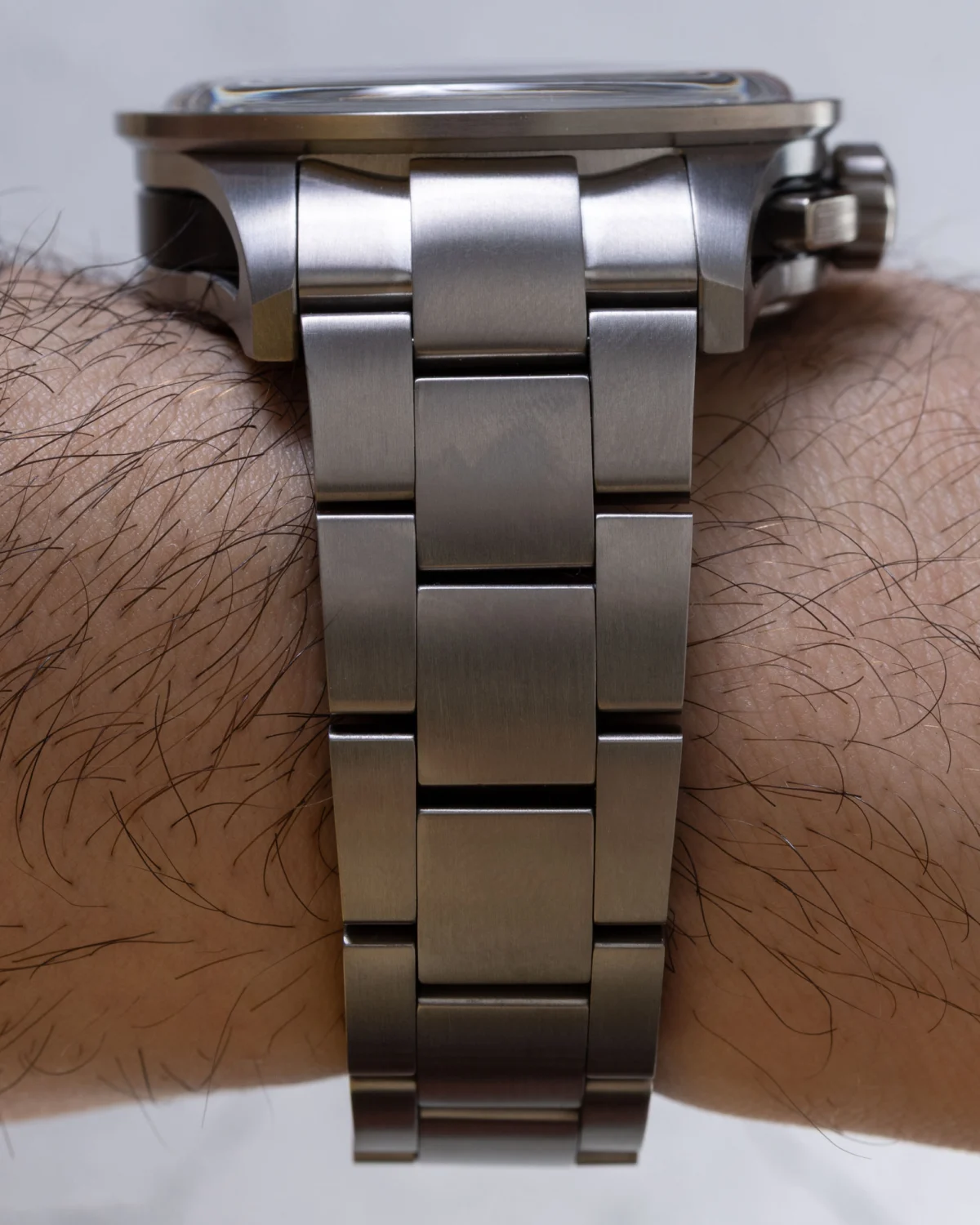
The flagship Timex Atelier Chronograph Automatic M1a Ti features a lightweight yet robust titanium case and an optional matching titanium bracelet. Titanium offers a distinct advantage in terms of weight reduction – approximately 30% lighter than steel – and possesses a unique, subtly deeper gray hue compared to the brighter polish of stainless steel. The bracelet itself is a marvel of user-friendly engineering, designed with tool-free sizing. Its links are equipped with a spring-loaded mechanism that allows for easy adjustment with the fingertips, a significant convenience in an era where many consumers purchase watches online and need to size them at home. This intuitive system addresses a common pain point, making the watch immediately wearable for a wider audience.
In contrast, the Timex Atelier Chronograph Quartz M1q utilizes a stainless steel case and bracelet. While steel is a more traditional material, it offers a brighter aesthetic and greater scratch resistance compared to the often softer titanium. The steel variant also boasts superior water resistance, rated at 100 meters, whereas the titanium model is rated for 50 meters. This distinction highlights Timex’s attention to detail in tailoring each variant to specific user needs and preferences.

Technical Specifications and Movement Choices
The heart of the Timex Atelier Chronograph Automatic M1a Ti is a Swiss Made Landeron caliber L72 movement. This automatic chronograph movement, closely related to the ubiquitous ETA Valjoux 7750, operates at a frequency of 4Hz (28,800 vibrations per hour) and provides a power reserve of approximately 43 hours. The movement features a subsidiary seconds dial and a 30-minute chronograph counter, enabling precise timekeeping and stopwatch functionality.
The Timex Atelier Chronograph Quartz M1q is powered by a Swiss Made Ronda quartz movement, known for its reliability and accuracy. While quartz movements offer a more accessible price point and reduced maintenance, they lack the mechanical complexity and heritage of an automatic caliber. Notably, the quartz version includes a date display at the 6 o’clock position, a feature absent on the automatic model.

Both models share a case diameter that, while officially listed as 40mm, can appear larger due to the bezel extending to 42mm. The overall thickness of the automatic model is approximately 15mm, a necessary dimension to accommodate the automatic chronograph movement. A sapphire crystal, in a box style, protects the dial, contributing to the watch’s visual appeal and durability while allowing for a slightly lower bezel profile. The caseback of the automatic version features a sapphire crystal window, offering a glimpse of the intricate Landeron movement within.
Dial Design and Aesthetic Considerations
The dial of the Timex Atelier Chronograph is where Giorgio Galli’s design prowess truly shines, blending vintage racing aesthetics with contemporary minimalism. The design language evokes the spirit of 1960s and 70s automotive chronographs, a period known for its bold and functional watch designs. The dial features contrasting gray subdials and hands, ensuring legibility, set against a primary black background. The bezel insert is crafted from black steel and incorporates a tachymeter scale, a nod to the chronograph’s performance-oriented heritage. While the numerals on the tachymeter are small, reflecting their largely decorative purpose in modern times, they contribute to the overall vintage racing aesthetic.

A distinctive characteristic of Galli’s design philosophy, as observed in this collection, is the deliberate omission of luminous material. While some may view this as a drawback for low-light visibility, Galli’s approach prioritizes the purity of the dial’s aesthetic. This decision reflects a commitment to a specific design vision, catering to enthusiasts who value an unadulterated visual experience over the functional utility of lume. This purist approach underscores the Atelier Chronograph’s positioning as a design-led piece rather than a purely utilitarian tool. The hour markers, presented as subtle indentations on an inner ring, are understated and blend seamlessly with the overall minimalist design, though they can be challenging to discern in certain lighting conditions. Despite this, the dial’s surfaces are captivating, interacting dynamically with light to create a visually rich experience.
Strategic Pricing and Value Proposition
The pricing strategy for the Timex Atelier Chronograph series is a key element of its appeal. The Timex Atelier Chronograph Quartz M1q is accessible, starting at $700 USD for the strap version and $800 USD for the matching steel bracelet. This positions it as a competitive option for those seeking a stylish and reliable Swiss-made quartz chronograph.

The Timex Atelier Chronograph Automatic M1a Ti, however, represents a more significant investment, priced at $2,100 USD on a black strap and $2,250 USD on the matching titanium bracelet. While this price point places it in a more premium segment, the article argues that it offers exceptional value for money. The combination of a Swiss automatic chronograph movement, titanium construction, and sophisticated design elements is rarely found at this price point. This strategy demonstrates Timex’s ambition to compete in the higher echelons of the watch market by offering compelling products that deliver tangible quality and design innovation without succumbing to exorbitant pricing.
Broader Implications and Market Position
The Timex Atelier Chronograph collection signals Timex’s ongoing commitment to elevating its brand perception and product offerings. By leveraging the design expertise of Giorgio Galli and focusing on premium materials and mechanical movements, Timex is challenging traditional notions of its market position. The Atelier line, particularly with releases like the Chronograph, aims to capture the attention of watch enthusiasts who appreciate both heritage and contemporary design, as well as those seeking luxury timepieces with a strong value proposition.

The success of this collection could influence Timex’s broader strategy, potentially leading to further exploration of higher-end mechanical watches and collaborations that push design boundaries. In a competitive watch market, the Atelier Chronograph stands out as a testament to Timex’s ability to innovate and deliver sophisticated, thoughtfully designed timepieces that offer a compelling alternative to established luxury brands. The collection’s ability to appeal to both seasoned collectors and newcomers to the watch world, by offering distinct choices in terms of movement and materials, is a strategic advantage.
A Companion for Discerning Travelers: The Discommon Goods "The Puck"
Complementing the sophisticated design of the Timex Atelier Chronograph Automatic M1a Ti, the article highlights the Discommon Goods "The Puck," a premium single-watch travel case. This accessory, inspired by classic automotive interiors with its racing green exterior and black and white houndstooth lining reminiscent of vintage Porsche 356 models, embodies a similar ethos of style and functionality. The Puck’s robust construction, featuring wet-formed Napa leather and a secure zipper closure, is designed to protect timepieces, especially those with bracelets that may not fit well in flatter cases. Its durable yet elegant design makes it an ideal companion for transporting watches like the titanium Atelier Chronograph. The Puck is priced at $115 USD, offering a blend of high-quality materials and thoughtful design for watch enthusiasts on the go.