










The global textile manufacturing sector is preparing for a significant technological shift as members of the Swedish Textile Machinery Association (TMAS) prepare to unveil a suite of advanced solutions at the ITM 2026 exhibition in Istanbul, Türkiye, from June 9-13. Leading the Swedish delegation is imogo, which will introduce its Dye-Max spray dyeing technology following the successful launch of its new showroom and test center in Sweden. This exhibition comes at a critical juncture for the textile industry, which is grappling with the dual pressures of increasing production costs and the urgent need for sustainable manufacturing practices. The Swedish contingent, known for integrating advanced process control with intelligent automation, aims to provide Turkish manufacturers with the tools necessary to maintain a competitive edge in an increasingly crowded global market.
The Strategic Importance of the Turkish Textile Hub
Türkiye has long served as a vital bridge between the European and Asian textile markets. Its industry is characterized by a deeply integrated value chain that begins with raw fiber production and extends through to high-end garment manufacturing. This domestic ecosystem is supported by a skilled workforce and decades of technical expertise in weaving, knitting, and finishing. However, the sector has faced headwinds in recent years. By 2025, rising energy prices and labor costs, combined with intense competition from lower-cost manufacturing hubs in Southeast Asia, forced many Turkish firms to re-evaluate their operational efficiencies.

According to TMAS Secretary General Therese Premler-Andersson, the enduring strength of the Turkish sector lies in its ability to adapt. "Türkiye remains a powerhouse because of its tightly connected ecosystem," Premler-Andersson noted. "The industry benefits from a massive domestic infrastructure and a legacy of export experience. However, to stay ahead, the focus must shift toward long-term industrial reliability and resource-saving technologies. Our members are heading to Istanbul specifically to address these needs."
imogo and the Revolution in Spray Dyeing
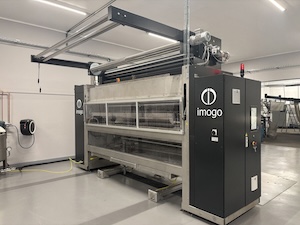
One of the most anticipated reveals at ITM 2026 is imogo’s Dye-Max system, located at Stand 305 in Hall 3. The technology represents a departure from traditional textile dyeing methods, which are notoriously resource-intensive. Traditional jet dyeing requires vast amounts of water and energy to heat dye baths and move fabric through the liquor. In contrast, the Dye-Max utilizes a precision spray process that drastically reduces the environmental footprint of the finishing stage.
Data provided by imogo indicates that the Dye-Max achieves a 90% reduction in water consumption and a corresponding 90% reduction in energy use compared to conventional methods. These savings are primarily attributed to the system’s extremely low liquor ratio of just 0.5 liters per kilogram of fabric. Christian Moore, executive partner and board member at imogo, explained that the system’s efficiency also extends to chemical usage.
"The spray process requires significantly less auxiliary chemistry to begin with," Moore stated. "Because the application is so precise, all of the chemistry is utilized in the process. This minimizes wastewater production to a negligible amount—only about 20 liters are required for a wash during a changeover." Furthermore, the low liquid content within the fabric after spraying means that far less energy is required for fixation and drying, ensuring that manufacturers can meet high-quality standards without the traditional overhead of massive utility bills. This technology has already seen real-world application, with a Dye-Max unit recently commissioned for a major H&M supplier in Bangladesh, proving its scalability for high-volume industrial use.
Automatex: Precision and Automation in Home Textiles
As labor costs rise, automation has become a necessity rather than a luxury. Automatex is addressing this shift with the introduction of the P12-PB Automatic Lock Stitch Quilting Unit. This platform is specifically engineered for the high-volume production of bedding and padded home textiles, sectors where Türkiye has a dominant market share.
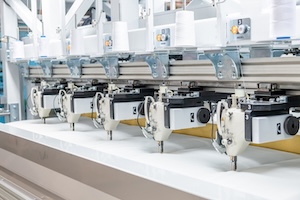
The P12-PB system is designed to minimize manual intervention through a sophisticated automation architecture. The unit feeds fabric and filling directly into a quilting module equipped with twelve modified servo-driven lock stitch sewing heads. These heads are arranged in two programmable banks of six, allowing for a level of flexibility previously unseen in mass production. Manufacturers can switch between straight-line quilting and complex geometric patterns without the need for mechanical changeovers, which significantly reduces downtime.

Technical specifications for the P12-PB highlight its industrial prowess:
- Operating Speed: Up to 12 meters per minute.
- Filling Weight Compatibility: 100 to 450 gsm.
- Stitch Length: Adjustable between 3 and 4 mm.
- Needle Spacing: 21.7 cm for standard configurations.
To maximize uptime, each sewing head includes an automatic bobbin case changer and a thread break detector. If a thread snaps or a bobbin runs out, the system can automatically intervene or alert the operator via a color touch screen interface. Furthermore, the system is equipped with remote access capabilities, allowing Swedish technicians to provide real-time troubleshooting and support to Turkish factories without the need for on-site visits.
Eltex: Ensuring Quality Through Real-Time Monitoring
Quality assurance is the third pillar of the Swedish showcase. Eltex of Sweden will present its latest electronic yarn sensors and tension monitoring systems in Hall 7, Stand 706a. As production speeds in weaving and tufting increase, the margin for error shrinks. A single broken yarn or an uneven tension spike can lead to costly defects or machine downtime.
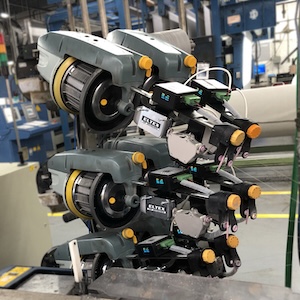
The centerpiece of the Eltex display will be the ACT-Multi system. This technology provides independent monitoring for each yarn channel, ensuring precise tension across processes such as heat setting. The system uses a predefined reference tension and can automatically stop the machine if the yarn behaves outside of preset limits.
Additionally, Eltex will showcase the ACT-R system, specifically designed for rapier weaving machines. This system is particularly relevant for the modern market, which is seeing an influx of recycled fibers. Recycled yarns often have irregular textures and strengths, making tension control difficult. The ACT-R system stabilizes these yarns, as well as high-value technical yarns like Kevlar, ensuring that the final fabric meets the rigorous standards required for industrial and protective applications.
IRO Gauge Parts and the Evolution of Tufting
The tufting industry, a major segment of the Turkish textile landscape—particularly in regions like Gaziantep—will find interest in the offerings from IRO Gauge Parts (a Vandewiele company) in Hall 7, Stand 710a. Since moving its gauge parts manufacturing to Sweden in 2020 following the acquisition of Cobble, the company has focused on precision grinding and controlled hardening to produce high-durability components.
IRO will highlight its "semi-module" concept, which aims to combine the efficiency of modular systems with the precision performance of single hooks. This hybrid approach allows carpet and rug manufacturers to maintain high speeds while ensuring consistent loop heights and cut qualities. The move of production to Sweden has allowed IRO to implement full traceability and improved accuracy in its manufacturing process, a critical factor for Turkish producers who operate 24/7 and require components that can withstand long-term wear.
Chronology of Innovation and Market Entry
The presence of TMAS at ITM 2026 is the result of a multi-year strategic roadmap focused on sustainability and digitalization.
- 2020: IRO Gauge Parts consolidates manufacturing in Sweden, upgrading its production technology to meet modern tufting demands.
- 2023-2024: imogo develops and refines the Dye-Max technology, focusing on the "minimum application" principle to solve the water scarcity issues facing the global textile industry.
- 2025: Swedish manufacturers report increased interest from the Turkish market as local producers face record-high energy costs, leading to the commissioning of initial pilot systems in the region.
- May 2026: imogo opens its new showroom in Sweden, providing a permanent hub for international clients to test the Dye-Max system.
- June 2026: The official launch of these integrated technologies at ITM Istanbul.
Economic Implications and Industry Analysis
The adoption of Swedish technology in Türkiye carries significant economic implications. For Turkish manufacturers, the primary benefit is a reduction in Total Cost of Ownership (TCO). While the initial capital expenditure for automated and resource-efficient machinery may be higher than traditional alternatives, the reduction in utility costs and waste disposal fees provides a rapid Return on Investment (ROI).
Furthermore, as the European Union—Türkiye’s largest export market—tightens its environmental regulations through the "Green Deal" and the Circular Economy Action Plan, Turkish manufacturers must prove their sustainability credentials. Technologies like the Dye-Max provide a quantifiable way for factories to report lower carbon footprints and water usage to their European brand partners.
Therese Premler-Andersson noted that while 2025 was a difficult year for the Turkish industry, the current environment is ripe for "forward-thinking" investment. "The difficulties caused by rising costs have actually accelerated the move toward high-tech solutions," she said. "Companies that invest now in automation and resource efficiency are the ones that will dominate the next decade of textile production."
The upcoming ITM 2026 exhibition serves as more than just a trade show; it is a barometer for the future of the industry. The Swedish delegation’s focus on "intelligent automation" and "long-term reliability" suggests a move away from the "fast fashion" manufacturing model toward a more sustainable, high-precision industrial framework. For the Turkish textile sector, these innovations offer a path to remain the primary supplier for Europe while navigating the complexities of a resource-constrained global economy.