








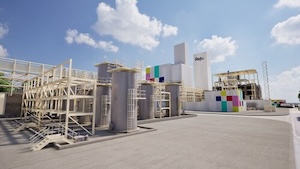
In a landmark move for the European circular economy, Reju, a pioneer in textile-to-textile regeneration technology, has officially been awarded €135 million in funding through the Netherlands’ Nationale Investeringsregeling Klimaatprojecten Industrie (NIKI) program. This substantial financial injection is earmarked for the development and operation of Reju’s first industrial-scale "Regeneration Hub," situated within the Chemelot Industrial Park in Sittard-Geleen. The announcement, made in early April 2026, marks a transformative moment for the textile industry, signaling a shift from experimental recycling pilots to large-scale, commercially viable circular production. The funding covers both the initial investment phase and the long-term operational costs, providing the financial security necessary for Reju to move toward a final investment decision and begin the construction of a facility that aims to redefine the lifecycle of polyester-based materials.
A Strategic Investment in Industrial Decarbonization
The NIKI program, administered by the Dutch Ministry of Economic Affairs and Climate, is the Netherlands’ primary vehicle for financing large-scale industrial projects that contribute to carbon neutrality and resource efficiency. By awarding Reju one of the largest grants in the program’s history, the Dutch government is placing a significant bet on the company’s ability to solve one of the most pressing environmental challenges: the management of post-consumer textile waste.
The textile industry is currently responsible for approximately 10% of global greenhouse gas emissions and 20% of global clean water pollution. Polyester, a petroleum-based synthetic fiber, accounts for more than half of all fiber production worldwide. However, the vast majority of polyester textiles—particularly those that are blended or heavily treated—end up in landfills or incinerators at the end of their life. Reju’s Regeneration Hub is designed specifically to address these "difficult-to-recycle" fractions, converting them into high-quality circular intermediates that can replace virgin, fossil-based polyester in the global supply chain.
Patrik Frisk, CEO of Reju and former chief executive of Under Armour, emphasized the importance of this public-private partnership. "We are grateful to the Government of the Netherlands and the Ministry of Economic Affairs and Climate for supporting the scale-up of commercial technologies that can deliver measurable emissions reductions and accelerate the transition to a truly circular textile industry," Frisk stated. He further noted that the Chemelot facility would serve as a "replicable blueprint," suggesting that the Sittard-Geleen site is only the first in a series of global hubs intended to localize textile recycling and reduce the carbon footprint associated with long-distance waste transport.
The Role of Chemelot Industrial Park
The selection of Chemelot Industrial Park as the site for Reju’s first industrial hub is a strategic choice rooted in the park’s existing infrastructure and its reputation as a center for chemical innovation. Located in the Limburg province, Chemelot is one of Europe’s largest integrated chemical sites, home to a dense ecosystem of research institutions, logistics providers, and energy-efficient utility networks.
For Reju, the "plug-and-play" nature of Chemelot offers several advantages:
- Shared Utilities: The hub can tap into existing high-capacity power grids, water treatment facilities, and steam networks, reducing the initial capital expenditure and improving operational efficiency.
- Logistical Synergy: Sittard-Geleen’s central location in Western Europe provides easy access to major textile collection markets in Germany, France, and the Benelux region, ensuring a steady stream of feedstock.
- Innovation Integration: The proximity to the Brightlands Chemelot Campus allows Reju to collaborate with materials scientists and engineers to continuously refine their regeneration processes.
The integration into an established industrial ecosystem is expected to accelerate the ramp-up phase, allowing Reju to begin processing significant volumes of textile waste shortly after construction is completed.
Technical Innovation: The Reju Process
At the heart of the new Regeneration Hub is Reju’s proprietary textile-to-textile technology. Unlike traditional mechanical recycling, which often results in "downcycling" (where textiles are turned into lower-value products like insulation or rags), Reju’s process focuses on chemical regeneration. This allows the company to break down polyester-containing textiles at the molecular level, removing dyes, finishes, and contaminants that typically hinder recycling efforts.
The resulting output, branded as "Reju Polyester," is a circular intermediate that is chemically identical to virgin polyester but carries a significantly lower environmental price tag. Preliminary data indicates that Reju Polyester delivers approximately 50% lower carbon emissions compared to traditional virgin polyester produced from crude oil. This material is then reintroduced into the downstream supply chain, where it can be spun into new yarns and woven into fabrics for apparel, home textiles, and industrial applications.
By focusing on "difficult-to-recycle" materials—such as multi-fiber blends and textiles with complex finishes—Reju is filling a critical gap in the circularity market. While pure polyester recycling has seen some advancement, the ability to process post-consumer waste at an industrial scale remains the "holy grail" of the sustainable fashion movement.
Chronology of Development and Future Milestones
The path to the €135 million NIKI award has been characterized by several years of intensive research and pilot testing.
- 2023-2024: Reju established its core technology and began small-scale pilot operations to prove the viability of its chemical regeneration process.
- Late 2024: The company identified Chemelot as the preferred site for its first commercial-scale plant, citing the park’s commitment to becoming the first circular chemical site in Europe.
- 2025: Reju underwent a rigorous vetting process by the Dutch government and independent auditors to qualify for the NIKI program, demonstrating the project’s potential for significant CO2 reduction and its alignment with EU circular economy directives.
- April 2026: Official announcement of the €135 million funding award.
- 2026-2027 (Projected): Final investment decision (FID) followed by the commencement of construction at the Sittard-Geleen site.
- 2028 (Projected): Commissioning of the Regeneration Hub and the first commercial shipments of Reju Polyester to brand partners.
Economic and Environmental Impact Analysis
The socio-economic implications of the Reju project extend far beyond the borders of the Chemelot Industrial Park. The construction and operation of the Regeneration Hub are expected to create hundreds of high-skilled jobs in the Limburg region, ranging from chemical engineering and plant management to logistics and supply chain specialized in waste management.
Environmentally, the impact is even more profound. The European Union’s Strategy for Sustainable and Circular Textiles mandates that by 2030, textile products placed on the EU market must be long-lived, recyclable, and largely made of recycled fibers. Reju’s facility directly supports these mandates by providing the infrastructure necessary to meet the increasing demand for recycled content.

Furthermore, the diversion of textiles from incineration has a dual benefit. First, it prevents the release of CO2 and other pollutants associated with burning synthetic fibers. Second, it reduces the demand for "virgin" petroleum, effectively decoupling the textile industry from the fossil fuel sector. If the 50% carbon reduction target is met at scale, the Chemelot hub could offset hundreds of thousands of tons of CO2 equivalent annually.
Industry Reactions and Broader Implications
The announcement has been met with enthusiasm from across the textile and chemical sectors. Industry analysts suggest that the NIKI funding represents a shift in how governments view the "waste" industry—not as a burden to be managed, but as a source of valuable raw materials for the future.
Loek Radix, CEO of Chemelot, welcomed the news, noting that Reju’s presence strengthens the park’s position as a leader in the energy and raw materials transition. "The arrival of Reju fits perfectly with our ambition to be a circular hub. We are moving away from traditional chemistry toward a future where waste is our feedstock," Radix noted in a statement following the announcement.
Retailers and apparel brands are also watching closely. As global brands face increasing pressure from consumers and regulators (such as the EU’s Extended Producer Responsibility or EPR schemes), the availability of traceable, high-quality circular polyester is a critical requirement. Reju’s emphasis on fully traceable circular supply chains ensures that brands can verify the origin and environmental impact of the materials they use, a key factor in avoiding "greenwashing" allegations.
Conclusion: A Blueprint for the Global Textile Industry
The €135 million investment in Reju’s Regeneration Hub is more than just a financial transaction; it is a proof of concept for the future of manufacturing. By integrating advanced chemical regeneration into an existing industrial ecosystem, Reju is demonstrating that the circular economy is not a distant ideal but a present-day industrial reality.
As the project moves toward its operational phase, the eyes of the global textile industry will be on Sittard-Geleen. The success of this hub will likely determine the speed at which similar facilities are deployed across Europe and North America. In an era where resource scarcity and climate change are defining the corporate landscape, Reju’s mission to "regenerate the world’s textiles" has moved one significant step closer to fruition, backed by the industrial might and strategic vision of the Netherlands.