









The Convergent Vision: Miuccia Prada and Raf Simons’ Evolving Partnership
The collaboration between Miuccia Prada and Raf Simons, announced in April 2020, marked a significant shift in the luxury fashion landscape. Simons, celebrated for his minimalist yet intellectually charged menswear, joined Prada, a house synonymous with intellectual fashion and a subtly subversive aesthetic, under a co-creative directorship. This unprecedented arrangement brought together two of fashion’s most influential minds, initially prompting questions about how their distinct voices would coalesce. Over thirteen seasons, however, their partnership has blossomed into an organic synthesis, where the boundaries of individual authorship have progressively blurred.
Their early collections, while demonstrating a clear dialogue between their styles, still allowed for discernible traces of each designer’s signature. Yet, with each subsequent season, a remarkable fusion has occurred, culminating in the SS27 menswear presentation where their shared vision was so absolute that their official press quotes were attributed to both, reflecting a truly unified creative entity. This evolution is not merely a testament to their personal synergy but also a strategic masterstroke by Prada, positioning the brand at the vanguard of collaborative design and intellectual discourse in fashion. Their ability to speak as one voice, particularly on such a critical topic, amplifies their message and reinforces Prada’s reputation as a thought leader.
Milan Fashion Week: A Stage for Innovation and Influence
Milan Fashion Week (MFW) holds a venerable position in the global fashion calendar, alongside Paris, London, and New York. It is a vital platform for Italian luxury brands, contributing significantly to Italy’s economy and maintaining its status as a fashion capital. MFW’s menswear editions, in particular, are keenly watched for their ability to forecast trends and set the tone for the coming seasons. Prada’s show is consistently one of the most anticipated events, often dictating the aesthetic and philosophical undercurrents that permeate the broader industry. The decision by Prada and Simons to use this prominent stage to deliver such a forthright critique of "useless design" underscores their commitment to sparking meaningful dialogue and influencing the very fabric of fashion’s future. The impact of their pronouncements during MFW extends beyond mere seasonal trends, often shaping conversations around sustainability, design ethics, and consumer values for months to come.
The Immersive Experience: From Invitation to Runway
The lead-up to the SS27 show began with an intriguing invitation, foreshadowing the collection’s central theme of "Clarity." Guests received long, translucent rods, subtly branded with the Prada logo. A flick of a switch transformed these rods into LED light sticks, a playful yet symbolic gesture. Were they being invited to a rave, as some speculated, or was this a literal illumination, a call for clarity in an often-obscured industry? The latter proved to be the more pertinent interpretation.
Upon arrival at the Fondazione Prada, the brand’s iconic show venue, guests found a space completely transformed, as is characteristic of Prada’s seasonal spectacles. The LED light sticks from the invitations reappeared in full-scale, becoming integral to the immersive environment. Rows upon rows of fluorescent tubes illuminated the room from beneath a transparent floor, casting a stark, almost clinical glow. This brilliant, sterile light immediately evoked a sense of transparency and precision. Guests’ seats were arranged in a deliberate, maze-like formation of parallel and perpendicular lines, creating a sense of ordered complexity within the luminous space. The still, expectant atmosphere, bathed in this intense, unwavering light, set the perfect stage for a collection intended to cut through noise and complication. This meticulous staging was not merely aesthetic; it was a physical manifestation of the "Clarity" the designers sought to bring to fashion, guiding attendees through an experience that mirrored the collection’s ethos of directness and fundamental design.
A Star-Studded Front Row and Global Reach
The front row of Prada’s SS27 show was a powerful convergence of global influence, highlighting the brand’s expansive appeal across entertainment, film, and music. Perennial "Prada boys" like Australian singer-songwriter Troye Sivan and actor Louis Partridge (known for his role in Enola Holmes) lent their youthful, sophisticated presence. They were joined by Club Kid director Jordan Firstman, Hamnet actor Noah Jupe, and Ruaridh Mollica, star of the critically acclaimed 2024 queer coming-of-age film Sebastian. This curated assembly of talent reflects Prada’s strategic engagement with cultural tastemakers who embody a certain intellectual and artistic sensibility.
However, the most electrifying presence came from the K-pop sensation Enhypen. Members Jay, Jake, Sunghoon, Sunoo, Jungwon, and Ni-Ki caused an "absolute meltdown" outside the venue, with throngs of waiting fans losing their minds at the sight of the idols. This phenomenon underscores the immense marketing power of K-pop stars in the luxury fashion arena. Brands like Prada leverage their colossal global fanbases, translating social media engagement into unparalleled visibility and desirability, particularly among younger, digitally native consumers. The fan frenzy outside the Fondazione Prada was a clear demonstration of this potent synergy, generating widespread media coverage and social media buzz.
Adding another layer of cultural relevance, the show also saw the attendance of NBA stars. Jarred Vanderbilt of the Los Angeles Lakers arrived in a stylish patterned camp collar shirt, while Anthony Edwards of the Minnesota Timberwolves opted for a simpler white shirt and stonewash trouser combination. This inclusion of basketball luminaries signifies Prada’s broadening appeal beyond traditional fashion circles, tapping into the mainstream popularity of sports figures, especially following the increased visibility of basketball in fashion through collaborations and celebrity endorsements. This diverse front row not only ensured widespread media attention but also mirrored the collection’s universal message of fundamental fashion, applicable to a broad spectrum of individuals.
The Collection: ‘Clarity’ as an Antidote to Complication
The "Clarity" collection itself was a masterclass in understated subversion and precise tailoring, directly embodying the designers’ stated philosophy. The runway opened with a striking statement: Julia Nobis, a long-time Prada muse, appeared in slimline white denim and an oversized blazer, her hair styled in pigtails. She was immediately followed by a male model, her aesthetic doppelganger, also in pigtails and head-to-toe black leather. This initial pairing subtly blurred gender lines and set a tone of quiet rebellion against conventional expectations, suggesting a unified human form beneath the garments.
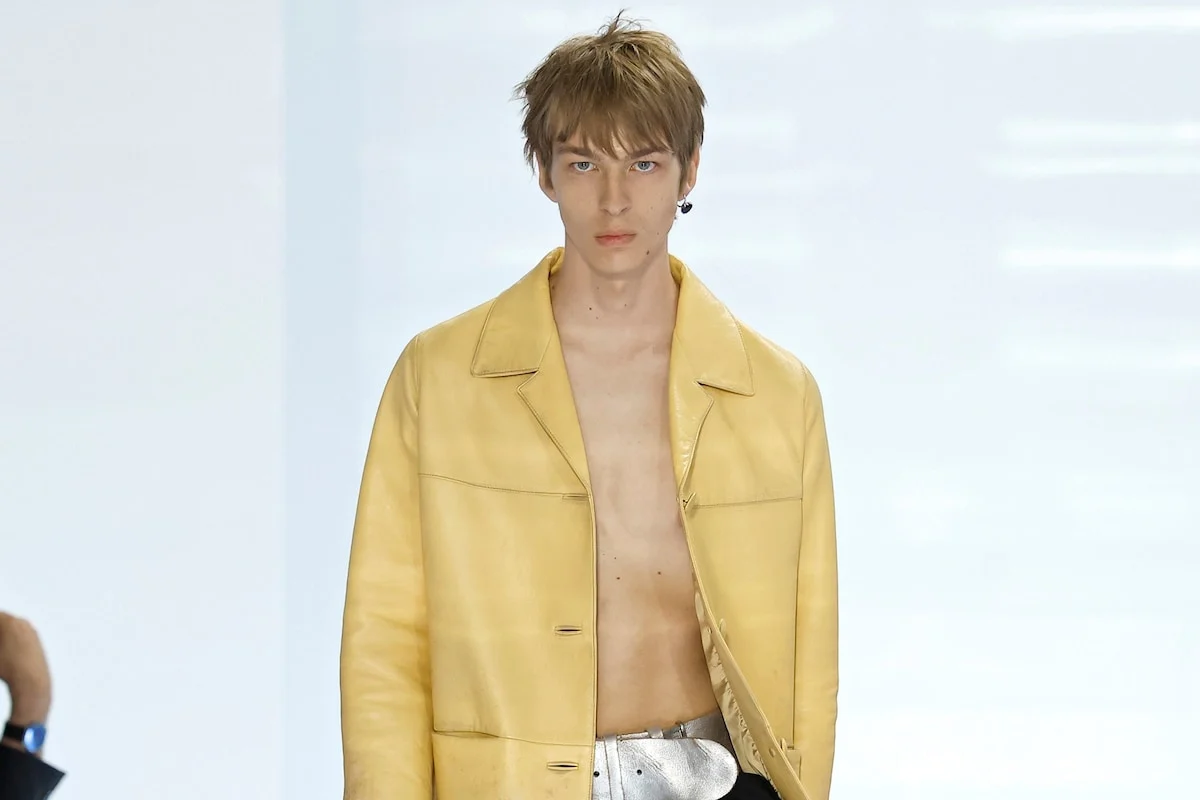
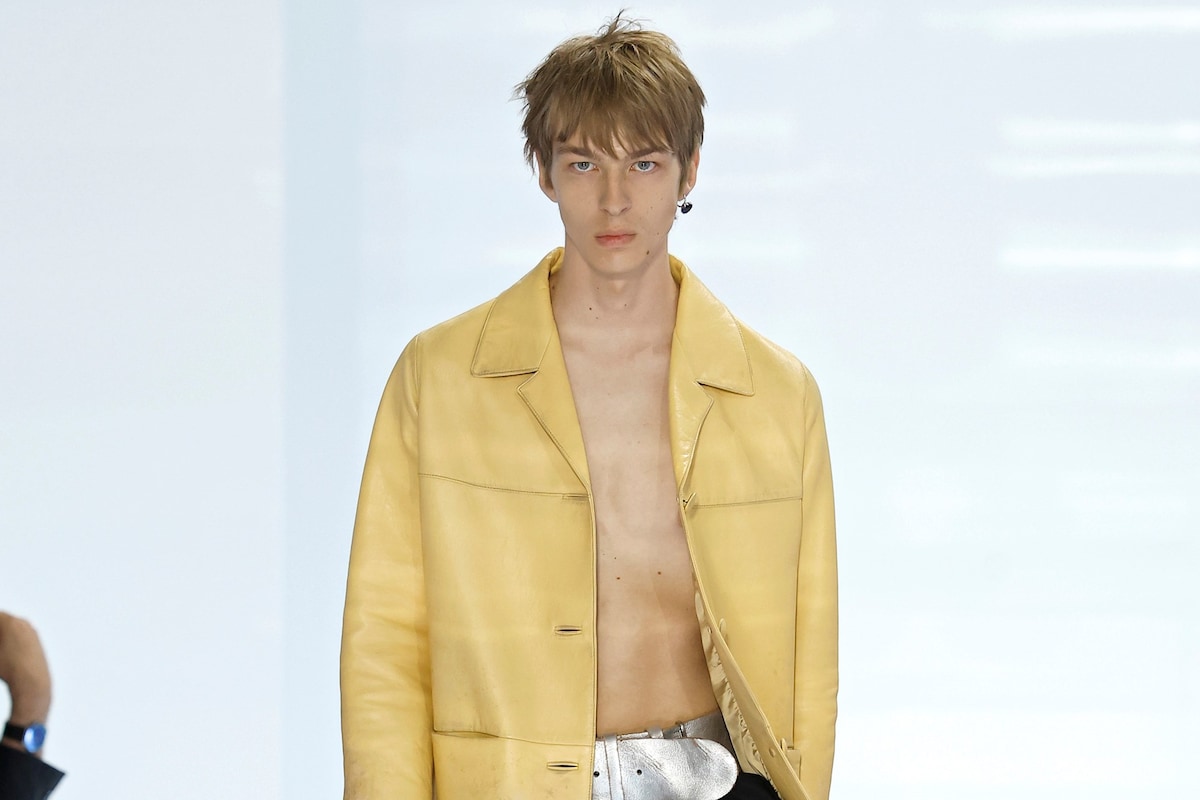
What followed was an exercise in classic Prada design, infused with the modern vigour and intellectual precision characteristic of Raf Simons. The collection was dominated by close-cut silhouettes that skimmed the body, offering subtle, sexy flashes of hip, particularly through strategically placed cut-outs or low-slung waistlines. Wardrobe staples, such as sweater vests and leather jackets, were subtly reproportioned, their familiar forms given a fresh, subversive twist without resorting to overt gimmickry. This careful re-evaluation of classic pieces spoke to the idea of fundamental fashion – taking the essential and refining it to reveal new possibilities.
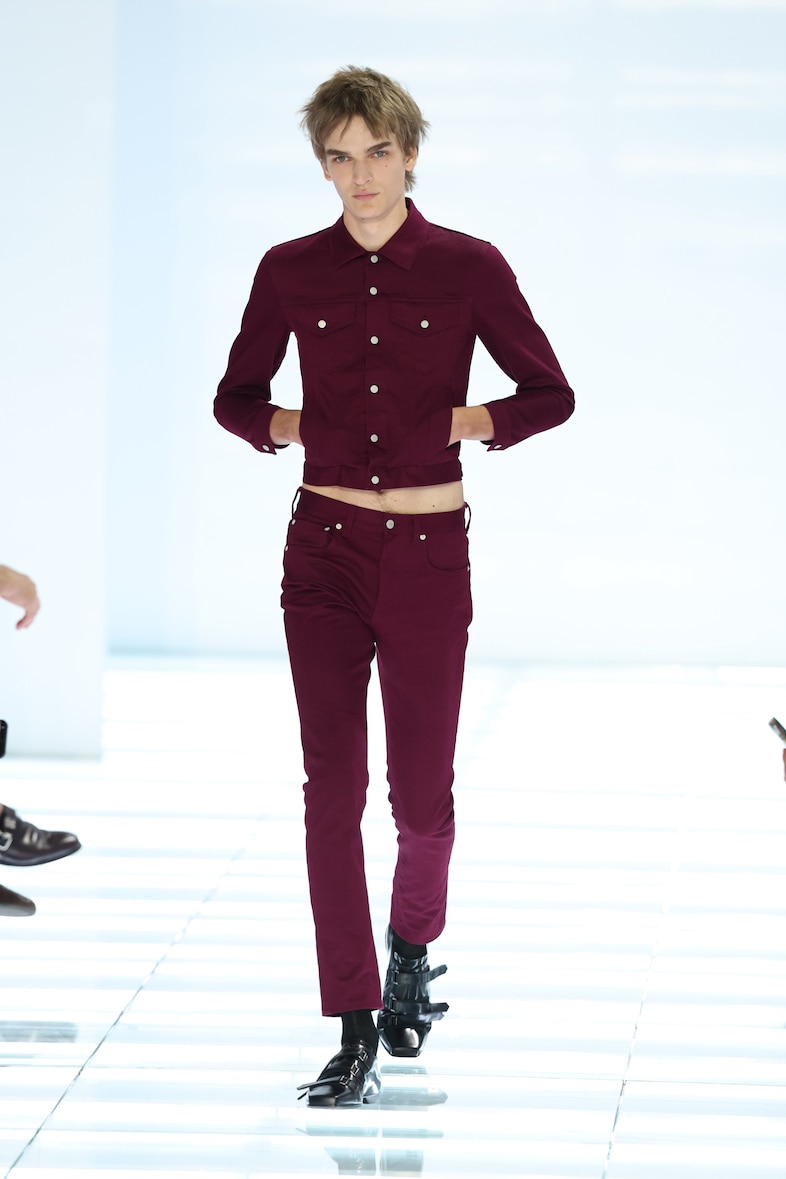
A distinct air of "slick efficiency and wastelessness" emanated from the collection. There were "barely any bells and whistles," and garments were constructed with "just enough fabric to constitute the garments themselves," reflecting a conscious move away from excessive material or superfluous ornamentation. This minimalist approach was not about austerity but about maximizing impact through precision and restraint. The most aesthetically daring moments arrived with the see-through shirts and trousers, where skeleton-like seams were joined by translucent fabric, creating an almost anatomical deconstruction of tailoring. These pieces offered a literal interpretation of "clarity," revealing the underlying structure of the garment and, by extension, the body beneath. Complementing this transparency were clashing, 70s-inspired prints, boldly worn together on tight trousers and brash knits, adding a touch of vibrant, almost defiant, individuality to the otherwise streamlined collection. These elements, while visually striking, were integrated with a clear purpose, avoiding any sense of "useless design."
The Philosophy: Prada’s Call to ‘K.I.S.S.’ and Denouncement of ‘Useless Design’
The profound philosophical undercurrent of the SS27 collection was articulated by Miuccia Prada and Raf Simons in their post-show statement. They revealed that "Clarity" was centred on the concept of "fundamental fashion," positioning it as an "antidote to complication" prevalent in modern design. Their ambition, they stated, "was to do something new with ‘nothing’ – against exaggeration, against complex material." The most striking and provocative declaration, however, was their direct condemnation: "Against useless design. There is nothing that I hate more in this period than useless design – this collection expresses this concept."
This potent declaration immediately brought to mind the "K.I.S.S." acronym, a design principle famously associated with aerospace engineer Kelly Johnson: "Keep It Simple, Stupid." The essence of K.I.S.S. posits that most systems perform best when they are least complex, suggesting that extraneous add-ons often introduce more problems than they solve. Prada and Simons are unequivocally transferring this engineering principle to the realm of high fashion. "Useless design," in their lexicon, appears to encompass anything that adds unnecessary complexity, embellishment, or material without enhancing the garment’s fundamental purpose, aesthetic clarity, or longevity. This could range from purely trend-driven, ephemeral details to excessive ornamentation that detracts from the form or function. Their collection, with its streamlined silhouettes, precise tailoring, and thoughtful material choices, stands as a direct manifestation of this philosophy – a testament to the power of stripped-back, purposeful design. By rejecting the superfluous, they argue for a more intelligent, enduring, and perhaps even more sustainable approach to fashion.
Broader Implications and Industry Resonance
The unified stance of Miuccia Prada and Raf Simons against "useless design" carries significant implications for the wider fashion industry. As leaders of one of the most influential luxury houses, their pronouncement is likely to spark introspection among designers, brands, and consumers alike. In an era increasingly grappling with issues of sustainability, overproduction, and fast fashion’s environmental toll, Prada’s call for "fundamental fashion" resonates deeply. It suggests a move away from transient trends and towards investment in well-designed, enduring pieces that transcend seasonal fads.
This philosophy aligns with a growing consumer demand for transparency, authenticity, and responsible production. While Prada operates at the pinnacle of luxury, its intellectual leadership often trickles down, influencing broader market trends and design sensibilities. Other brands may be prompted to re-evaluate their design processes, focusing more on utility, craftsmanship, and timelessness rather than novelty for its own sake. The emphasis on "wastelessness" and "slick efficiency" in the collection subtly echoes principles of circular design and resource consciousness, which are becoming imperative for the industry’s future.
Prada’s "Clarity" collection and its accompanying manifesto serve as a powerful reminder that fashion, at its best, is not merely about clothing but about culture, ideas, and purposeful innovation. By articulating their "hate" for "useless design," Prada and Simons are not only defining their own aesthetic for SS27 but are also challenging the industry to consider its ethical and creative responsibilities. Their unified vision offers a streamlined, precise, and intellectually rigorous pathway forward, potentially inspiring a renewed focus on the essence of design and the enduring value of truly fundamental fashion.