







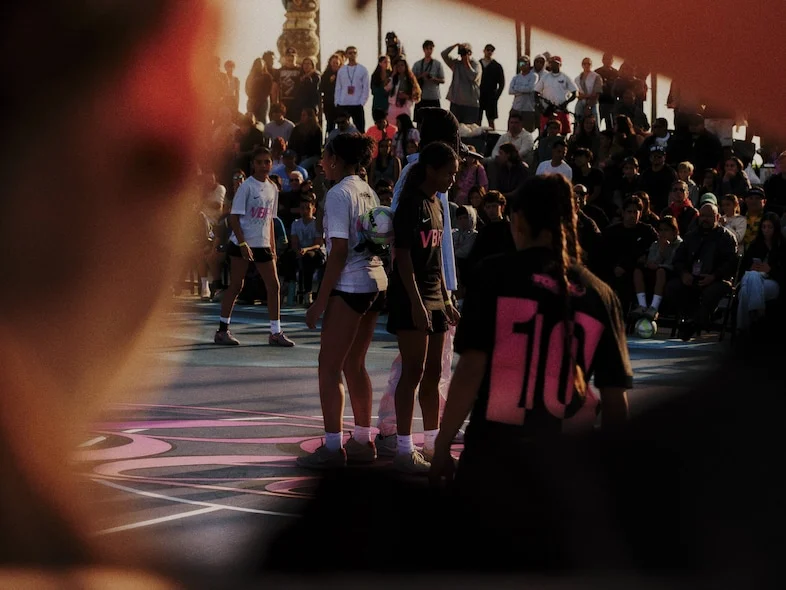
As the sun dipped below the Pacific horizon, casting long shadows across the iconic Venice Beach boardwalk, the vibrant energy of Los Angeles surged under the glow of stadium lights. On a balmy May evening in 2026, something extraordinary unfolded: the third stop of Nike’s "TOMA La Noche" tour, a dynamic night edition of its small-sided street football movement. This particular event, hosted by the deeply rooted Venice Beach Football Club (VBFC), transformed a culturally charged stretch of concrete into a pulsating arena where four young players per side battled for supremacy, watched by a captivated city and the keen eyes of professional scouts. This initiative, more than just a series of tournaments, has rapidly become a cultural touchstone, re-imagining the beautiful game for a new generation by seamlessly integrating music, food, and fashion into the sporting spectacle.
The Genesis of "TOMA El Juego": Reclaiming the Pitch
The "TOMA El Juego" (Take the Game) movement first launched in Los Angeles in June 2025, born from Nike’s strategic response to a long-whispered question within the global football community: What does the sport truly look like when it’s returned to its rightful owners – the people? This wasn’t about the meticulously groomed academy prospects or the structured league systems. Instead, it was a deliberate pivot towards the raw, unadulterated passion of players honing their craft in parking lots, schoolyards, and urban concrete canvases. These are the "diamonds in the rough," often overlooked by traditional scouting networks, whose talent thrives in the improvisational, fast-paced environment of street football.
Nike, a brand with a storied history deeply interwoven with football through iconic advertising campaigns, innovative product development, and a long-standing commitment to youth sports, recognized a unique opportunity. "TOMA La Noche" added an entirely new dimension to this engagement. Far from merely formalizing the inherent energy of street football, these electrifying, community-building events were conceived as powerful cultural catalysts. The aim was to redefine the "juego bonito" – the beautiful game – for contemporary urban youth, creating an immersive experience where athletic prowess met artistic expression. The platform’s success in its inaugural year in Los Angeles quickly propelled its expansion, reaching diverse metropolises such as Seoul, Mexico City, Lima, Miami, and Atlanta. By early 2026, the tour was poised for an even broader global footprint, with plans to touch down on six continents and in over 20 cities, underscoring its universal appeal and profound resonance.
Tournament Structure and Inclusive Participation
The "TOMA La Noche" tournament format is intentionally streamlined, a direct-elimination bracket designed for accessibility and high-octane action. Eight neighborhood-based teams, comprising young male and female athletes aged 14 to 18, compete for local bragging rights and, crucially, a spot in the coveted Los Angeles Finals slated for later that summer. A foundational principle of the initiative is its commitment to inclusivity: registration, attendance, and participation are entirely free, removing financial barriers that often prevent talented youth from engaging in organized sports.

The Venice Beach iteration showcased a diverse cross-section of Los Angeles’s vibrant football landscape. Teams included Culture FC (Orange County), Football For Her (South Los Angeles), House of 626 (San Gabriel Valley), Insainz (San Fernando Valley), La Comunidad (East Los Angeles), Tiki-Taka Futbol (Central Los Angeles), Toque (Southeast Los Angeles), and the host, Venice Beach Football Club (West Los Angeles). This geographical representation not only fostered healthy rivalries but also highlighted the widespread passion for street football deeply embedded within the city’s various communities. Each team brought its unique style and neighborhood pride, contributing to an atmosphere thick with competitive spirit and communal celebration.
The Philosophy of Street Football: Freedom and Flair
To fully grasp the enduring appeal of "TOMA" in Los Angeles, one must understand the fundamental distinctions between traditional field football and its street counterpart. Field football is governed by strict rules, referees, substitution boards, and intricate tactical formations; street football, by contrast, operates on an entirely different ethos. It’s a game that rewards the bold, the improvisational, and the player who dares to attempt something previously unseen. The confined spaces of the street pitch necessitate quick thinking, exceptional ball control, and audacious creativity.
Elischa Edouard, a prominent football entertainer and advocate for the street game, articulates this distinction with precision: "The perimeter shrinks, but your mind expands. You gain more freedom, and the fluidity of the game is exponentially greater." This sentiment is echoed by football freestyler Janella Hernández, who notes, "On the street, you have more freedom. You move with more style and are able to showcase different moves." This emphasis on individual expression, inventive dribbling, and unpredictable play is precisely what "TOMA La Noche" seeks to celebrate and amplify. It’s a return to the roots of the game, where skill is honed through sheer passion and self-expression, not rigid coaching manuals. The street environment encourages a fearless approach, where mistakes are part of the learning curve and audacious attempts are often met with enthusiastic cheers from spectators.
Los Angeles: The Epicenter of Street Football Culture
The choice of Los Angeles as the launchpad and recurring hub for "TOMA" is no accident. The city’s football culture is intrinsically linked to its diverse populace. According to the Pew Research Center, Los Angeles County boasts the largest Hispanic population in the United States. These communities didn’t merely adopt football upon arrival; they brought it with them, a cherished cultural inheritance woven into the fabric of their daily lives. From informal kickabouts in parks to competitive neighborhood matches, street football has long been a vibrant, if often understated, aspect of life in LA’s Latino communities.
Content creator Megan Reyes keenly observed this cultural integration during the very first "TOMA" event: "It felt like a celebration of LA’s Latino community and its cultural influence on football – from the local food and merchandise vendors to the teams and neighborhoods represented." Hernández further attests to this deep-seated tradition: "Street football has existed for years on a smaller scale. I remember my neighborhood playing against others." Edouard expands on this global ubiquity: "TOMA is everywhere. It’s in Haiti, it’s in Harlem, it’s in Southeast London, it’s in Soweto. We’re just lucky to have it now presented through the optics of TOMA." What "TOMA La Noche" provides is not a new invention, but rather a formalized, amplified stage for this deeply ingrained global phenomenon, offering structure, visibility, and a tangible pathway to professional football for talented youth who previously lacked such opportunities. The tour’s previous stops in Los Angeles, from Compton to The Bridge on 6th Street, built momentum, with Venice Beach setting a new standard and attracting the city’s finest talent. With the Pacific Ocean as a breathtaking backdrop, the May 2026 event was particularly special, building upon the Venice Beach Football Club’s decade-long legacy of fostering street football. Players unleashed their dazzling skills and fantasy moves, their efforts met with gasps and cheers ("ohs" and "ahs") from the crowd, making them the vibrant heart of the spectacle.

Beyond the Ball: A Cultural Spectacle
"TOMA La Noche" transcends the boundaries of a mere sporting event; it’s a holistic cultural festival. Attendees are drawn not just by the football, but by an immersive experience that celebrates the broader tapestry of urban youth culture. Live music is a central pillar, with renowned artists like Andre Power, NAM, and Brazilian artist Rogê curating dynamic soundtracks that underscore the profound intertwining of music and football. This fusion creates an electrifying atmosphere, transforming the concrete pitches into dance floors between matches and elevating the overall mood.
The culinary offerings pay homage to the myriad cultures that call Los Angeles home, with local vendors serving authentic dishes that reflect the city’s diverse gastronomic landscape. Fashion, too, is an event in itself. "TOMA La Noche" frequently features limited-edition merchandise drops in collaboration with local streetwear brands, turning the tournament into a showcase for emerging designers and trends. The attention to detail extends to personal style, with elaborate hairstyles and meticulously manicured nails on display, signaling that players bring their complete identities to the concrete pitch. As Megan Reyes aptly observes, "Around 80 percent of TOMA La Noche happens away from the ball: fashion, hairstyles, music, and style. What we see on the pitch feels like an embodiment of all of that." This integrated approach ensures that "TOMA La Noche" is a true celebration of urban creativity, where sport is merely one facet of a rich, multi-dimensional cultural expression.
From Concrete to Contracts: Pathways to Professionalism
A year into its journey, the critical question arises: will the impact of "TOMA La Noche" endure? The answer, unequivocally, is a resounding yes. The initiative has already demonstrated its capacity to forge legitimate pathways to professional football for deserving talents. During the July 2025 Los Angeles Finals, MVPs Noe Morales and Jennifer Álvarez were signed to two-year contracts as Nike athletes. This significant achievement was followed by their participation in a U.S. talent identification camp, offering them a tangible opportunity to potentially join the national team pool.
Janella Hernández believes this pathway is entirely authentic: "It’s a route to professional football, because talent is talent, whether it’s on or off the pitch." The raw skills and unconventional techniques honed in street play are proving to be highly transferable to the professional arena. Elischa Edouard perceives an even broader shift in perception: "People are no longer underestimating Los Angeles. You don’t get to witness a game of that magnitude without a genuinely consolidated and already existing culture." This statement underscores how "TOMA" has not only identified talent but also validated the rich football culture that has long simmered beneath the surface in Los Angeles.
Driving Diversity and Inclusion in American Soccer

The significance of initiatives like "TOMA La Noche" extends far beyond individual success stories; they play a crucial role in addressing historical inequities and fostering greater diversity within American soccer. In 1990, the U.S. Men’s National Team featured only two Black players. By 2022, this number had risen to a record 12 Black players on the roster. Similarly, the 2023 Women’s World Cup squad included a record seven Black women and two Mexican-American players, signaling a welcome demographic shift.
These statistics highlight the increasing recognition and integration of diverse talent within U.S. soccer, a trend actively supported by programs like "TOMA La Noche." According to data from "For Soccer," while 80 percent of Hispanic teenage footballers are male, participation among young women has surged by an impressive 82 percent year-over-year and a remarkable 185 percent since 2021. This burgeoning female engagement is visibly reflected on the "TOMA" pitches. Edouard affirms, "’TOMA La Noche’ gives young street football players a voice and a space to shine. The girls are brilliant players, and the competition is just as fierce. I’ve seen the girls take a lot more risks, show a bit more creativity, and the crowd celebrates it as high-level football." Hernández, reflecting on the profound community impact, states, "’TOMA’ gives hope to the kids from the neighborhood." By spotlighting and nurturing talent from all backgrounds, "TOMA La Noche" is actively shaping a more inclusive and representative future for American soccer.
E Pluribus Unum: The Unifying Spirit of "TOMA La Noche"
A phrase from the original motto of the United States, E Pluribus Unum – "Out of many, one" – frequently surfaces in discussions about football and the city of Los Angeles. While initially coined for a nation, it equally encapsulates the essence of a cohesive football team and the vibrant tapestry of a street tournament fair. What "TOMA La Noche" has ambitiously and imperfectly achieved in Los Angeles is the powerful act of bringing these "many" together.
It is the Salvadoran kid with an exquisite first touch, the young woman from East Los Angeles whose dazzling skills defy reality, and the spectator capturing every moment on their phone. All are present, all are engaged; the game belongs to them. This collective spirit defines football in the United States in 2026: a profound celebration of community, unbridled expression, and shared passion. "TOMA La Noche" stands as a testament to the idea that true sporting greatness emerges when diverse talents and cultures converge, creating a unified force that transcends individual differences. It’s a powerful narrative of inclusion, opportunity, and the enduring power of the beautiful game to unite and inspire.