










The Swiss luxury watchmaker H. Moser & Cie. has officially unveiled the Off-Grid, a bold digital-analog hybrid timepiece that challenges the brand’s long-standing reputation for exclusivity and high-barrier entry. Priced at $4,900 USD, the watch represents a strategic pivot for the Schaffhausen-based manufacture, which typically commands five-figure price tags for its mechanical creations. By introducing a model that is both technologically distinct and significantly more accessible than the Pioneer or Streamliner collections, H. Moser & Cie. is positioning itself to capture a broader demographic of collectors while testing the boundaries of its "Very Rare" ethos.

The Evolution of the Digital-Analog Hybrid
The development of the Off-Grid stems from the technical groundwork laid by the H. Moser & Cie. Streamliner Alpine Mechanics Edition, which debuted last year. The Streamliner was a collaborative effort designed specifically for the Alpine Formula 1 team, featuring a specialized connected interface intended to relay real-time telemetry and pit communications directly to the driver’s wrist.
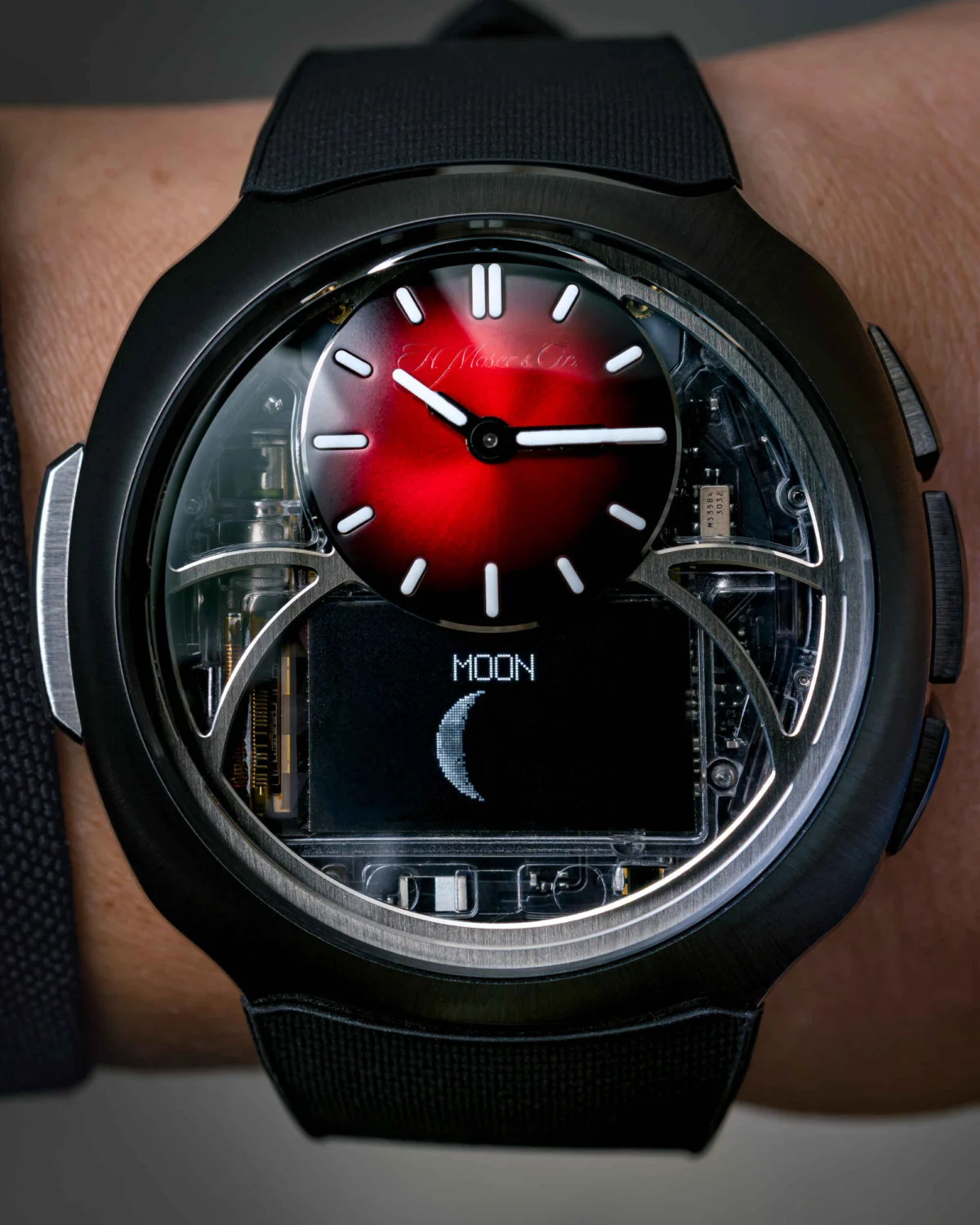
The Off-Grid retains the foundational architecture of its predecessor, utilizing a 42.6mm stainless steel case characterized by a sophisticated split-level design. The upper portion of the dial displays a signature Moser fumé aesthetic, maintaining the brand’s visual identity, while the lower portion houses a high-resolution digital display. Unlike the Alpine edition, which served a singular, high-performance function, the Off-Grid is designed for daily, independent use. The watch removes the connectivity requirements of the previous iteration, opting instead for a standalone interface that operates without the need for a smartphone or constant cloud synchronization.

Technical Specifications and Functionality
The Off-Grid is engineered as a multi-functional tool for the modern traveler. Its movement and software architecture support a comprehensive suite of features, including:
- Timekeeping and Calendar: Local time display, GMT functionality with a user-friendly country selector for rapid time-zone adjustments, and a perpetual moon phase display that recalibrates hourly and remains accurate for a century.
- Utility Tools: A split-seconds chronograph, an integrated timer, and a silent, vibrating alarm system.
- The "Off-Grid" Mode: The primary differentiator is the proprietary software that allows the user to operate in a disconnected environment. By utilizing the pusher on the left side of the case, the user can toggle the digital display to conserve energy or maintain a clean aesthetic.
- Global Linguistic Support: A unique feature allows the user to access a dictionary of ten essential phrases in over 21 languages, tailored to the selected geographic city. This functionality serves as a nod to the "off-grid" concept, emphasizing self-reliance in international travel.
The watch is available in two distinct references: the Ref. 6DI0-1202, which features a blue PVD steel case with a black fumé dial and a white rubber strap; and the Ref. 6DI0-1205, which pairs a black PVD steel case with a striking red fumé dial and a black rubber strap.

Strategic Market Positioning and Production Scale
Historically, H. Moser & Cie. has maintained an annual production volume in the low thousands, ensuring that supply consistently trails demand. This scarcity is central to the brand’s marketing strategy. The release of the Off-Grid, with a total production run of 2,000 units—1,000 of each reference—represents a significant departure from these norms.
The $4,900 price point is perhaps the most critical element of this launch. In the context of luxury watchmaking, this entry-level pricing serves to lower the barrier to ownership, potentially introducing a new generation of enthusiasts to the brand’s design language. Industry analysts observe that by creating a "gateway" product, the company is attempting to build brand loyalty among younger, tech-savvy consumers who may eventually transition to the company’s higher-end mechanical perpetual calendars and tourbillons.

Timeline of Availability and Distribution
H. Moser & Cie. has instituted a phased release strategy to manage the inventory of the Off-Grid, balancing the needs of its existing, long-term clientele with its goal of reaching new customers.
- September 21–23, 2026: The watches are offered exclusively to existing registered clients and collectors with established purchase histories.
- September 24, 2026: The remainder of the stock is made available to the general public via the brand’s official website.
- October 5, 2026: The official sales window concludes. This finite availability window reinforces the sense of urgency, even at a higher production volume.
Analysis: Rarity Versus Accessibility
The move has sparked debate within the horological community regarding the definition of "rarity." Traditionally, Moser has defined its value through mechanical complexity and limited supply. By introducing a digital, battery-operated, higher-volume piece, the brand is effectively redefining its identity.

Critics might argue that a $4,900 digital watch faces stiff competition from established smart-tech leaders; however, proponents suggest that the value proposition lies in the "Moser experience." The brand is effectively betting that its design prestige and the inherent novelty of a high-end, independent-made digital watch will outweigh the technical capabilities of mass-market wearables.
From a corporate standpoint, the Off-Grid serves as an experimental platform. If the model proves successful, it could signal a broader diversification of the company’s product portfolio. The brand is betting on the idea that the true value of a luxury timepiece is not merely in the complexity of its gears, but in the creative vision of the manufacturer—a philosophy that allows for the integration of digital technology without sacrificing the "Moser" soul.

Implications for the Luxury Watch Industry
The launch of the Off-Grid occurs at a time when the luxury watch industry is grappling with the encroachment of digital technology. While many traditional Swiss houses have resisted the "smart" trend, H. Moser & Cie. has chosen to embrace it through a lens of artistic irony and practical utility.
By avoiding the "smartwatch" label and instead framing the product as an "Off-Grid" tool, the company distances itself from the tech industry’s planned obsolescence. The watch is not intended to track health metrics or push notifications, but rather to function as a refined, autonomous instrument for global transit.

Whether this strategy will dilute the brand’s prestige remains a subject of ongoing discussion among industry stakeholders. However, the initial market response indicates that the demand for "accessible luxury" from established independent watchmakers is currently at an all-time high. By bridging the gap between high-end independent horology and functional digital utility, H. Moser & Cie. has successfully initiated a new chapter in its corporate narrative—one that prioritizes reach without abandoning the eccentric, forward-thinking spirit that has defined its reputation for nearly two centuries. As the watch moves into the public domain on September 24th, the ultimate test will be whether the brand can successfully integrate these new owners into its ecosystem, proving that a watch can be both attainable and, in its own distinct way, very rare.