







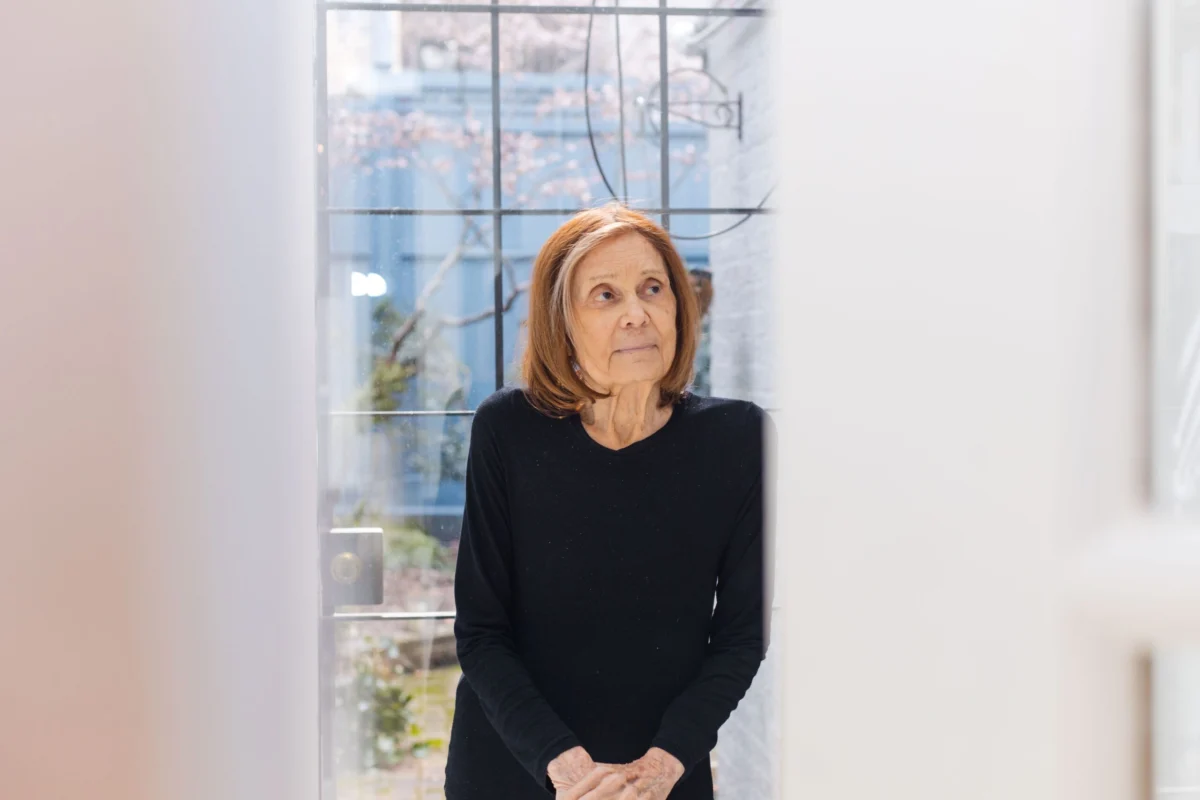
At 92 years old, Gloria Steinem, a titan of American feminism, continues to be a formidable presence, her voice a beacon of activism and intellectual engagement. For over half a century, Steinem has championed women’s rights, co-founding the groundbreaking Ms. magazine in the early 1970s and dedicating her life to speaking, marching, and organizing for equality. Her profound impact was recognized with the Presidential Medal of Freedom bestowed by President Barack Obama in 2013. Even now, in her tenth decade, Steinem remains an active writer and, as she readily admits, a lifelong learner, her insights as sharp and relevant as ever. Yet, when the subject turns to beauty, a characteristic, yet revealing, reticence emerges.
This apparent paradox is amplified by Steinem’s own striking and stylish appearance. Her signature center-parted, highlighted hair and poised demeanor have always been an undeniable part of her public persona, even as she consistently downplayed their significance. In a previous statement to The New York Times, Steinem reflected on her early days as an activist, noting, "I was ‘the pretty one.’" This acknowledgment, juxtaposed with her lifelong insistence that beauty is not paramount, invites a deeper examination of her perspective on a topic that has long captivated and often constrained women.
The current focus on beauty was brought into sharp relief during a recent gathering. Approximately 25 guests convened for a talking circle, an intimate forum designed for discussion and shared experience, sponsored by Maison, a private membership network catering to women entrepreneurs. This event, held at Steinem’s enduring Upper East Side brownstone – her home since the 1960s – is but one iteration of the regular meetings she hosts. These gatherings serve as vital spaces for dialogue on a diverse array of subjects, reflecting Steinem’s multifaceted interests and her commitment to fostering community. For instance, the week prior, she hosted a similar group comprised of clinicians and reproductive justice leaders to engage in critical discussions surrounding abortion care.
"Each person is a world," Steinem articulated during the recent talking circle, her words resonating with the assembled guests, "and we get to learn from each other." The setting itself, her living room, is a testament to a life rich with experience and advocacy. Adorned with crystals from her late sister, the space captures the natural light that streams through the windows, reflecting off the warm yellow walls. Decades of travel and activism are visually chronicled through a collection of photographs and art that fill the room. Steinem’s insatiable curiosity and forward-looking perspective are evident as she shares her fascination with a woman in the Himalayas who reportedly claims to be 130 years old. "That’s a good goal," she declared with a hint of playful aspiration, "I’ll try." This sentiment embodies the quintessential Gloria Steinem: unbothered, perpetually engaged, and grounded in the pursuit of growth and longevity.
The Weight of Expectations: Steinem’s Perspective on Beauty Standards
Steinem’s lifelong dedication to elevating women’s achievements over their physical appearance provides a unique lens through which to examine the societal obsession with beauty. Her approach, characterized by a profound focus on what women can do rather than how they look, is both refreshing and intellectually rigorous. When the topic of beauty was raised in a pre-event conversation, her initial reaction was a laugh, followed by her characteristic directness. Her subsequent reflections on aging, cosmetic surgery, and the pervasive beauty standards reveal a deeply considered and consistent philosophy.
"If I could sit down with a room of 10-year-old girls, I would want them to know that beauty is not important—and that they could be president," Steinem stated emphatically, encapsulating her core message. This desire to instill a sense of empowerment and possibility from an early age underscores her belief that a woman’s worth should be intrinsically linked to her capabilities and aspirations, not to superficial attributes.
Personal History and the Rejection of Conventional Beauty Rituals
Steinem’s personal journey offers tangible evidence of her stance. "Listen, I’ve never worn lipstick," she confided, explaining, "In fact, I look awful in lipstick." Her preference for long hair, a consistent feature throughout her life, is acknowledged with a degree of personal curiosity rather than adherence to a trend. "Why? I don’t entirely know," she admitted. Her engagement with makeup has been minimal, typically limited to "a little eye makeup," a practice she attributes to her two-year sojourn in India, where she observed women’s skillful application of cosmetics. "I think I just acquired a liking for it," she said, underscoring that this was the extent of her beauty routine, a practice that has never demanded significant thought.
This disengagement from conventional beauty rituals is not an oversight but a deliberate choice, rooted in a deeper critique of societal pressures. Steinem’s perspective suggests that the time and energy women often invest in conforming to beauty ideals could be far more productively directed towards personal growth, intellectual pursuits, and activism.
The Tyranny of the Single Ideal: Celebrating Uniqueness
Steinem’s critique extends to the very notion of a singular beauty ideal. "I think we should all be encouraged to look like our unique selves," she asserted. This call for individuality stands in stark contrast to the homogenizing effect of mass media and advertising, which often promote a narrow, unattainable standard of beauty. She emphasizes the global diversity of appearances: "There are many different looks and races around the world, and looking like yourself should be possible for everybody."
The pressure to conform, Steinem argues, is not an individual failing but a systemic issue. "The pressure to look like someone else—that’s not your problem," she stated firmly. "It’s the problem of the people who are putting that out there. Why do they place so much value on exterior qualities that would never apply to men?" This question highlights the deeply ingrained sexism in how beauty standards are constructed and perpetuated, a double standard that disproportionately burdens women.

Cosmetic Surgery: A Medical Necessity vs. Societal Pressure
Steinem’s views on cosmetic surgery are nuanced, distinguishing between procedures undertaken for medical necessity and those driven by societal pressure. She views cosmetic surgery as a valuable intervention "for accidents or birth defects; situations where someone isn’t being seen as themselves." However, she expresses strong reservations about its elective use, particularly when driven by the pursuit of an external ideal. "Otherwise, I can’t imagine a reason why anyone in their right mind would have surgery that wasn’t necessary," she stated. Her apprehension also extends to the physical implications: "And I don’t think putting foreign objects inside of bodies is good for us."
This stance reflects a concern for bodily autonomy and health, urging a reevaluation of the motivations behind such procedures. Her preference for authentic self-expression is clear: "If we are each unique, wanting to look unique makes more sense than wanting to look like somebody from a beauty magazine."
Early Activism and the Struggle for Recognition
Steinem’s early career was marked by a conscious effort to subvert the focus on her appearance. She described how, in her initial public engagements, she would "always try to speak alongside a woman from a different ethnicity or race, so that at least together, we looked a little more like the country." This was a strategic attempt to broaden representation and shift the focus from her individual looks to collective identity. Despite these efforts, she found it "frustrating to have people comment on how I looked instead of what I said."
Her approach to addressing this persistent issue was direct and pragmatic. "And sometimes you can shame people out of it by just naming it: How are you reporting on me in a way you wouldn’t if I were a man? That tends to land," she explained. This tactic, by highlighting the discriminatory nature of the commentary, aimed to provoke self-reflection and accountability.
Progress and Persistence: Feminism’s Impact on Beauty Standards
The feminist movement, Steinem contends, has always been fundamentally opposed to the valuation of women based on their looks. "Feminists always objected to being judged by our looks. That was the tie between beauty and feminism," she explained. The overarching goal, she elaborated, was "to diminish beauty as a standard." While acknowledging that this objective has not been fully realized, Steinem notes significant progress. "I’m not sure we’ve fully gotten there, but I do think women are allowed to be older now than they used to be and still be considered relevant. That’s something."
This evolution signifies a broader societal shift, where women’s contributions and roles are increasingly defined by their capabilities and experiences rather than by their reproductive status or outward appearance. "We’ve been playing a more active role, less defined by reproduction or appearance and more by the many different things women actually do."
The Broader Impact: A Future Defined by Accomplishment
The implications of Steinem’s lifelong advocacy extend beyond the realm of personal beauty. Her consistent emphasis on accomplishments over appearance carries significant weight for societal progress. "The more we’re valued for our accomplishments and not for our looks, the better," she stated. The ultimate measure of success, in her view, will be a future where gender-based disparities in how individuals are perceived and discussed are eliminated.
"We’ll know we’ve made real progress when a woman is running for political office and her appearance is no longer a source of comment any more than it would be for a man," she articulated. While acknowledging that men also face scrutiny regarding their appearance, Steinem’s point is to highlight the disproportionate and often superficial focus on women. The implicit analysis suggests that achieving genuine equality requires dismantling the cultural framework that assigns undue importance to female aesthetics.
A Perspective on Aging and Fulfillment
Despite the ongoing challenges and the persistent influence of beauty standards, Steinem expresses a profound sense of gratitude for her present circumstances. "But I feel lucky," she said, highlighting her stable home, the stimulating presence of friends for her meetings, and her ongoing literary endeavors. "I have a house I like to live in, friends coming for meetings, a book I’m trying to finish."
Her perspective on aging is one of acceptance and appreciation: "Age is good. It beats the alternative, and it means you’ve been in good health." This pragmatic outlook is infused with the wisdom of experience, recognizing that age brings not only physical changes but also invaluable knowledge and understanding. "You know more because you’ve experienced more."
In closing, Steinem offers a simple yet powerful affirmation of self-acceptance. "I’ve never said to myself ‘I feel ugly’ or ‘I feel beautiful.’ You look in the mirror and you want to look like yourself. That’s enough," she concluded. This final statement encapsulates a lifetime of dedication to authenticity and the quiet revolution of valuing one’s intrinsic self above all external measures.