










Long before Girard-Perregaux established its formidable reputation for high complications, the visionary Jean-François Bautte (1772-1837) laid the groundwork for a new era in watchmaking. A true polymath—skilled as a watchmaker, engraver, and goldsmith—Bautte revolutionized production by consolidating multiple artisanal crafts under a single roof. This integrated approach stood in stark contrast to the prevailing fragmented établissement system, effectively prefiguring the modern concept of a fully integrated manufacture. Bautte was also an early pioneer in the realm of chiming mechanisms, developing timepieces capable of audibly repeating the hours and quarters on demand. Following his passing, his esteemed company was eventually integrated into Girard-Perregaux in the early 20th century, forging a direct lineage between his innovative spirit and the brand’s enduring commitment to mechanical sophistication. The latest embodiment of this legacy is the Girard-Perregaux Minute Repeater Flying Bridges watch, a testament to the brand’s dedication to crafting entirely new, in-house high-end movements.

The Genesis of Mechanical Excellence: A Historical Perspective
The story of Girard-Perregaux is deeply interwoven with the history of Swiss watchmaking, a narrative stretching back to its founding in 1791 by Jean-François Bautte. While the brand is now synonymous with intricate complications, its roots lie in Bautte’s innovative approach to manufacturing. In an era where watch components were often sourced from disparate artisans, Bautte’s Geneva-based workshop was a hub of integrated craftsmanship. This allowed for a level of control and consistency that was exceptional for its time, enabling the creation of highly refined and complex timepieces. His early explorations into minute repeaters, a notoriously challenging complication, demonstrated a forward-thinking ambition that would resonate through the centuries. The eventual acquisition of Bautte’s company by Girard-Perregaux ensured that this legacy of precision and mechanical artistry would continue to flourish under a new banner, paving the way for future innovations that would define the brand.
Caliber GP9530: A Symphony of Complications and Acoustic Engineering
At the heart of the new Girard-Perregaux Minute Repeater Flying Bridges beats the Caliber GP9530, a movement that masterfully unites a minute repeater, a tourbillon, and an automatic winding system featuring a micro-rotor. This new caliber represents a significant achievement for Girard-Perregaux, comprising 475 meticulously crafted components and demanding approximately 440 hours of dedicated assembly and finishing. This launch marks the third entirely new high-end movement introduced by the Manufacture in less than six months, underscoring a strategic and focused commitment to internal development and innovation. This sustained output highlights Girard-Perregaux’s current philosophy: to create complete, novel calibers from the ground up, rather than relying on modifications of existing structures.

The development of the Caliber GP9530 was, by necessity, an exercise in acoustic precision. Every significant design decision, from the selection of materials to the architectural layout of the movement, was guided by the pursuit of optimal sound. The plate and bridges are fashioned from titanium, a material chosen for its inherent rigidity and its remarkable ability to efficiently transmit vibrations. This crucial choice directly impacts the clarity and resonance of the minute repeater’s chimes.
Furthermore, the mainplate is engineered for direct contact with the case. This direct coupling serves as a conduit, facilitating the outward transmission of vibrations. The objective is to ensure that the sonorous output generated by the hammers striking the gongs resonates effectively through the solid gold case, amplifying the auditory experience for the wearer. To further minimize any extraneous noise that could detract from the chime, the gongs and their mounting point are integrated into a single, monolithic piece of metal. This eliminates potential points of interference and vibration loss. The strikework regulator, responsible for controlling the timing of the repeater, has been strategically repositioned to the rear of the movement. This relocation is a deliberate measure to reduce any audible disruption during the operation of the chiming mechanism, ensuring an unadulterated auditory performance.

The Iconic Three Bridges Architecture: A Modern Reimagining
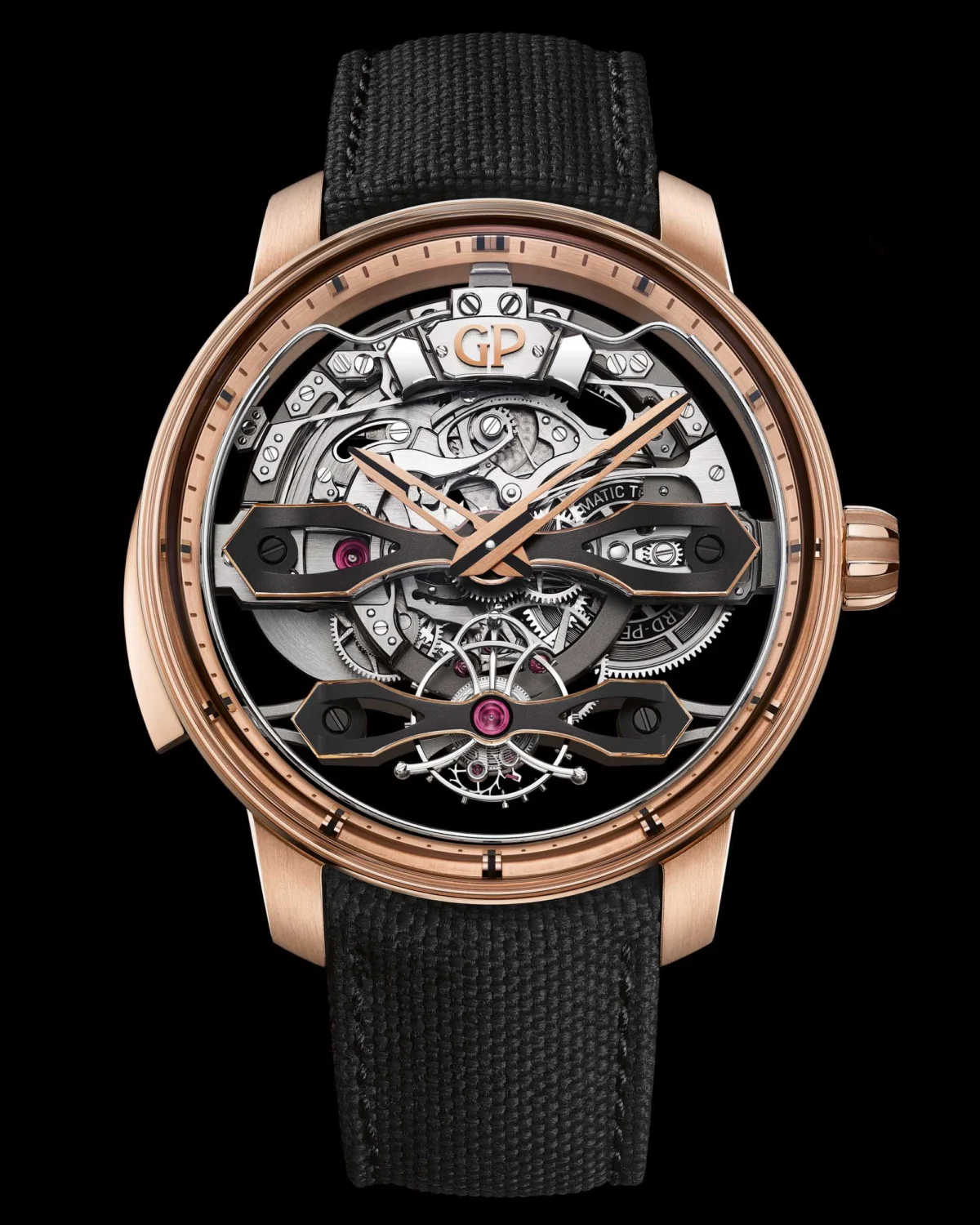
Aesthetically, the Caliber GP9530 proudly carries forward Girard-Perregaux’s iconic Three Bridges architecture, albeit with a distinctly modern interpretation. The movement is extensively openworked, a design choice that serves a dual purpose: to showcase the intricate internal construction and, critically, to enhance acoustic performance by minimizing any physical barriers to sound propagation. The three signature bridges, rendered here in lustrous pink gold, are arranged in a symmetrical configuration that has become a cornerstone of the brand’s identity. These bridges not only provide structural support for the gear train and the tourbillon but also form the visual backbone of the timepiece.
In this updated iteration, the third bridge is strategically positioned on the reverse side of the movement, contributing to the overall visual depth and balance. The distinctive arrow-shaped design motif that defines these bridges is elegantly echoed in other components, including the hammers of the minute repeater and the micro-rotor of the automatic winding system. This cohesive design language reinforces the watch’s identity and showcases the meticulous attention to detail that permeates every aspect of its construction.

The automatic winding system itself is a marvel of discreet engineering. It is built around a micro-rotor crafted from white gold, meticulously designed to operate with exceptional quietness. This deliberate choice ensures that the subtle whirring of the rotor does not interfere with the purity of the minute repeater’s chimes. The placement of the micro-rotor is also a key element in the movement’s overall symmetry, ingeniously balancing the mainspring barrel, which is located on the opposite side. The tourbillon, a complication renowned for its ability to counteract the effects of gravity on timekeeping accuracy, is presented with Girard-Perregaux’s signature lyre-shaped cage. In this configuration, the tourbillon cage also serves as a functional element, displaying the small seconds. The Caliber GP9530 operates at a frequency of 21,600 vibrations per hour (3Hz), offering a robust power reserve of a minimum of 60 hours, ensuring both precision and endurance.
Unparalleled Finishing and Craftsmanship
The level of finishing applied to the Caliber GP9530 is nothing short of extraordinary, reflecting the highest echelons of haute horlogerie. The movement boasts an impressive 1,340 hand-polished chamfers, a staggering figure that includes a significant number of interior angles. This painstaking manual work is a clear indicator of the immense dedication and skill invested in each timepiece. As a final, deeply personal touch, Girard-Perregaux incorporates a small, discreet plate engraved with the initials of the master watchmaker responsible for the assembly of the movement. This subtle yet significant detail serves as a powerful acknowledgment of the individual artisanship and expertise that lie at the heart of each watch.

Case Engineering for Sound and Usability
The case of the Girard-Perregaux Minute Repeater Flying Bridges has been meticulously engineered in tandem with the movement, with a dual focus on optimizing acoustic performance and ensuring user comfort and reliability. Measuring an imposing 46mm in diameter and 17.9mm in thickness, the case is crafted from solid pink gold, a material chosen for its density and its contribution to the overall resonance of the chiming mechanism. To further enhance the auditory experience and provide a clear view of the intricate movement, box-type sapphire crystals are fitted on both the front and the back of the watch. These specially shaped crystals are designed to amplify and project the sound produced by the repeater.
The activation of the minute repeater is managed by a newly developed slide-piece. This sophisticated mechanism is seamlessly integrated into the monobloc case-middle, a design choice that not only contributes to the watch’s clean aesthetic but also significantly improves reliability. Crucially, this integration maintains water resistance to a depth of 30 meters, a practical consideration for a high-complication timepiece. The watch is presented on a striking black rubber strap, distinguished by a fabric-like texture that adds a touch of refined sportiness. This is secured by a secure and elegant pink gold folding clasp, ensuring both comfort and a precise fit on the wrist.

Broader Implications and Market Position
The Girard-Perregaux Minute Repeater Flying Bridges watch firmly positions itself at the zenith of contemporary watchmaking. It represents a confluence of mechanical complexity, exquisite finishing, and sophisticated acoustic engineering, where each element is given equal importance. This timepiece is a powerful demonstration of what a fully integrated Manufacture is capable of achieving when it exercises complete control over every facet of the production process.
The introduction of the GP9530 caliber, the masterful integration of the historic Three Bridges architecture, the continued refinement of the minute repeater complication, and the inclusion of a high-precision tourbillon all signal that Girard-Perregaux is not merely resting on its laurels but actively pushing the boundaries of horological innovation. The brand is clearly committed to honoring its rich heritage while embracing the future of watchmaking.

The Girard-Perregaux Minute Repeater Flying Bridges, reference 99840-52-2013-5CC, is offered at a price of $590,000 USD. This pricing reflects the immense investment in research and development, the use of precious materials, the extensive hand-finishing, and the sheer complexity of the complications involved. It places the watch within the ultra-high-end segment of the luxury watch market, appealing to discerning collectors who appreciate the pinnacle of mechanical artistry and horological history.
This release also signifies a broader trend within the high-end watchmaking sector, where brands are increasingly emphasizing their in-house capabilities and the development of exclusive, proprietary movements. This focus on internal expertise not only ensures greater control over quality and innovation but also allows brands to tell a more compelling story about their craftsmanship and heritage. For Girard-Perregaux, this renewed emphasis on developing new calibers internally is a strategic move that reinforces its position as a leading Manufacture, capable of creating timepieces that are both technically groundbreaking and aesthetically timeless. The Minute Repeater Flying Bridges stands as a powerful testament to this enduring commitment to excellence.