

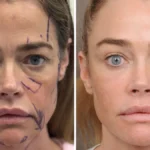





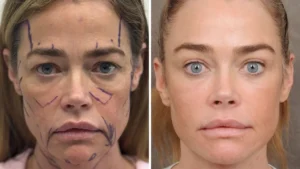
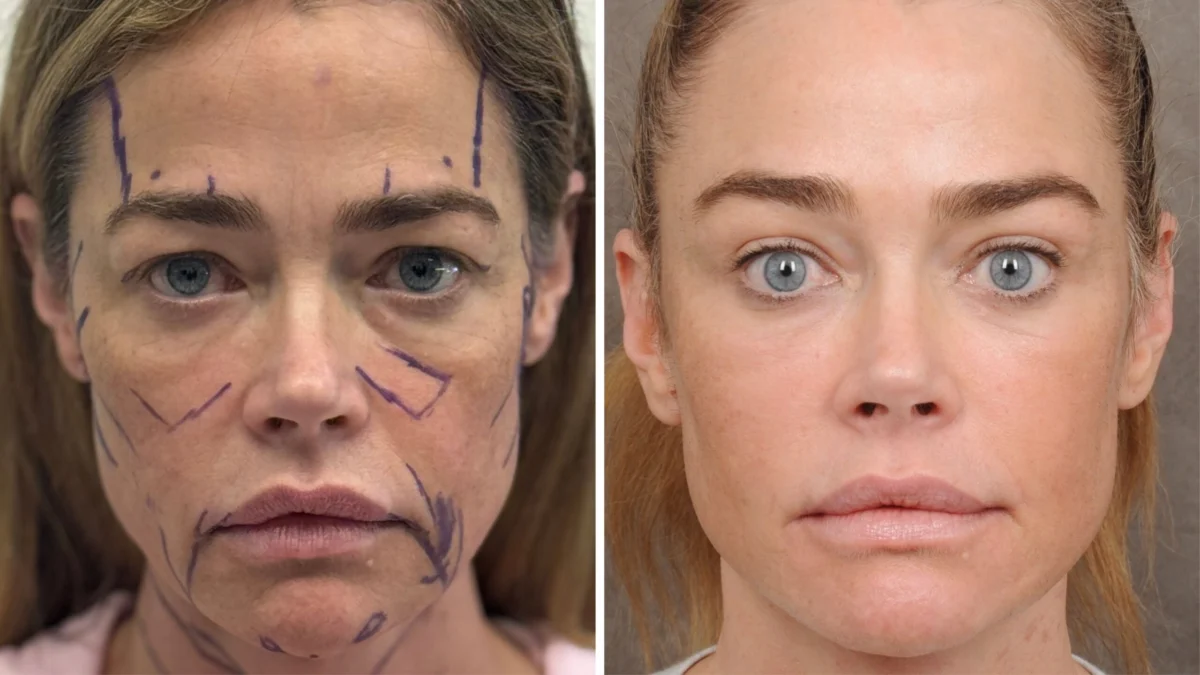
Denise Richards, a 55-year-old actress who cemented her status as a sex symbol through a series of iconic, steamy roles in the 1990s, and later graced the pages of Playboy in 2004 and starred in two seasons of The Real Housewives of Beverly Hills, has ignited a firestorm of online discussion. Her latest move, a bold and unprecedented revelation of unedited before-and-after photographs of her recent facelift, is arguably her most provocative act to date, pushing the boundaries of aesthetic transparency to an entirely new level.
A Radical Act of Honesty in the Age of Curated Selves
Richards has not merely nudged the needle on the growing trend toward greater honesty about cosmetic procedures; she has decisively shattered it. In an exclusive feature with Allure, she laid bare every intimate detail of her plastic surgery journey. Most remarkably, this included not only the clinical before-and-after photographs, but also candid images taken on the morning of her surgery with her face marked for the procedure, and subsequent shots documenting the inevitable bruising and swelling in the days that followed.
The impact of this candid disclosure was immediate and widespread. Following the initial publication, Richards’ surgeon, Dr. Ben Talei, a distinguished facial plastic surgeon based in Beverly Hills, shared his complete set of standardized before-and-after photographs of the actress. These images, presented from multiple angles and meticulously free of makeup and filters, featured consistent lighting and expressions, adhering to the strict protocols for such medical documentation. The sheer volume of media outlets that subsequently disseminated these unfiltered images led to an internet-flooded landscape dominated by Denise Richards’ face, presented in its most raw and unvarnished form.
Historically, the landscape of celebrity confessions regarding cosmetic surgery has been characterized by a notable reticence. A select few famous individuals have offered glimpses into the procedures that contribute to their seemingly "ageless" appearances, but an even smaller fraction have ever dared to share the unvarnished reality of their pre- and post-operative transformations. These critical medical records, typically captured within the controlled environment of a plastic surgeon’s dedicated studio, are subject to stringent guidelines. Pre- and post-operative images are meticulously captured using identical equipment, settings, and camera distances, at specific angles, against uniform backdrops, under consistent lighting conditions, and with the patient posing both with a neutral expression and a smile.
What is often presented to the public as "celebrity before and afters" in the media is a vastly different entity. These are typically photographs taken in public settings, often at glamorous events, at two distinct points in time—before and after an alleged procedure. Such images frequently boast a high degree of production value, incorporating professional makeup, flattering lighting, and carefully posed stances. They may also be layered with digital filters, further obscuring the true nature of any underlying transformation. In stark contrast, Richards’ revelation was entirely devoid of such artifice, offering an unvarnished glimpse into the reality of surgical intervention.
Public Reception and the "Natural Aging" Debate
The public’s response to Richards’ unprecedented level of transparency has been overwhelmingly positive, bordering on celebratory. As a plastic surgery reporter myself, approaching a milestone age, I found her disclosure to be a profoundly refreshing development. The internet was awash with commendations for Richards’ candor, praise for Dr. Talei’s evident surgical skill, and widespread admiration for the "time machine" quality of the results.
Inevitably, however, the discourse also included the familiar refrain: "Why can’t we just be allowed to age naturally?" This sentiment, a common reaction to virtually any post concerning plastic surgery, surfaced prominently on Allure‘s Instagram page. The individual who posed this question, an advocate for a more natural approach to aging, encountered a significant wave of pro-choice pushback from readers, with over 242 individuals at last count. Richards herself weighed in, offering a measured response: "I respect your opinion. I believe everyone has a choice and [can] do what’s best for them and for me this was best." This exchange highlights the ongoing societal tension between embracing natural aging processes and the personal autonomy to make choices about one’s appearance through cosmetic procedures.
Professional Acclaim and the "Boss Moves" Commentary
The collaboration between Richards and Dr. Talei has also garnered significant applause within the plastic surgery community itself. Dr. Talei’s Instagram post, which showcased Richards’ before-and-after images alongside a detailed, nuanced breakdown of her surgical procedure, achieved remarkable engagement, accumulating over 222,000 likes and approximately 10,000 comments. A substantial number of these comments came from prominent figures within the field.
Among the deluge of congratulatory emojis and affirmations, one particular comment from Beverly Hills plastic surgeon Dr. Ashkan Ghavami resonated deeply and captured widespread attention. He remarked, "Boss moves. My patients pretend like I don’t exist. How do you do it?" While delivered with a touch of humor, Dr. Ghavami’s observation aptly addressed the often-unspoken reality of celebrity engagement with plastic surgery.
The Hollywood Silence and its Impact on Beauty Standards
In recent years, there has been a discernible increase in plastic surgery confessions among a certain echelon of celebrities. Figures like Ricki Lake have publicly lauded their facelift surgeons, and Kylie Jenner has openly shared details about her breast augmentation. However, the highest echelons of Hollywood continue to maintain a veil of secrecy regarding the procedures they undergo and the surgeons responsible for their transformations.

Dr. Steven Teitelbaum, a plastic surgeon in Santa Monica, notes that this silence is pervasive among the crème de la crème of the entertainment industry. These individuals often appear remarkably youthful on screen and the red carpet, yet remain conspicuously quiet about their methods. This silence fosters an environment where the public is left to speculate or, more often, to suspend disbelief and accept the convenient, yet often misleading, notion that the affluent and famous are somehow immune to the natural signs of aging, such as wrinkles, sagging skin, and loss of facial volume.
The harm in this pervasive omission, as critics argue, lies in its active reshaping of societal beauty standards. The prevalence of seemingly "snatched" and impeccably youthful 60-year-olds on streaming dramas, for instance, can create a false impression of natural aging. In reality, achieving and maintaining such appearances often necessitates the consistent intervention of skilled surgeons. This creates an unspoken pressure to conform to an increasingly unattainable ideal, where "measuring up" implicitly means having a dedicated surgical team on retainer.
The Distraction of Disguised Transparency
Conversely, some observers suggest that a complete silence might be preferable to a form of transparency that is, in reality, a distraction. The author wryly notes that if she had a nickel for every celebrity who attributed their impossibly sharp jawline or lifted brow to something other than surgery—citing vague explanations like "a little bit of Botox," a promoted skin-tightening gadget, a dermatologist in Dubai, or even daily horseback riding, Pilates, or chia seeds—she would be considerably wealthier. Such explanations, often coupled with undisclosed paid endorsements or strategically chosen anecdotes, serve to obfuscate the true extent of cosmetic interventions.
The sheer scope of Richards’ revelation is therefore unprecedented. It stands as a powerful counterpoint to the pervasive culture of carefully curated narratives and often misleading explanations that the public has become accustomed to. More than just an act of personal openness, Richards’ disclosure represents a profound show of respect for her audience. As she articulated to Allure, "Being in the public eye since my 20s, people know what I look like—a facelift is not something that I could hide." This sentiment is particularly poignant, as many individuals who have also matured in the spotlight have attempted to conceal their surgical procedures or attribute their refreshed appearances to more palatable, less invasive sources such as vacations, new hairstyles, or even significant life changes like divorce.
The Kris Jenner Case Study: A Different Approach to Disclosure
The case of Kris Jenner offers a contrasting example of celebrity engagement with cosmetic surgery disclosure. Last spring, a representative for Jenner confirmed to Page Six that Dr. Steven Levine had performed her "recent work," a statement that was presented as a moment of transparency. However, this disclosure stopped short of revealing the specifics of the procedures undertaken or the precise timing of the treatments.
Critically, and as many plastic surgeons have pointed out in the wake of Richards’ candid reveal, the public never saw standardized, clinical before-and-after photographs of Jenner. The accompanying images from Paris, which coincided with the news of her "work," were not medical documentation. Instead, they were carefully staged photographs, taken with full hair and makeup, meticulously edited, and clearly filtered by her team. As Allure contributor Valerie Monroe aptly noted during the peak of the "Jenner Facelift Frenzy," "Nobody looks like Kris. Not even Kris." This distinction underscores the fundamental difference between Richards’ raw, unedited medical documentation and the highly polished, public-facing images often presented by other celebrities.
Setting Unrealistic Expectations: The Dangers of Filtered Realities
The carefully curated "after" images of Jenner have drawn criticism for setting potentially unrealistic expectations. Austin plastic surgeon Dr. Ashley Gordon articulated this concern in an Instagram post, stating, "A facelift does not airbrush or FaceTune your face." This sentiment was echoed by Philadelphia plastic surgeon Dr. Christian Subbio during an appearance on Victoria Garrick Browne’s mental health podcast, Real Pod. Dr. Subbio observed, "A lot of these photos that I see of her after are a beautiful, top-tier facelift plus a filter, plus perfect lighting, plus Kardashian angles and all that. So, what is top-tier, beautiful, 10-out-of-10 work suddenly becomes 13-out-of-10 work and perhaps unrealistic to the average man or woman seeking a facelift." This highlights the critical importance of standardized, unvarnished before-and-after photography in providing a true representation of surgical outcomes.
The Art and Science of Medical Photography in Plastic Surgery
For those who report on plastic surgery, the meticulous nature of medical photography is a key indicator of a surgeon’s commitment to their craft. The best doctors understand that the quality of their before-and-after portfolios directly reflects the quality of their outcomes. In the realm of facial plastic surgery, Dr. Talei’s dedication to exacting photographic standards is well-recognized.
Dr. Jonathan Cabin, a facial plastic surgeon in Washington D.C., elaborates on Dr. Talei’s methodology: "Ben is very careful about head positioning and expressions—no soft smiles or other subtle expressions that can make results look more impactful. And his lighting is pristine." Dr. Cabin points to the consistent "catchlights"—reflections of the flash within the eyes—in Richards’ photographs as evidence of this meticulous approach. These flecks of light appear in the exact same position in both her pre- and post-operative images, indicating a consistent photographic setup. While some social media users speculated that the lighting in the after photos might have been altered to make her eyes appear bluer and brighter, surgeons explain that Richards’ upper blepharoplasty, a procedure that removes excess skin from the upper eyelids, reduces hooding, and consequently allows more light to enter the eyes, naturally contributes to this brighter appearance.
The Enduring Power of Relatable Emotion
Beyond the technical precision of the photography, what is most compelling about Richards’ images is the raw, relatable emotion captured on her face. Anyone who has undergone the process of having "before" photos taken understands the inherent vulnerability involved. These images, captured without artifice for the express purpose of exposing perceived flaws and insecurities, invite scrutiny and resist deception. They are, by their very design, honest.
By consenting to share her before-and-after photographs with the world, Denise Richards has redefined transparency. She has transformed it from a fleeting trend or a talking point into a profound moment of truth. In an era saturated with curated perfection, her raw and radical act of openness serves as a powerful reminder of the courage it takes to be truly seen, and in doing so, she has presented a far more provocative and impactful statement than any carefully posed photograph ever could.