








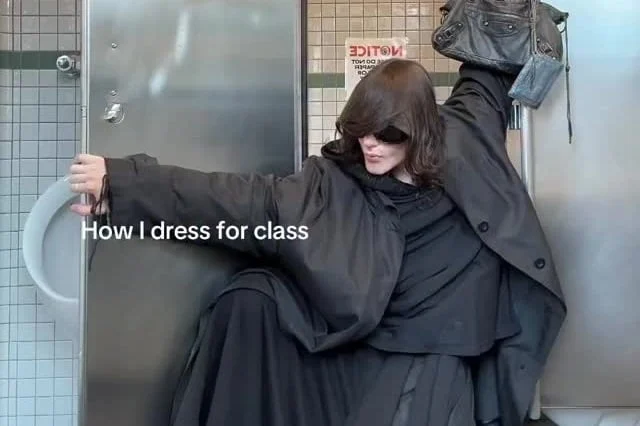
In the rapidly evolving landscape of digital content, where trends flicker and fade with algorithmic caprice, a singular figure has emerged, captivating audiences with a blend of the bizarre, the athletic, and the deeply conceptual. David Estrada, a New York City-based creative and student at Parsons School of Design, has garnered widespread attention for his viral “dressing for class” videos, transforming the mundane act of selecting an outfit into a compelling, almost unsettling, performance art piece. His distinctive style, characterized by a veiled figure cloaked in layered black garments, scaling university bathroom stalls with chunky boots, has drawn comparisons ranging from a "spider" and "roach circling the drain" to a "sleep paralysis demon," underscoring the videos’ unsettling yet mesmerizing appeal. These sped-up loops, primarily filmed in the utilitarian confines of university lavatories, reimagine the everyday Outfit of the Day (OOTD) as something far more profound and sinister, challenging conventional notions of fashion, art, and online self-expression.
The Genesis of a Viral Phenomenon: Subverting the OOTD
Estrada’s distinctive content didn’t materialize overnight but is the culmination of years spent navigating the ever-shifting currents of social media. His journey began on Vine in 2013, a platform known for its short, looping videos, which arguably laid the groundwork for his current mastery of concise, impactful visual narratives. After Vine’s demise, he transitioned to TikTok, initially engaging with various trend-led clips, a common trajectory for many digital creators. However, it was within the last year that Estrada truly "locked in" on the format that would define his virality. He explains the practical utility of his unique approach: "It’s a really cool way for me for me to archive what I’m wearing." This simple statement belies the complex artistic choices at play, positioning his videos not merely as fashion showcases but as dynamic, living archives of his personal style.
The visual grammar of Estrada’s "dressing for class" series is instantly recognizable. The artist consistently appears veiled, obscuring his facial features and directing the viewer’s attention to the contorted, almost insect-like movements of his body. His attire, often consisting of layered black garments, heavy boots, and an overall deconstructed aesthetic, contributes to the enigmatic persona. The choice of university bathrooms as his primary stage is particularly potent. These spaces, typically mundane and private, are transformed into a surreal arena for his acrobatic displays. The sped-up loops, a signature element, amplify the uncanny nature of his movements, making him appear to scuttle and climb with an almost preternatural agility. This deliberate aesthetic choice not only captures attention but also provokes a visceral reaction, positioning him as an outlier in a digital landscape often dominated by polished, aspirational content.
Behind the Veil: A Journey of Self-Acceptance and Artistic Courage
The audacity required to perform such acts in semi-public spaces, let alone broadcast them to millions, speaks volumes about Estrada’s burgeoning self-assurance. This confidence, however, was not an innate trait. He candidly shares his earlier struggles with conformity: "When I was growing up, I was so into fitting in with everyone else." The turning point came when he observed others drawing inspiration from his unique sartorial choices. This external validation fostered an internal shift, leading to a profound realization: "I realised if you’re the first to do it, it doesn’t mean it’s bad."
This journey of self-discovery and acceptance was significantly nurtured by his academic environment at Parsons School of Design. Surrounded by a diverse community of creatives, Estrada found a space where individuality was not just tolerated but celebrated. "I learnt that especially at Parsons, being around so many people who are just happy to look a mess," he recounts, highlighting how the institution’s ethos of embracing unconventional aesthetics empowered him to shed inhibitions and fully lean into his unique artistic vision. This background context from Parsons is crucial, as it illustrates how an environment fostering experimentalism can cultivate the kind of artistic bravery needed to produce truly groundbreaking content.
The Practicalities of Performance: Filming, Flexibility, and Fortitude
A frequently posed question by viewers pertains to the logistics of his unconventional shoots. "Has anyone ever walked in while you’re filming? Do people care?" is a common inquiry. Estrada’s response is refreshingly candid and reflective of the Parsons culture: "People don’t give a fuck at Parsons, and if they do, they’re not there for the right reasons." He also notes that the bathrooms are often empty, minimizing interruptions. This lack of external judgment allows him the freedom to fully immerse himself in the performance, unbothered by potential onlookers.
Another practical concern for a creator consistently generating high-quality video content is storage. "How does your phone storage handle it?" is a pertinent question in the age of digital media. Estrada, with a touch of humor, reveals his solution: "My storage isn’t doing the best but I’m on that iCloud family plan, thankfully." This seemingly trivial detail offers a glimpse into the everyday realities of being a prolific digital artist.
The physical demands of his videos are undeniable. Scaling stall dividers, contorting his body into various precarious positions, and executing fluid, spider-like movements requires a significant degree of flexibility. When asked about his secret, Estrada credits his past: "I used to dance growing up, but honestly, I’m just throwing my leg as high as it goes and hoping for the best." This blend of trained agility and spontaneous improvisation underscores the raw, unpolished energy that defines his performances. The audio accompanying his videos is another distinctive element, often described as "a mess." Estrada clarifies its origin: "It’s just me moving [laughs]." He explains that when posting daily, he eschewed external sounds, opting instead for the authentic, visceral sounds of his own movements, further enhancing the raw, immersive quality of his work.
Beyond the Screen: An Interactive Designer’s Vision
David Estrada’s artistic endeavors extend far beyond his viral TikToks. He is currently studying Interactive Design at Parsons, a discipline that emphasizes user engagement and innovative solutions. His final major project, a testament to his boundary-pushing approach, involved working with urine as a watercolor base. This audacious concept immediately challenges conventional notions of art materials. He describes the process: "filtering it until it became clean enough to use, and it ended up smelling like roses. I built a large custom filtration system, then let the liquid pour and stain different canvases."
This project is not merely an exercise in shock value; it is deeply rooted in conceptual inquiry. Estrada articulates its underlying philosophy: "The project was about challenging conventional ideas of design and questioning what is considered art. I was interested in how something is transformed into something ‘clean’ and how that shift changes the perceived value of an object in today’s society." This statement offers profound insight into his artistic mindset, revealing a creator who is not content with superficial aesthetics but is driven by a desire to interrogate societal values and perceptions. His work, whether on TikTok or in a gallery, consistently aims to disrupt and redefine.
Fashion’s Pantheon and Future Aspirations
Estrada’s deep engagement with fashion is evident not just in his videos but also in his articulate appreciation for influential designers. When asked about his "Fashion Mount Rushmore," he names Rei Kawakubo, Demna, Shayne Oliver, and Simone Rocha. This selection speaks to a sophisticated understanding of contemporary fashion’s avant-garde and its most disruptive forces. Rei Kawakubo, founder of Comme des Garçons, is revered for her radical deconstruction of garments and challenging of beauty standards. Demna (formerly Gvasalia), known for his work at Vetements and Balenciaga, is celebrated for his subversive take on luxury and appropriation of everyday aesthetics. Shayne Oliver, of Hood by Air fame, pioneered a distinctive blend of streetwear, club culture, and high fashion, pushing boundaries in gender and identity. Simone Rocha, on the other hand, offers a more romantic yet equally challenging vision, often exploring historical references with a modern, subversive twist. Estrada’s admiration for these designers underscores his own commitment to pushing artistic and sartorial boundaries.
His ultimate fashion "holy grail" is the entire Autumn/Winter 2004 Comme des Garçons runway collection, a testament to his reverence for Kawakubo’s groundbreaking work. This specific collection is iconic for its "broken beauty" aesthetic, featuring garments with exaggerated holes, frayed edges, and distressed textures, further aligning with Estrada’s own interest in challenging perfection and conventional beauty.
Looking beyond graduation, Estrada expresses a clear vision for his career trajectory. "I really am obsessed with creating a whole world and executing a vision," he states. This ambition could lead him into "some sort of marketing or PR," where his creative vision could be applied to brand storytelling, or, ideally, "just being an artist." This dual aspiration highlights his understanding of both the commercial and conceptual aspects of the creative industries.
Persona, Inspiration, and a Life Mantra
Estrada’s personality, as revealed through his responses, is a compelling mix of artistic intensity and relatable charm. He feels most creative "late at night," a common sentiment among artists who find inspiration in the quiet hours. His mantra, "Keep moving," is a simple yet powerful declaration, reflecting both the physical dynamism of his videos and a broader philosophy of continuous progress and adaptation.
When contemplating a hypothetical encounter in a lift with his celebrity crush, Lisa Rinna, Estrada provides a glimpse into his personal style: "I’m wearing a Comme des Garçons skirt, a Vetements hoodie, Balenciaga boots and a City Bag." This ensemble perfectly encapsulates his aesthetic – a high-low mix of avant-garde luxury, streetwear sensibility, and iconic accessories, reflecting the influences of his chosen designers.
Perhaps most tellingly, when asked which fictional character he relates to most, Estrada chooses Spider-Man, explaining, "because he’s always climbing the walls." This seemingly lighthearted comparison provides a poignant self-reflection. It directly references the physical act central to his viral videos but also hints at a deeper resonance with Spider-Man’s dual identity, his agility, and his role as a somewhat unconventional hero navigating complex urban environments. It frames his artistic practice as a heroic endeavor in its own right – climbing the walls of societal expectations and artistic norms.
Broader Implications and The Future of Digital Artistry
David Estrada’s work transcends mere viral entertainment; it represents a significant commentary on the evolving nature of art, fashion, and identity in the digital age. His "dressing for class" videos subvert the meticulously curated, often performative authenticity prevalent on social media platforms. By embracing the grotesque, the uncanny, and the physically demanding, he carves out a niche that challenges viewers to look beyond superficial aesthetics.
His integration of performance art within the accessible format of TikTok democratizes a genre traditionally confined to galleries and specialized venues. He blurs the lines between fashion content, contemporary dance, and conceptual art, demonstrating how platforms designed for mass consumption can become fertile ground for sophisticated artistic expression. The veiled persona, while obscuring his individual identity, paradoxically amplifies the universality of his artistic message, allowing viewers to project their own interpretations onto the enigmatic figure.
Estrada’s journey, from struggling with conformity to confidently pushing boundaries, serves as an inspiring narrative for aspiring artists and creatives. His willingness to experiment, even with unconventional materials like urine, and his unwavering commitment to challenging perceived values, positions him as a significant voice in the contemporary art landscape. As he moves forward, whether as an artist or in a creative marketing role, his "obsession with creating a whole world and executing a vision" promises a continued trajectory of innovation and disruption. David Estrada is not just making videos; he is crafting an immersive, thought-provoking universe, one climbed bathroom stall and conceptual art project at a time, continually asking us to question what we see, what we value, and what truly constitutes art.