








The recent release of Charli XCX’s single "Camera" marks the completion of a thematic trifecta for her much-anticipated follow-up to the critically acclaimed 2024 album, Brat. Titled Music, Fashion, Film, the forthcoming project has been meticulously unveiled through a series of singles, each anchoring a specific artistic pillar. "Rock Music" initiated the sequence, serving as the sonic representation of the "music" component. This was followed by "SS26," a track that immersed listeners in the world of high fashion, showcasing Charli’s enduring influence in style and visual artistry. Now, with "Camera," the avant-pop icon definitively corners the "film" aspect, offering a rich tapestry of cinematic allusions and personal reflections on her recent forays into acting.
"Camera" features French actor Vincent Cassel, renowned for his roles in films such as La Haine, Shrek, and Black Swan, lending a significant weight of cinematic gravitas to the accompanying video. Beyond Cassel’s compelling presence, the visual narrative of "Camera" is replete with frequent references to the legendary Hollywood icon James Dean. These nods are far from subtle, serving as a direct acknowledgment of Charli XCX’s own burgeoning experiences in filmmaking and acting over the two years since Brat made its seismic impact on the music world. Her engagement with the craft of acting, often experimental and boundary-pushing, is a theme she directly addresses in the closing lyrics of the track. She candidly sings, "I don’t feel embarrassed even if I suck / I’m always craving an experience that feels dangerous / And maybe this is it, maybe it’s what I need / ‘Cause it’s the only way to feel like I’m not actually me." This introspective confession underscores a recurring motif in her artistry: the pursuit of transformative experiences and the shedding of self through creative exploration.
For dedicated followers, affectionately known as "Angels," Charli XCX’s deep-seated affinity for cinema is not a new revelation. Her discography is peppered with homages, direct samples, and conceptual frameworks drawn from the world of film, demonstrating a consistent engagement with visual storytelling as integral to her musical expression. This article delves into five other landmark examples that illuminate the enduring relationship between Charli XCX’s music and the silver screen, tracing a chronological path through her career.
Early Explorations: Pulp Fiction and the Vroom Vroom EP
In 2016, Charli XCX released the Vroom Vroom EP, a pivotal moment that marked a significant stylistic shift in her career. This project was a slick, left-field pivot into the then-burgeoning underground sound of PC Music, characterized by its hyper-real, deconstructed pop aesthetics. The EP was shaped by groundbreaking production and collaborative efforts with key PC Music affiliates: SOPHIE, A.G. Cook, and Hannah Diamond. While the title track, "Vroom Vroom," often garnered the most immediate attention for its aggressive, industrial-tinged pop sound and its role in defining her "hyperpop" identity, it is the neighboring cut, "Trophy," that delivers one of the project’s most direct and memorable cinematic references.
Before "Trophy" snaps into its characteristic jerky hooks and bouncing beat, the song opens with an iconic sample from Quentin Tarantino’s seminal 1994 film, Pulp Fiction. The chosen snippet features Uma Thurman’s character, Mia Wallace, delivering a memorable line during the legendary Jack Rabbit Slim’s dance sequence: "Now I want to dance, I want to win, I want that trophy." This particular sample is not merely an aesthetic flourish; it encapsulates the EP’s audacious ambition and its playful subversion of mainstream pop tropes. Pulp Fiction, celebrated for its non-linear narrative, stylized violence, and sharp dialogue, mirrored Charli’s own artistic daring at the time. The choice of a line that speaks to desire, competition, and a hunger for victory perfectly aligned with the assertive, genre-bending statement Charli was making with the Vroom Vroom EP, solidifying her reputation as an artist unafraid to challenge conventions and embrace experimental sounds. The EP itself was met with a mixed but ultimately influential reception, with critics recognizing its futuristic vision and its role in shaping the sound of the late 2010s.
A Mixtape Mosaic: Cruel Intentions, Kill Bill, and Beyond
Perhaps the most comprehensive early testament to Charli XCX’s profound film affinity is her 2012 mixtape, Heartbreaks and Earthquakes. This 20-minute project, created with a raw, DIY spirit, offers an immersive experience punctuated by a rapid-fire series of film sound snippets. Armed with little more than a dream and a synthesizer, Charli curated a sonic collage that drew from an eclectic array of films, showcasing her diverse cinematic tastes. The mixtape samples include atmospheric sounds and dialogue from Beyond the Black Rainbow, The Craft, Kill Bill, Cruel Intentions, and American Beauty.
This early work is a crucial piece of her artistic puzzle, demonstrating that her engagement with cinema was present from the very beginning of her career. The mixtape’s aesthetic—characterized by its DIY edit cover art, vibrant neon typography, and its initial dissemination via early SoundCloud and YouTube uploads—speaks volumes. It was a clear declaration of her artistic influences and her method of incorporating them into her burgeoning sound. The choice of these particular films reveals a fascination with dark fantasy (The Craft, Beyond the Black Rainbow), stylized revenge narratives (Kill Bill), intense romantic dramas (Cruel Intentions, American Beauty), and cult classics. These films often explore themes of rebellion, transformation, and intense emotion, which would become hallmarks of Charli’s lyrical and musical output. Heartbreaks and Earthquakes served as an intimate glimpse into the creative mind of a young artist, laying the groundwork for the sophisticated, multi-layered cinematic references that would define her later work. It highlighted her knack for repurposing cultural artifacts to create something entirely new and deeply personal, foreshadowing her future as a pop innovator.
Thematic Depth: Crash and the Exploration of Dark Desires
In 2022, as Charli XCX prepared to conclude her record deal with Atlantic Records, she teased her fifth and final album under the label by sharing evocative stills from David Cronenberg’s controversial 1996 film, Crash. The album, also titled Crash, followed shortly thereafter, featuring striking cover art shot by Terrence O’Connor. The image depicted a blood-splattered Charli gazing intensely through a cracked windscreen, an overt visual homage to Cronenberg’s unsettling cinematic universe and a stark departure from conventional pop album aesthetics.
In an interview with NPR, Charli XCX confirmed that the album was indeed partly inspired by Cronenberg’s film, which itself is an adaptation of J.G. Ballard’s equally provocative 1973 novel of the same name. Both the film and the novel explore the disturbing psychological landscape of a group of individuals who experience sexual arousal and fetishistic pleasure from staging and participating in car accidents. This extreme premise provided a fertile ground for Charli to delve into themes of danger, control, and the darker aspects of desire. She elaborated on her conceptual approach for the album, stating, "I was exploring the idea of what the most sexualized, heightened, vampiric version of myself could be." She explained that this artistic inquiry directly related to the central themes of both Ballard’s novel and Cronenberg’s adaptation, where characters "want and feed off their favorite thing and will go to any length to feel this sexuality and connection."
The Crash album was a deliberate exercise in embracing a more commercial, yet still subversive, pop persona, playing with the expectations of a major label swan song. It allowed Charli to critically engage with the archetypes of pop stardom, presenting a version of herself that was both alluring and unsettling. The album received widespread critical acclaim, with many praising its blend of mainstream appeal and experimental edge. It debuted at number one on the UK Albums Chart, marking her first chart-topping album in her home country, and earned her a nomination for the Mercury Prize. The album’s commercial success, coupled with its intricate thematic depth rooted in Crash, demonstrated Charli’s ability to fuse high art concepts with accessible pop music, solidifying her status as a conceptual artist within the mainstream.
Debut and Dedication: True Romance and Reckless Love
Long before the conceptual depth of Crash, Charli XCX’s cinematic influences were evident in the very title of her 2013 debut album, True Romance. The album takes its name from Tony Scott’s 1993 cult classic film, a crime thriller penned by Quentin Tarantino. The film tells the story of two lovers who, after stealing a suitcase full of drugs, embark on a chaotic journey on the run. This narrative of reckless love against a backdrop of chaos found a profound resonance with Charli’s artistic vision for her inaugural full-length project.
The majority of True Romance’s tracks had already appeared in earlier forms on her EP You’re the One, as well as across the Heartbreaks and Earthquakes and Super Ultra mixtapes. This iterative process allowed her to refine her sound and themes, culminating in a cohesive debut that captured the essence of youthful intensity and emotional rawness. Charli explained the deeply personal meaning behind the record, stating, "Every corner of my own romantic history is explored on this record, so for me, it’s very raw, it’s very honest, and it’s very true." Both the album and the film True Romance deal in heightened, often reckless, romance and the relentless pursuit of love amidst chaotic circumstances. The album’s themes of obsessive love, heartbreak, and emotional vulnerability mirror the intense, all-consuming passion depicted in the film.
True Romance was critically praised for its unique blend of dark pop, synth-pop, and witch house elements, showcasing Charli’s distinctive voice and songwriting prowess. While it didn’t achieve immediate mainstream chart success, it laid the foundation for her future career, establishing her as an artist with a distinct vision and a willingness to explore the complexities of human emotion through a cinematic lens. The album’s influence has grown over time, becoming a foundational text for a generation of artists exploring similar sonic and thematic territories. Its critical re-evaluation has solidified its place as a significant debut, demonstrating Charli’s early mastery of weaving narrative and emotional depth into her music.
Nostalgia and Neo-Futurism: The Matrix and "1999"
The year 1999 holds a special place in Charli XCX’s artistic lexicon, particularly as showcased in her 2018 single "1999," a collaboration with Australian singer-songwriter Troye Sivan. The cover art for the single is an immediate and iconic reference point: Charli XCX and Troye Sivan cosplay as The Matrix’s main characters, Trinity and Neo. This choice is deliberate, as The Matrix, released in 1999, stands as one of the most culturally significant films of its era, redefining science fiction cinema and popular culture with its groundbreaking visual effects, philosophical themes, and iconic aesthetic.
The music video for "1999" is a veritable treasure trove of late 90s pop culture references, with The Matrix serving as a central motif among many. Beyond the futuristic leather and sunglasses, the video takes viewers on a nostalgic journey through the cultural touchstones of the turn of the millennium. After navigating through the numerous brand placements that playfully open the video, viewers encounter Charli and Sivan dressed as Jack and Rose from James Cameron’s epic 1997 film Titanic. The video further features homages to various pop stars and groups who defined the era, including TLC and the Spice Girls. In another poignant cinematic reference, a blonde Charli is sprawled across a bed of rose petals, directly referencing a famous scene from the 1999 film American Beauty—a film also sampled in her early mixtape, Heartbreaks and Earthquakes.
The sheer volume and detail of the references scattered throughout the "1999" video were so extensive that outlets like Dazed published entire breakdowns, meticulously cataloging each nod to the era. This track and its accompanying visual were not just a nostalgic trip; they were a clever commentary on pop culture’s cyclical nature and Charli’s own position within it. By embodying these iconic figures and moments, Charli XCX positioned herself as both a product and a curator of pop history, capable of channeling collective memory into fresh, contemporary art. "1999" was a commercial success, charting globally and becoming a fan favorite, further cementing Charli’s ability to craft catchy, culturally resonant pop anthems. It demonstrated her keen understanding of how visual media and music can intersect to create a rich, multi-layered experience for her audience.
The Enduring Influence of Cinema on Charli XCX’s Artistry
Charli XCX’s consistent and deliberate engagement with cinema is more than just a stylistic choice; it is a fundamental aspect of her artistic identity. From her earliest mixtapes to her most recent singles, film has provided a rich wellspring of inspiration, offering narrative frameworks, visual aesthetics, and thematic depth that elevate her music beyond mere pop songs. Her ability to integrate iconic film moments, characters, and concepts into her work allows her to explore complex ideas about identity, desire, rebellion, and transformation in ways that are both intellectually stimulating and viscerally impactful.
Her career trajectory illustrates an artist who is constantly pushing boundaries, evolving her sound, and challenging perceptions of what pop music can be. The forthcoming Music, Fashion, Film project, meticulously rolled out with "Rock Music," "SS26," and now "Camera," is a testament to her multidisciplinary approach. It signals an ambitious conceptual undertaking, positioning Charli XCX not just as a musician, but as a comprehensive cultural force whose work spans across various artistic mediums. The inclusion of an acclaimed actor like Vincent Cassel and the direct lyrical reflections on her acting experiences in "Camera" further cement her commitment to cinematic exploration.
Charli XCX’s influence on contemporary pop culture is undeniable. She has championed experimental sounds, fostered collaborative communities, and consistently demonstrated how to maintain artistic integrity while navigating the complexities of the music industry. Her cinematic references are not just Easter eggs for fans; they are integral to the storytelling and world-building that characterize her unique brand. As "Angels" eagerly await the full release of Music, Fashion, Film, "Camera" offers a compelling glimpse into Charli XCX’s ongoing artistic evolution, reaffirming her status as a visionary artist who continues to blur the lines between music, fashion, and film, creating a cohesive and captivating universe all her own.
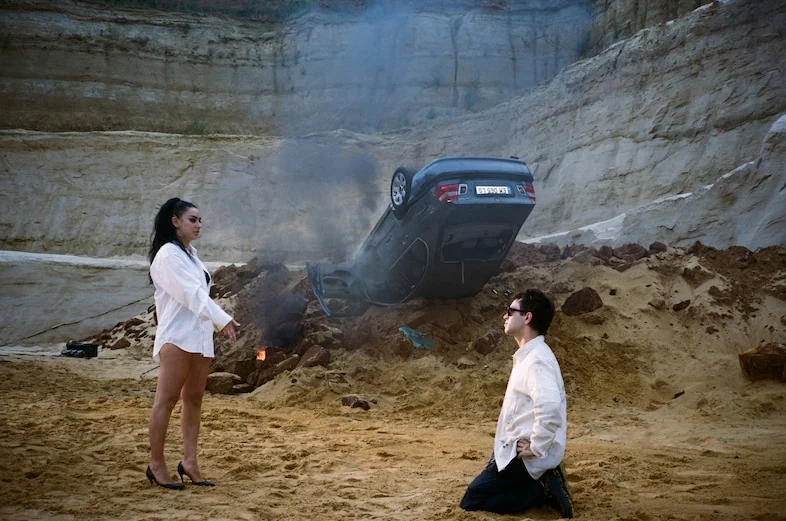
Charli’s “Camera” music video is out now. Catch a glimpse behind the scenes of the video shoot in the gallery above.