










The British film industry gathered at The Rosewood London on Wednesday evening to celebrate the conferment of the BFI Fellowship upon Academy Award-winning director Guillermo del Toro, an event marked by a significant sartorial shift from one of cinema’s most watched fashion icons, Cate Blanchett. The Australian actress, a long-time collaborator and friend of del Toro, utilized the high-profile occasion to showcase a radical departure from her established red-carpet aesthetic, appearing in a complex ensemble from the Maison Margiela Co-Ed Fall-Winter 2026 collection. This appearance serves as a definitive marker in Blanchett’s ongoing stylistic evolution, following her transition away from a decade-long professional partnership with stylist Elizabeth Stewart toward a more experimental, avant-garde approach to public dressing.
The BFI Fellowship represents the highest honor bestowed by the British Film Institute, recognizing individuals for their outstanding contribution to film or television culture. For the 2026 ceremony, the focus remained on del Toro’s unique ability to blend high-art craftsmanship with commercial genre filmmaking. Blanchett, who provided the voice for Spazzatura in del Toro’s Pinocchio and starred as the formidable Dr. Lilith Ritter in his neo-noir Nightmare Alley, was a central figure in the night’s proceedings. However, it was her choice of Maison Margiela, a house currently defined by John Galliano’s "Artisanal" deconstructionist philosophy, that captured the attention of industry analysts and fashion critics alike.
The Architecture of the Maison Margiela Look
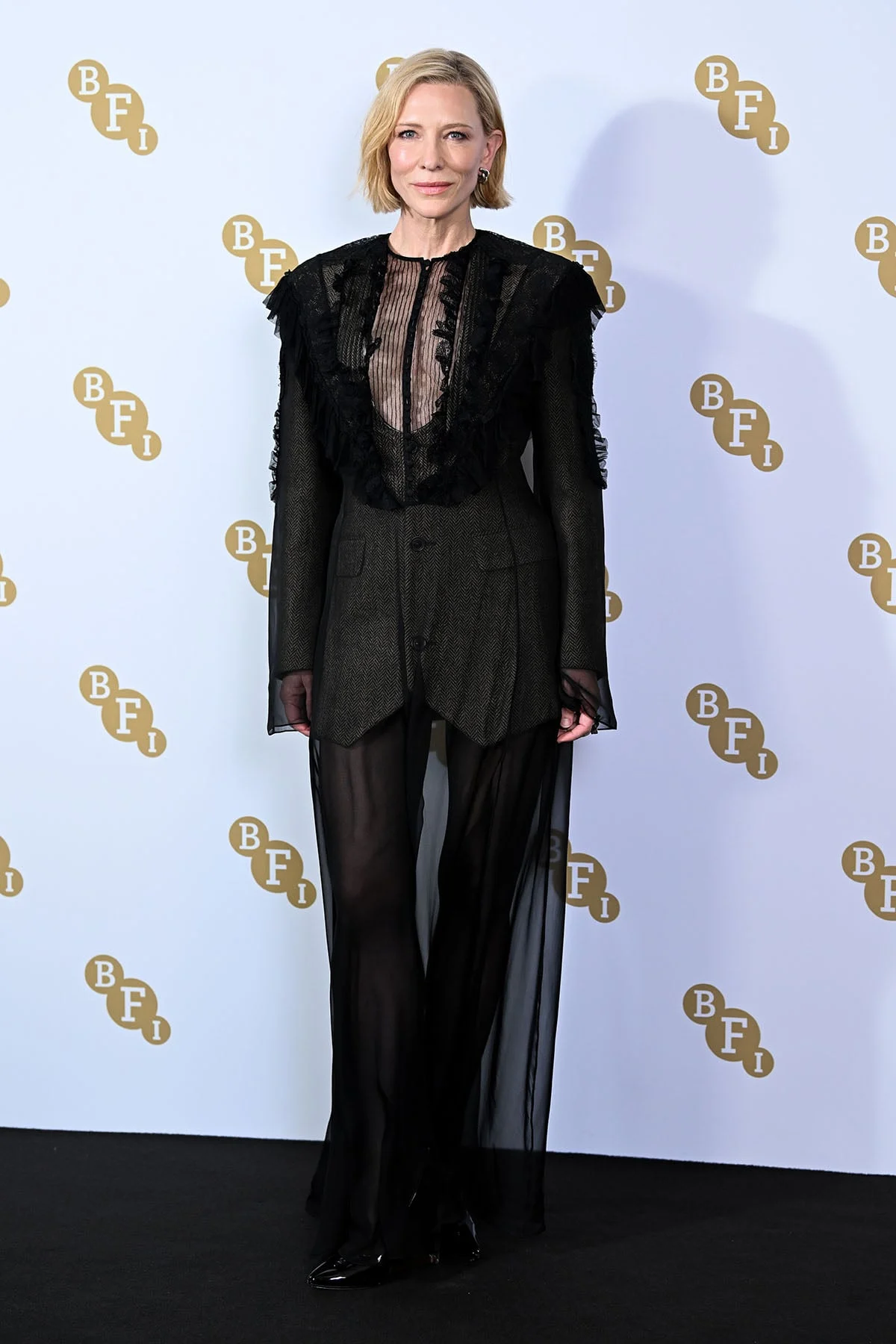
The ensemble worn by Blanchett is a study in Edwardian-inspired tailoring filtered through a contemporary, eerie romanticism. The core of the outfit consists of an elongated, structured black jacket characterized by sharp lines and a high-neck silhouette reminiscent of early 20th-century formal wear. This foundational piece was layered beneath an intricate, transparent overlay that featured voluminous, ruffled trims and sheer paneling. The juxtaposition of the heavy, opaque tailoring with the ethereal, weightless quality of the sheer fabric created a visual tension that has become a hallmark of the Maison Margiela 2026 aesthetic.
Technically, the garment highlights the "decortiqué" technique popularized by the house, where a garment is stripped back to its essential frame to reveal its internal construction. On the runway, this look was presented as a commentary on historical silhouettes being reclaimed by the modern, gender-neutral "Co-Ed" movement. For Blanchett, the look was grounded by the Plexi Claw pumps—a footwear design featuring black uppers set upon transparent Perspex wedges, further emphasizing the theme of visibility and structural transparency.
A Strategic Shift in Stylistic Direction
The industry has closely monitored Blanchett’s public appearances since the conclusion of her long-term collaboration with Elizabeth Stewart. Stewart was instrumental in crafting Blanchett’s reputation for "statuesque elegance," often leaning toward structured gowns from Armani Privé or sleek silhouettes from Givenchy. The move toward Maison Margiela suggests a pivot toward a more intellectualized form of fashion, where the objective is not merely to flatter the wearer but to engage with the garment as a piece of performance art.
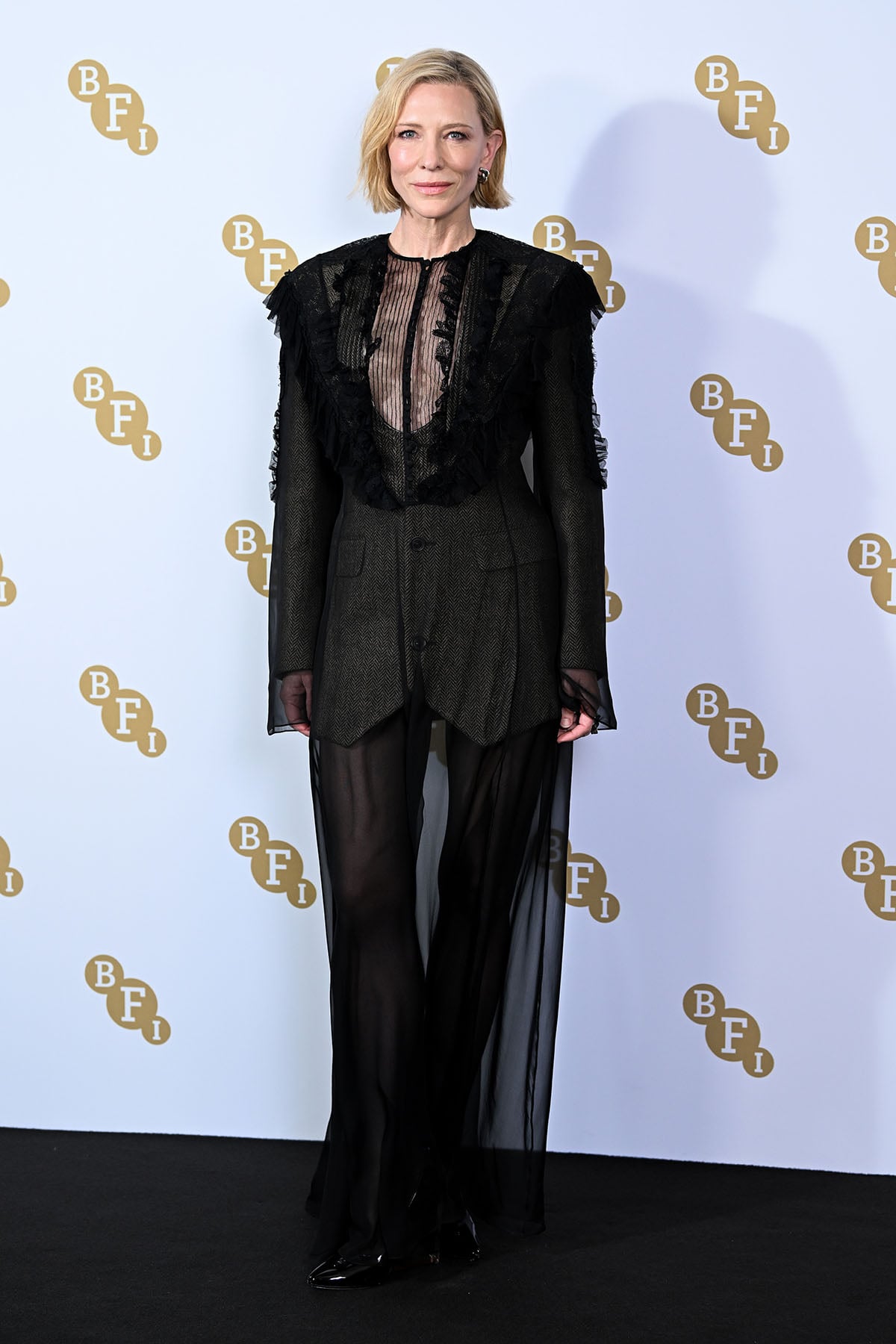
This shift mirrors a broader trend among elite actors who are increasingly using the red carpet to signal artistic alignment rather than traditional glamour. By choosing a look that requires the context of runway imagery to fully comprehend—specifically the way the ruffled trims interact with light and movement—Blanchett is positioning herself within a more challenging fashion tier. The sheer elements of the gown, which in a different context might be interpreted as provocative, were tempered by the conservative cut of the underlying jacket, maintaining a balance between avant-garde experimentation and the dignity required of a BFI event.
Contextualizing the BFI Fellowship and Guillermo del Toro
The BFI Fellowship has historically been awarded to titans of the industry whose work defies easy categorization. Past recipients include Akira Kurosawa, Orson Welles, Tilda Swinton, and Christopher Nolan. Guillermo del Toro’s induction into this cohort highlights his specific influence on the visual language of modern cinema. Known for his "Cabinet of Curiosities" approach to world-building, del Toro’s films often explore the beauty in the monstrous and the structural integrity of fantasy.
During the celebration at The Rosewood, speakers noted del Toro’s commitment to physical effects and the "handmade" quality of his films. This thematic focus on craftsmanship provided a fitting backdrop for Blanchett’s Margiela ensemble. Just as del Toro’s work often reveals the "seams" of his monsters to create a sense of tactile reality, the Maison Margiela collection emphasizes the "seams" and internal structures of high fashion. The synergy between the honoree’s cinematic philosophy and the attendee’s sartorial choice suggests a deliberate curatorial effort on the part of Blanchett and her current creative team.
Chronology of the Event and Industry Response
The evening commenced with a private reception in the Mirror Room of The Rosewood London, followed by a formal dinner where the Fellowship was officially presented. Blanchett’s arrival was the subject of immediate discussion among fashion correspondents, many of whom noted the "eerie" quality of the look, which seemed to reference the gothic sensibilities often found in del Toro’s filmography.
- Arrival (7:30 PM): Blanchett arrived, showcasing the movement of the sheer ruffles against the backdrop of the London venue.
- The Presentation (9:00 PM): The BFI Chair delivered a keynote address detailing del Toro’s three-decade career, from Cronos to his more recent stop-motion achievements.
- The Tribute (9:30 PM): Blanchett joined other collaborators in a toast to the director, where her outfit’s high-collared, Edwardian silhouette provided a striking profile during the televised segments of the event.
Initial reactions from fashion historians suggest that this look will be remembered as a "transitional" moment for Blanchett. While she has previously experimented with bold colors and unconventional shapes, the 2026 Margiela outing represents a deeper immersion into conceptual fashion. The use of transparent materials, which have seen a 22% increase in red-carpet usage over the last two fashion cycles according to industry data, was handled here with a level of modesty that aligns with Blanchett’s public persona.
Broader Implications for Red Carpet Fashion
Blanchett’s embrace of the "experimental phase" signals a potential shift in how veteran actresses manage their brand longevity. In an era where "quiet luxury" has dominated the market, a move toward the "eerie romanticism" of Margiela suggests a fatigue with minimalism. Data from luxury retail platforms indicates a growing interest in "deconstructed tailoring," with searches for "avant-garde suiting" rising by 15% in the first quarter of 2026.
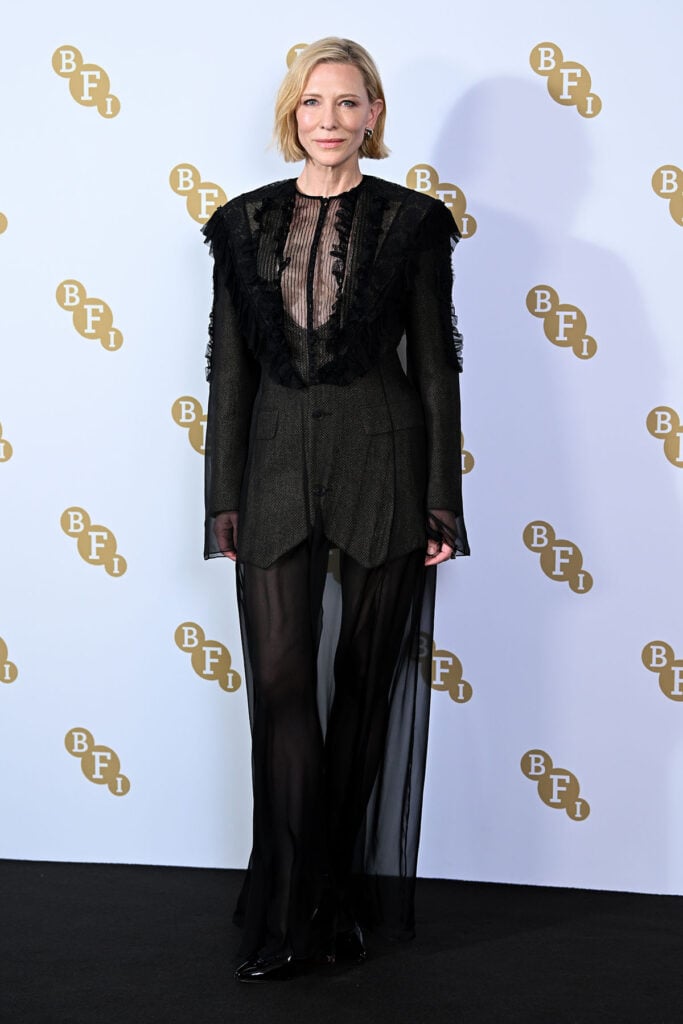
Furthermore, the choice of the Maison Margiela Co-Ed collection highlights the dissolving boundaries between traditional gendered dressing. The "Co-Ed" line is designed to be fluid, and by adopting this for a major film industry event, Blanchett continues to participate in the conversation regarding the future of formal wear. The look challenges the expectation that a female lead must appear in a gown to be considered "formal," instead offering a hybrid of masculine tailoring and feminine ornamentation.
Conclusion: The Intersection of Art and Identity
The BFI Fellowship celebration for Guillermo del Toro was more than a tribute to a director; it was a showcase of the symbiotic relationship between cinema and the high-fashion industry. Cate Blanchett’s selection of Maison Margiela served as a visual manifestation of the night’s themes: the honoring of tradition through the lens of radical reinvention.
As Blanchett continues to navigate her post-Stewart style era, her choices indicate a preference for garments that tell a story—often one that is complex, layered, and slightly unsettling. This approach ensures that her red-carpet presence remains as critically engaged as her film performances. By eschewing "traditional elegance" in favor of "challenging expectations," Blanchett remains at the forefront of the cultural conversation, proving that at the highest levels of the industry, fashion is not merely about what one wears, but about the intellectual and artistic space one chooses to inhabit.
The event concluded with a standing ovation for del Toro, but the images of Blanchett in Margiela will likely circulate in the fashion press for months to come, serving as a primary case study in the power of the sartorial pivot. For the BFI and the attendees at The Rosewood, the evening was a successful marriage of cinematic achievement and the ongoing evolution of the modern icon.