









The enduring debate between sapphire and Hesalite crystals in watchmaking, particularly for instruments destined for the rigors of aerospace, has long presented a fundamental compromise. For decades, watch enthusiasts and engineers alike have grappled with the distinct properties of each material: sapphire’s unparalleled scratch resistance and enduring clarity versus Hesalite’s superior shatter resistance and impact behavior. This dichotomy has historically forced a choice between resisting surface damage and preventing catastrophic failure. However, San Francisco-based manufacturer Barrelhand is poised to challenge this established paradigm with the introduction of its meticulously engineered Barrelhand Monolith, a mechanical watch designed from the ground up for modern extravehicular (EVA) and intravehicular (IVA) activities.

Developed over a demanding six-year period in collaboration with leading partners in aerospace manufacturing and advanced materials engineering, the Monolith represents a significant leap forward, approaching the crystal dilemma not as a matter of nostalgic tradition, but as a solvable materials science challenge. Its innovative crystal technology is just one facet of a comprehensive design philosophy aimed at creating a tool watch capable of withstanding the extreme and unpredictable conditions encountered in space exploration.
The Hesalite Legacy and Its Limitations
The preference for Hesalite, an acrylic crystal famously featured on NASA’s iconic space watches of the mid-20th century, stemmed primarily from its resilience against fracturing. In contrast to traditional sapphire, which can shatter explosively under sharp impact, acrylic materials tend to deform or crack in a less destructive manner. This characteristic was a critical factor in NASA’s original astronaut watch qualification processes, where preventing catastrophic failure was paramount. The concern was that shards of broken sapphire could pose a significant hazard in a zero-gravity environment, potentially damaging sensitive equipment or even posing a risk to astronauts.

However, Barrelhand’s extensive research has unearthed a less frequently discussed, yet equally critical, aspect of Hesalite’s performance: its thermal limitations. A review of NASA’s astronaut watch testing results from March 1, 1965, reveals that Longines Wittnauer chronographs, which utilized an acrylic-based crystal chemically similar to Hesalite (as Hesalite is essentially a branded form of PMMA acrylic), experienced significant issues. During both high-temperature and decompression testing, these watches exhibited crystal warping and even disengagement.
Barrelhand’s own rigorous testing protocols mirrored these historical findings. During trials exposing Monolith prototypes to prolonged high-temperature conditions, the company documented physical deformation and warping in a thermo-hygrometer constructed from a high-strength ABS material. This material possesses a glass-transition temperature comparable to Hesalite and PMMA acrylic, around 105°C. Barrelhand posits that such thermal instability is an inherent characteristic of acrylic-based crystals when subjected to sufficiently elevated temperatures, a factor that may have been underestimated or less emphasized in historical qualification documentation.

Further supporting their argument against the unqualified superiority of acrylic, Barrelhand points to real-world incidents. The reported instance of astronaut Dave Scott’s Speedmaster crystal popping off during the Apollo 15 mission serves as a tangible example that acrylic-based crystals were not immune to structural failures in the demanding operational environment of space. These historical and experimental observations underscore that while Hesalite offered advantages in impact resistance, it also presented vulnerabilities under extreme thermal and pressure variations.
The Sapphire Solution: Rethinking Crystalline Structure
The limitations of traditional sapphire, primarily its propensity for catastrophic shattering under sharp, localized impact, have been a long-standing concern. Barrelhand’s groundbreaking approach centers on a custom-developed lab-grade C-plane sapphire window, engineered in collaboration with Guild Optics. The crucial distinction lies in the crystallographic orientation of C-plane sapphire. Unlike conventional sapphire, where the internal atomic structure is less organized regarding stress propagation, C-plane sapphire features a precisely aligned crystalline lattice.

This directional alignment fundamentally alters how stress is distributed throughout the material. Barrelhand draws an analogy to the crumple zones in automotive engineering, where specific structural designs are intended to absorb and dissipate impact forces, thereby reducing the risk of critical structural failure. In the case of C-plane sapphire, this controlled stress propagation is designed to prevent the immediate, splintering fracture characteristic of traditional sapphire.
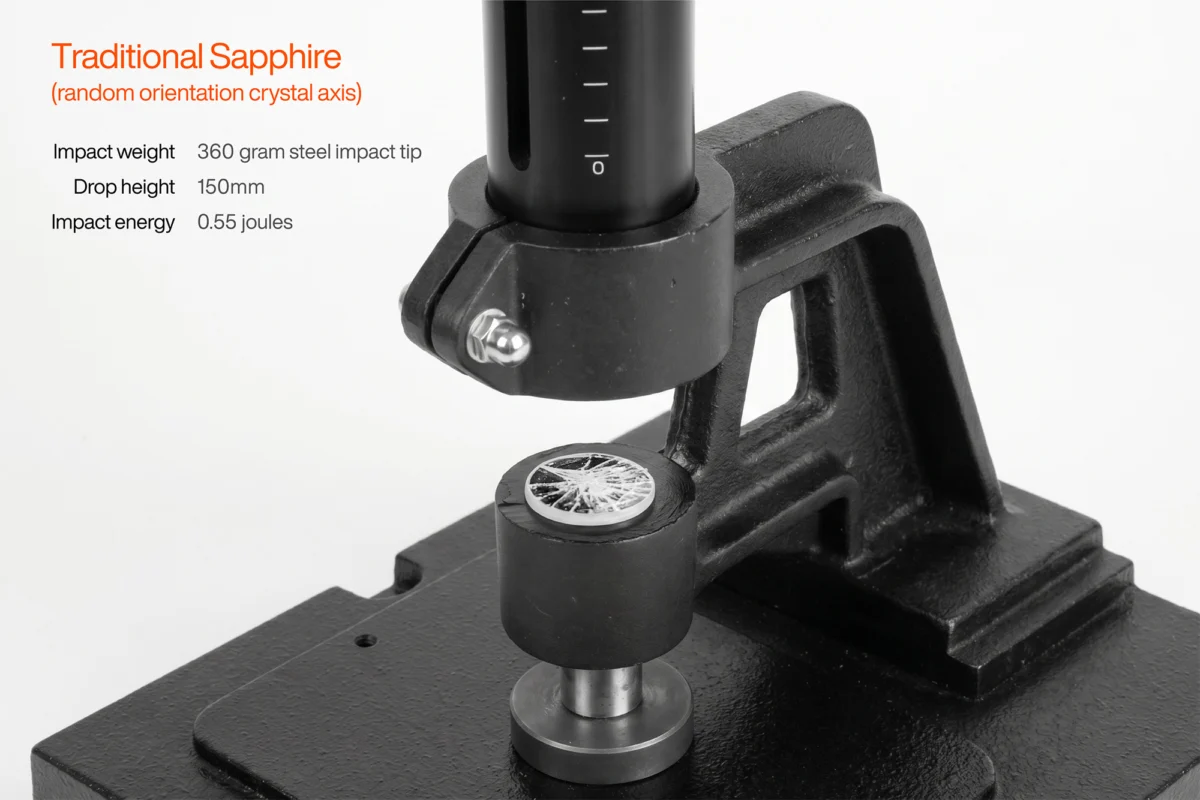
To scientifically validate this concept, Barrelhand conducted a series of controlled impact tests. Using a standardized 360-gram steel impact tip dropped from varying heights onto different crystal materials, the company meticulously recorded the results. According to their published testing data, the C-plane sapphire demonstrated a remarkable improvement in impact resistance, outperforming both traditional sapphire and transparent aluminum alternatives by nearly 2.5 times.

Crucially, the C-plane sapphire exhibited what Barrelhand terms "anti-spalling" behavior. Under extreme load, instead of immediately shattering, the material reportedly dented and deformed before any catastrophic failure occurred. This behavior is highly desirable for an aerospace tool watch, as it suggests a controlled failure mode rather than an immediate and hazardous fragmentation. This engineered resilience aims to bridge the gap between the superior scratch resistance of sapphire and the impact mitigation traditionally offered by Hesalite.
Beyond the Crystal: A Holistic Approach to Aerospace Engineering
The Barrelhand Monolith’s innovative crystal is not an isolated feature but an integral part of a broader engineering philosophy aimed at creating a watch truly optimized for the space environment. The watch case itself is a testament to this commitment, constructed using 3D-printed Scalmalloy, an aerospace-grade aluminum-scandium alloy renowned for its high strength-to-weight ratio. This advanced manufacturing technique results in a remarkably lightweight case, weighing just 31 grams excluding the strap, while maintaining exceptional durability.

The heart of the Monolith is its M1 Engine, a movement based on the robust Sellita SW300 architecture. However, Barrelhand has significantly enhanced this base movement with features specifically designed for the challenges of spaceflight. These enhancements include extensive magnetic resistance, advanced shock isolation systems, and thermal insulation to protect the delicate mechanisms from extreme temperature fluctuations.
The commitment to rigorous testing is evident in Barrelhand’s extensive validation process for the Monolith. Prototypes underwent a comprehensive suite of environmental simulations, including vacuum exposure, thermal cycling across extreme temperature ranges, decompression simulations, vibration testing, and humidity exposure. These protocols were meticulously modeled after historical NASA EVA qualification procedures, demonstrating Barrelhand’s dedication to meeting the stringent demands of aerospace applications.

A significant portion of Barrelhand’s development documentation reads more like an aerospace engineering white paper than a typical watch press release. This detailed analysis delves into the historical astronaut-watch qualification processes of the 1960s, critically examining where legacy systems excelled and, more importantly, where they revealed their limitations under real-world operational conditions. This in-depth review informs the Monolith’s design, ensuring it addresses not only the successes of past space-grade timepieces but also their inherent vulnerabilities.
Design for Extremes: Functionality and Longevity
The visual design of the Barrelhand Monolith is a direct reflection of its technical purpose, embracing a distinctly utilitarian and technical aesthetic. The dial features a monolithic ceramic lume structure, a departure from traditional painted markers, ensuring superior luminosity and longevity in low-light conditions.

A key functional element is the oversized "Airlock Crown," engineered for effortless operation even when wearing bulky gloves or in extreme environmental conditions, including underwater or potentially even in a vacuum. The EVA/IVA strap system is equally considered, incorporating micro-adjustable titanium hardware. This hardware is specifically designed for compatibility with both legacy Extravehicular Mobility Units (EMUs) and next-generation spacesuits, ensuring a secure and functional fit for astronauts.
Further underscoring the watch’s integration into the existing spaceflight infrastructure, Barrelhand has utilized Torx screws for the caseback and strap bars. This choice facilitates easy servicing with tools commonly found and utilized on the International Space Station (ISS), and also optimizes driver stability in microgravity.

The Memory Disc Module: A Legacy for the Future
Beyond its immediate functional capabilities as a timekeeping instrument, the Barrelhand Monolith incorporates a unique feature designed for long-term cultural preservation. Integrated into the caseback is a Memory Disc Module, a 3GB NanoFiche archive. This archive is engineered to preserve vital cultural artifacts for over a thousand years. Its contents are carefully curated, including translations of UNESCO documents, significant artworks, and influential literary works. This inclusion positions the Monolith not merely as a tool for survival and navigation in harsh environments, but as a symbolic vessel for human knowledge and cultural heritage, intended to endure for future generations and distant exploration missions.
Addressing the Industry’s Core Debate
The Barrelhand Monolith directly confronts one of the longest-standing debates in the watch community: the sapphire versus Hesalite dilemma. For years, enthusiasts have accepted this as an unavoidable compromise between the practical durability of sapphire and the functional resilience of Hesalite. Barrelhand’s assertion is that advancements in modern aerospace materials science have rendered this trade-off obsolete.

By developing a C-plane sapphire crystal combined with a Hytrel suspension mounting system designed to absorb sharp impacts before they reach the crystal, Barrelhand aims to achieve what many have considered the holy grail of aerospace watchmaking: the scratch resistance and long-term clarity of sapphire married with the impact resistance of Hesalite. As Barrelhand articulates, "a solution which exhibits scratch resistance of sapphire and impact resistance of Hesalite is the optimal solution for longevity and legibility."
While the broader impact of the Monolith on the industry’s thinking remains to be seen, it undoubtedly represents one of the most technically ambitious and comprehensive attempts to re-evaluate and ultimately solve a problem that has captivated watch enthusiasts for generations.

The Barrelhand Monolith is slated for a price point of $9,750 USD, with deliveries for new orders anticipated in the fourth quarter of 2026. Further details can be found on the Barrelhand website.