










The final evening of London Fashion Week for the Spring/Summer 2027 season provided a sharp narrative pivot for one of Britain’s most historic fashion houses. Moving decisively away from the high-energy ode to the Great British night out that defined his previous collection, Burberry creative director Daniel Lee traded nocturnal revelry for academic introspection. For the SS27 presentation—marking Burberry’s fourth consecutive runway show at the venue—the brand transformed the historic grounds of the Chelsea College of Arts into an open-air fashion amphitheater.
An institution with an illustrious creative lineage, the Chelsea College of Arts has historically served as a fertile training ground for some of the United Kingdom’s most celebrated modern artists, including Turner Prize winners and Turner nominees such as Steve McQueen, Anish Kapoor, and Chris Ofili. By anchoring the SS27 presentation within this storied campus on Millbank, Lee signalled a thematic preoccupation with British creativity, intellectual rigor, and foundational design principles. The choice of location offered a deliberate nod to process, heritage, and the meticulous study of craft that underpins both fine art and luxury fashion.
The Main Facts and Front-Row Spectacle
As is customary for a brand that positions itself as the pinnacle of contemporary British lifestyle and commerce, the front row functioned as a cultural barometer for the current state of UK arts, sports, and entertainment. Observers on the benches included musicians Skepta and Jorja Smith alongside critically acclaimed actor Jonathan Bailey. The worlds of elite athletics and high fashion collided with the presence of British tennis star Jack Draper and England national football team defender Djed Spence.
Further adding to the domestic star power were prominent fashion figures Lila Moss, Romeo Beckham, Jason Statham, and Rosie Huntington-Whiteley. The international contingent proved equally robust, featuring Nigerian singer-songwriter Tems, American actors Rachel Brosnahan and Kieron Moore, and digital creator Nara Smith. This carefully curated guest list underscored Burberry’s ongoing strategy to bridge traditional British heritage with hyper-relevant contemporary global culture, ensuring high-visibility engagement across various demographic sectors.
Chronology and Show Production
The SS27 presentation unfolded as the grand finale of London Fashion Week, a five-day marathon of British design talent that draws international buyers, editors, and influencers to the UK capital. Scheduled for the twilight hours of the final day, the Burberry event served as the emotional and stylistic crescendo of the city’s fashion calendar.
The runway presentation commenced with an auditory landscape designed to reflect Lee’s fascination with deep musical cuts and cultural archives. Rather than opting for immediate commercial gratification or predictable crowd-pleasing anthems, the show opened with "Abdulmajid," an atmospheric instrumental track by David Bowie. This transitioned seamlessly into Bowie’s "Weeping Wall" and "Subterraneans," forming a trilogy of ambient, experimental compositions from the late artist’s Berlin era.
Bowie’s influence permeated the sonic architecture of the event. While the fashion industry has long relied on Bowie’s ubiquitous 1977 anthem "Heroes" as a standard runway finale, Lee deliberately bypassed the track in favor of a deeper archival selection. The presentation concluded with the haunting, reflective tones of Bowie’s 1980 single "Ashes to Ashes," a choice that reinforced the collection’s themes of reinvention, maturity, and retrospective evaluation.
Design Direction: Back to Basics and Soulful Minimalism
In the official show notes, the directive for the collection was summarized in a single, evocative phrase: “Burberry at its most soulful.” Elaborating on this vision, Lee described the outing as “a return to the basis of things,” signaling a conscious corporate and creative recalibration following several seasons of stylistic experimentation.
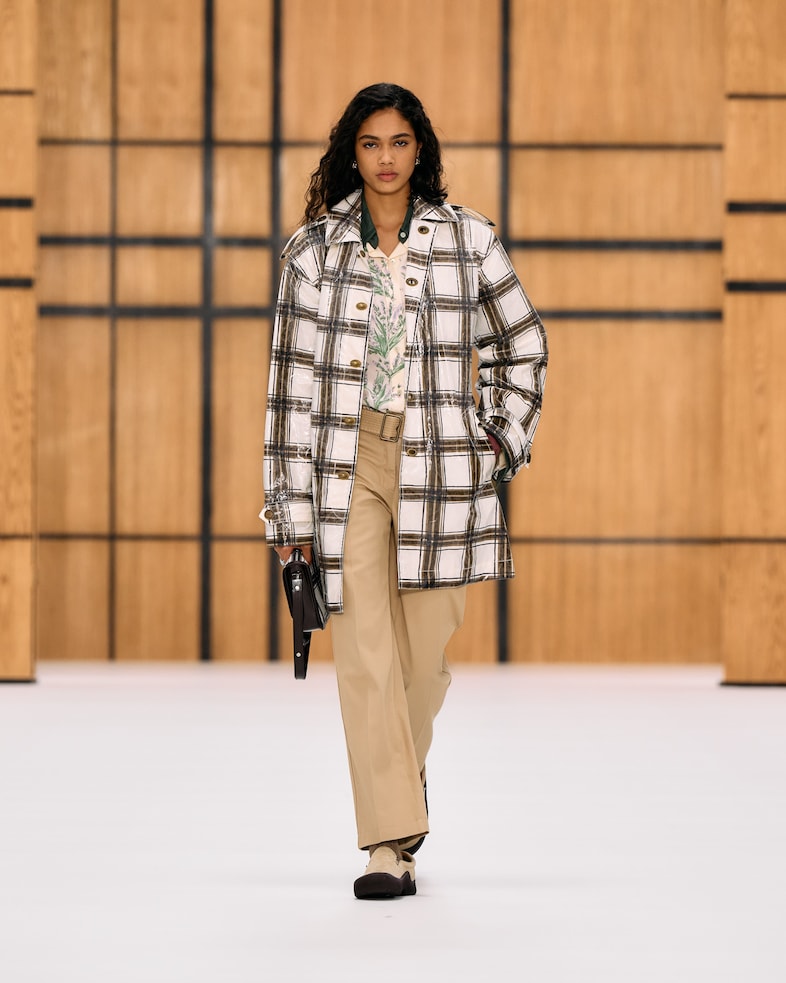
The physical garments mirrored this pursuit of foundational design. The opening sequence featured innovative nylon trench coats constructed with voluminous puffball hems, marrying the brand’s quintessential outerwear heritage with contemporary volume and silhouette manipulation. These were followed by supple leather coats detailed with intricate appliqués, and leather shorts rendered in sophisticated earthy tones of mocha and steel.
Subtle detailing defined the textile approach. Micro-floral patterns were delicately dotted across lightweight shirts and coats, introducing a pastoral softness that contrasted with the structural weight of the outerwear. Knitwear provided some of the season’s most visually striking moments, notably through jumpers featuring trompe-l’œil epaulettes. These exaggerated, cartoonish fabric manipulations sat heavily on the models’ shoulders, subverting traditional military tailoring with a touch of surrealism. Completing several looks were nylon bakerboy caps, which transformed the contemporary models into stylized, modern-day interpretations of historical British figures.
Another standout piece within the ready-to-wear lineup was a salmon-colored leather trench coat meticulously adorned with blueberry-like beading, demonstrating an investment in artisanal surface embellishment that elevates standard luxury garments into collector’s items.
The Celia Birtwell Collaboration
A central pillar of the SS27 collection was an artistic collaboration with legendary British textile designer Celia Birtwell. An octogenarian icon whose signature prints helped define the bohemian aesthetic of 1960s and 1970s British fashion, Birtwell produced original textile designs exclusively for Burberry.
The partnership yielded some of the season’s most commercially promising and visually distinct pieces. A notable leather coat served as a canvas for Birtwell’s hand-drawn green, orange, and white face motifs, which resembled primitive, proto-emojis expressing various emotional states. This whimsical graphic motif was translated across a range of shirts and lightweight jumpers, establishing a playful dialogue between heritage artistry and digital-age iconography. Furthermore, Birtwell reinterpreted Burberry’s historic Nova Check, softening the traditional tartan geometry into a design closely resembling classic, youthful picnic gingham.
Surprise Runway Cameos: Central Cee Takes the Catwalk
Burberry has established a recurring tradition of subverting traditional modeling standards by inviting revered British cultural figures—particularly from the worlds of acting and music—to make unexpected runway debuts. Past seasons have featured veteran performers such as Richard E. Grant, Jason Isaacs, Lesley Manville, and Elizabeth McGovern.
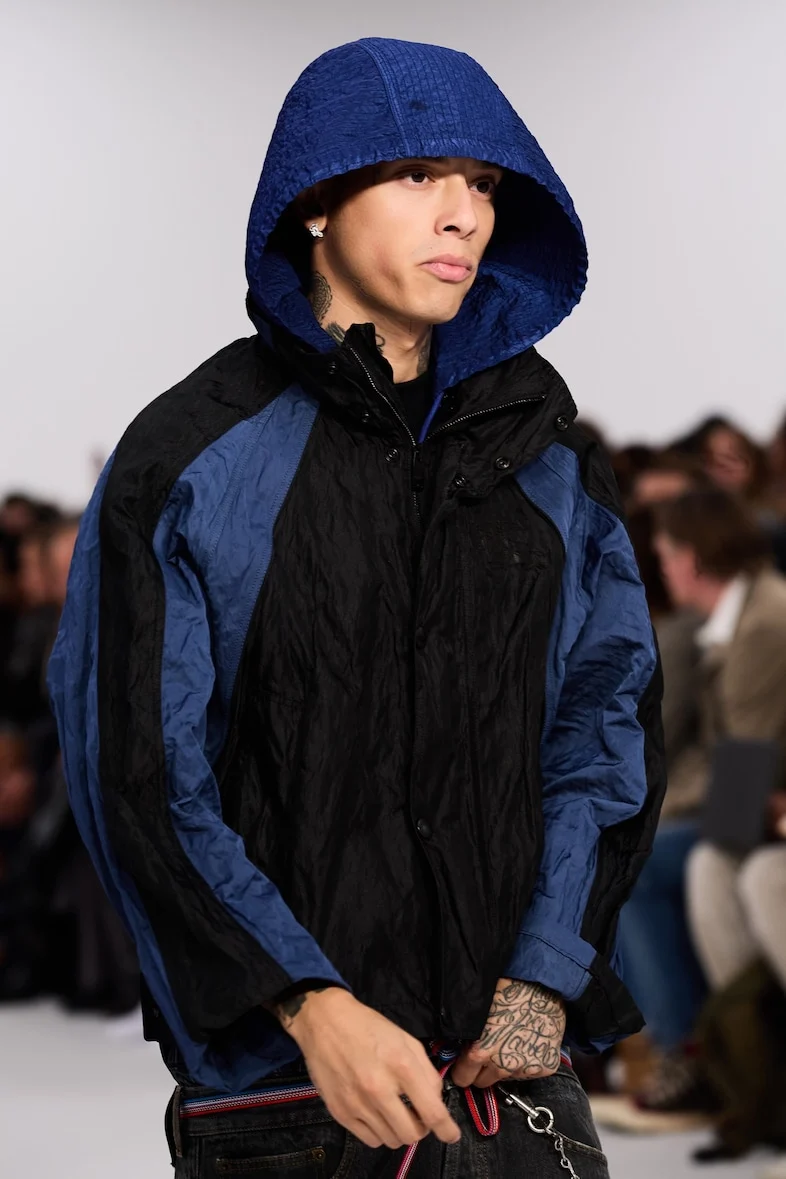
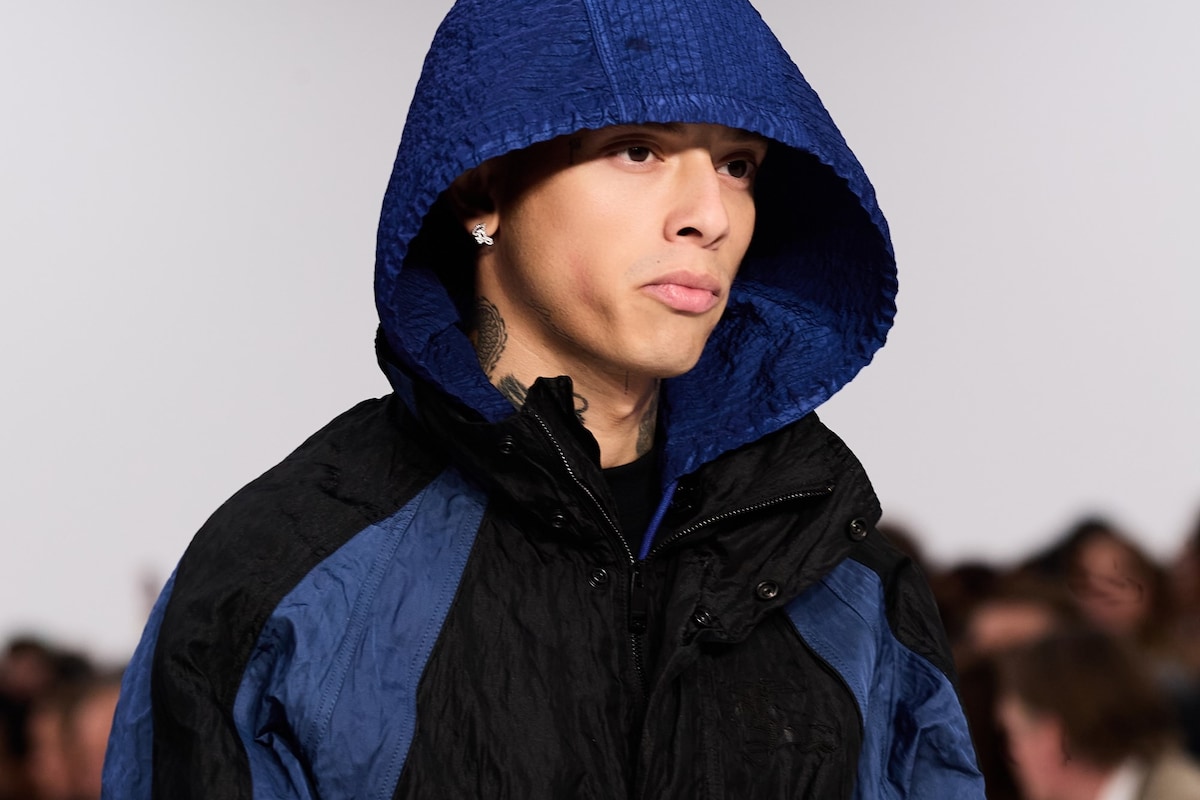
For SS27, that mantle was assumed by British rap superstar Central Cee. The artist’s appearance on the Chelsea College of Arts runway capped off a remarkably busy London Fashion Week schedule, which had previously seen him supporting emerging talent by attending Traiceline Pratt’s GOYAGOMA presentation and sitting front row at Fashion East.
True to his signature personal style, Central Cee walked the runway in a utilitarian hooded anorak paired with intentionally slumping denim jeans. The trousers were worn low enough to deliberately expose the elastic waistband of a pair of classic Burberry check boxers, blending high-fashion tailoring with contemporary streetwear codes and youth-culture signaling.
Broader Impact, Market Implications, and Industry Analysis
From an industry perspective, Daniel Lee’s SS27 collection for Burberry arrives at a crucial juncture for the historic label. As legacy luxury houses navigate a global retail environment marked by cautious consumer spending and shifting macroeconomic conditions, creative directors are increasingly pressured to balance commercial viability with brand heritage.
Lee’s “back to basics” approach represents a pragmatic pivot toward product integrity. By stripping away extraneous theatricality and focusing on wearable, beautifully crafted outerwear, leather goods, and high-end knitwear, Burberry aims to reassure its core retail demographic while maintaining the cultural relevance generated by high-profile collaborations with figures like Celia Birtwell and Central Cee.
The strategic integration of British cultural touchstones—from Bowie’s Berlin-era soundscapes to the academic heritage of the Chelsea College of Arts—serves to reinforce Burberry’s position as an unabashed ambassador of British identity. Analysts suggest that grounding the collection in tactile craftsmanship and recognizable brand codes, such as the trench coat and reinterpreted check prints, provides a stabilizing anchor during a period of broader luxury market adjustment.
Ultimately, the SS27 presentation suggests a maturation of Lee’s tenure at Burberry. By leaning into the soulful, foundational elements of the house rather than relying solely on transient shock value, the brand has charted a sustainable course forward—one that honors the past while remaining securely fastened to the realities of contemporary luxury commerce.