










The watch industry has long been defined by the pursuit of the "ideal" timepiece, a quest that often leads enthusiasts to conclude that the market lacks a specific intersection of form and function. Thomas Hill, the founder of the Malmesbury-based brand Abinger, identified this void during his engagement with the British watch community. Following the successful reception of the debut Nimrod model—a watch inspired by Ernest Shackleton’s 1907-1909 Antarctic expedition—Abinger has officially introduced its sophomore release, the Abinger Phantom. This new collection, featuring the fully lumed Luna and the monochromatic Nox, marks a strategic pivot for the brand, emphasizing both tactical aesthetics and a transition toward domestic assembly in the United Kingdom.
The Genesis of a British Microbrand
The story of Abinger is reflective of a broader resurgence in British watchmaking that has gained momentum over the last two decades. The brand’s inception was catalyzed by direct input from the Bristol RedBar community, a global network of watch collectors. Ken Lam, founder of Arken Watches, is frequently cited as a key advisor in the early developmental stages of the brand. This collaborative environment echoes the spirit of the independent watchmaking scene from the mid-2000s, where proximity to enthusiast circles directly informed product design.

By grounding its development in the feedback of seasoned collectors, Abinger has attempted to bypass the common pitfalls of start-up brands. The transition from the debut Nimrod, a historical tribute, to the Phantom, a contemporary tactical instrument, demonstrates a clear evolution in the company’s design language.
Technical Specifications and Design Philosophy
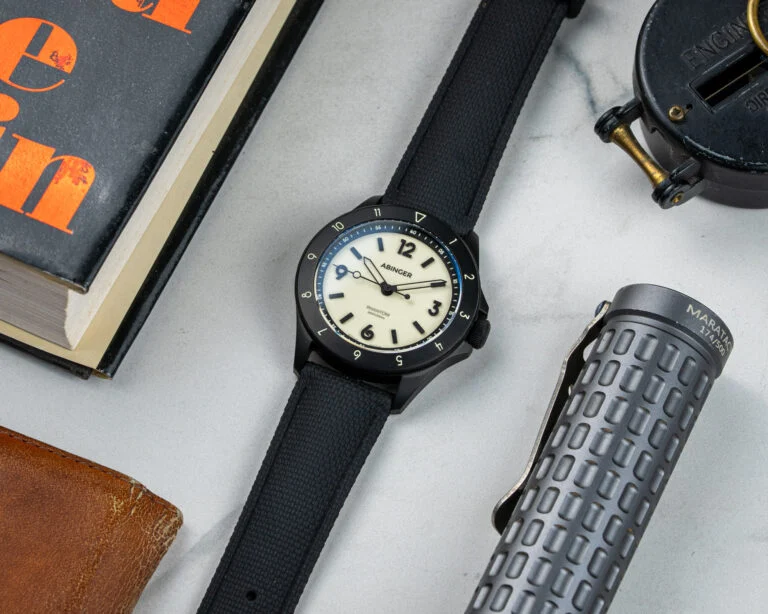
The Abinger Phantom is built upon a 38.5mm 316L surgical stainless steel case, finished with a sand-blasted Diamond-Like Carbon (DLC) coating. This choice of materials and finishing is intended to offer a rugged, non-reflective surface suitable for field conditions. Despite the "tactical" classification, the watch retains a compact profile, measuring 10.8mm in thickness with a 45mm lug-to-lug distance. This geometry is intentional; by maintaining a moderate footprint, the brand seeks to ensure wearability across a variety of wrist sizes, particularly those that struggle with the current market trend of oversized tool watches.
The dial architecture is available in two distinct configurations. The Luna variant utilizes a fully C3-lumed surface, creating high contrast against black-rendered indices at the 12, 3, 6, and 9 o’clock positions. The Nox variant offers a traditional black-on-black tactical aesthetic. Both models are protected by an anti-reflective sapphire crystal and feature a unidirectional 120-click, 12-hour bezel. The inclusion of a 12-hour scale instead of a standard dive timer suggests that the brand is targeting the frequent traveler demographic, allowing for a secondary time zone reference.

Performance and Mechanical Integrity
At the heart of the Phantom series lies the Miyota 9039 automatic movement. Introduced by Citizen’s movement division in 2018, the 9039 is a 24-jewel, high-beat (28,800 vph) caliber that has become a staple for microbrands seeking a balance between thinness and reliability. With a 42-hour power reserve, the movement aligns with the expectations of the £725 price bracket.
The selection of the 9039 over more budget-oriented calibers indicates a commitment to longevity. Because the movement is known for its serviceability, it complements the watch’s intended purpose as a daily-wear tool. Furthermore, the Phantom features 200 meters of water resistance and a screw-down crown, verifying its utility in aquatic environments. The watch is supplied on a custom-textured black FKM rubber strap, which incorporates DLC-coated hardware to match the case finish, ensuring structural consistency in the design.
The Shift Toward Domestic Assembly
Perhaps the most significant development in the Phantom launch is the brand’s decision to transition assembly operations to the United Kingdom. This move represents a growing trend among enthusiast-driven labels to exert greater control over quality assurance. In an era where global supply chains are frequently scrutinized for transparency, Abinger has opted to disclose the sourcing of its components while centralizing the final build process in Malmesbury.

For the domestic watchmaking industry, this is a strategic move. By bringing assembly in-house, Abinger is able to perform rigorous quality control checks locally, reducing the logistical friction associated with international shipping and repairs. This decision not only enhances the brand’s "British-made" narrative but also aligns with the broader economic goal of fostering specialized manufacturing skills within the UK.
Market Positioning and Competitive Analysis
The £725 price point places the Abinger Phantom in a highly contested segment of the horological market. It faces stiff competition from established microbrands such as CWC and Elliot Brown, both of which hold deep ties to British military and maritime history.
Competitive Landscape Table
| Feature | Abinger Phantom | Typical Market Rival |
|---|---|---|
| Case Material | DLC Stainless Steel | Standard Steel/PVD |
| Movement | Miyota 9039 | Seiko NH35/Miyota 9xxx |
| Assembly | United Kingdom | Asia/Mixed |
| Water Resistance | 200 Meters | 100-200 Meters |
| Primary Market | Enthusiasts | General Consumer |
The success of the Phantom will largely depend on whether consumers perceive the value of domestic assembly and the brand’s specific design ethos as sufficient justification for its price. While some competitors offer similar specifications at a lower cost, the Phantom differentiates itself through its specific, modern aesthetic—a departure from the purely vintage-inspired designs that currently dominate the microbrand space.

Implications for Future Growth
The Phantom’s release provides insight into the sustainability of the "community-funded" model of watchmaking. By proving that a brand can iterate successfully from a historical debut to a contemporary tactical follow-up, Abinger has established a roadmap for long-term viability. The brand’s trajectory suggests that it will likely continue to focus on tool-watch versatility, perhaps expanding into different case materials or complications as it matures.
For the collector, the Phantom represents an entry point into the burgeoning British scene. It avoids the trap of excessive nostalgia, instead offering a design that feels pertinent to the present. The decision to limit the initial run and focus on precise, localized assembly suggests a measured approach to growth—one that prioritizes reputation and quality over rapid, mass-market expansion.
Conclusion
The Abinger Phantom Luna is a study in calculated minimalism. By blending high-spec materials like DLC-coated steel and reliable Japanese movements with a transparent assembly process in the UK, Abinger has positioned itself as a serious player in the enthusiast segment. While the competitive landscape remains intense, the brand’s reliance on community feedback and its commitment to a coherent design language provide a strong foundation. As the industry continues to shift toward smaller, more nimble operations, Abinger’s transition to domestic assembly may serve as a model for other emerging brands looking to establish a sustainable, quality-focused presence in the global market. The Phantom does not attempt to reinvent the tool watch, but rather to refine it—a task that, in the current market, is both necessary and welcome.