










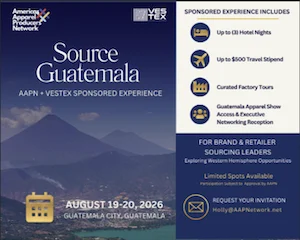
The Americas Apparel Producers’ Network (AAPN) and The Apparel and Textile Association of Guatemala (VESTEX) have officially announced a strategic partnership to launch "Source Guatemala," an exclusive, sponsored sourcing experience tailored specifically for senior leadership within the global apparel and retail sectors. Scheduled to take place on August 19 and 20, 2026, this high-level program is designed to provide a comprehensive, boots-on-the-ground perspective of Guatemala’s rapidly evolving textile and apparel supply chain. The event will coincide with the Guatemala Apparel Show, the region’s premier industry trade fair, offering a concentrated environment for networking, factory inspections, and strategic supplier engagement.
Based in Mount Pleasant, South Carolina, the AAPN has long served as a critical bridge between North American brands and Western Hemisphere manufacturers. By partnering with VESTEX, the representative body for Guatemala’s garment and textile industry, the organization aims to facilitate deeper integration between U.S. demand and Central American supply. The "Source Guatemala" initiative is positioned as a response to the increasing demand for nearshoring solutions, as global brands seek to mitigate the risks of long-distance logistics and capitalize on the trade benefits provided by regional agreements.
The Source Guatemala Program: Objectives and Structure
The primary objective of Source Guatemala is to demystify the Guatemalan manufacturing landscape for sourcing and supply chain executives. While many brands are aware of Guatemala’s role in the apparel sector, the program seeks to showcase the modern technological advancements and vertical integration that have transformed the local industry over the last decade. Participants will engage in a curated itinerary that emphasizes transparency, capacity evaluation, and relationship building.
The experience is structured to maximize the efficiency of time for high-level executives. It includes escorted factory tours of world-class facilities, ranging from spinning and knitting mills to high-capacity sewing operations and specialized finishing plants. These tours are designed to demonstrate the country’s capabilities in high-performance synthetic wear, circular knits, and premium cotton garments. Furthermore, the program features dedicated networking sessions where brand leaders can meet directly with the owners and operators of Guatemala’s leading textile firms, fostering the trust necessary for long-term strategic partnerships.
Participation in Source Guatemala is strictly limited to qualified brand and retailer professionals who hold decision-making authority over sourcing strategy and supplier selection. This exclusivity ensures that the dialogue remains focused on high-level business development and regional strategy rather than general trade inquiries.
Chronology of the Event and Industrial Context
The announcement of Source Guatemala on June 4, 2026, serves as the beginning of a multi-stage rollout leading up to the August event. The timeline for the initiative reflects a strategic alignment with the annual Guatemala Apparel Show, an event that has historically drawn thousands of participants from across the globe.
- June 2026: Official launch of the partnership and opening of the application process for brand leaders.
- July 2026: Vetting and approval of participants, followed by the coordination of customized factory tour itineraries based on the specific product needs of the attending brands.
- August 19, 2026: Commencement of Source Guatemala. Day one typically focuses on factory immersions and technical demonstrations of vertical production capabilities.
- August 20, 2026: Integration with the Guatemala Apparel Show, featuring panel discussions on regional trade policy, networking luncheons, and one-on-one supplier meetings.
The timing of this event is particularly significant given the current state of the global textile market. In 2026, the apparel industry continues to navigate a landscape defined by volatile shipping costs, geopolitical tensions in the Far East, and a heightened focus on environmental, social, and governance (ESG) standards. By hosting this event in August, AAPN and VESTEX provide a timely opportunity for brands to finalize their sourcing strategies for the 2027 fiscal year.
Guatemala’s Textile Sector: Supporting Data and Economic Impact
Guatemala remains a cornerstone of the Central American textile industry, consistently ranking as one of the top exporters of apparel to the United States under the Dominican Republic-Central America Free Trade Agreement (CAFTA-DR). According to industry data, the textile and apparel sector in Guatemala accounts for approximately 8.9% of the country’s Gross Domestic Product (GDP) and represents its leading export category.
As of 2025, the sector employed over 80,000 workers directly, with an additional 300,000 jobs created indirectly through the broader supply chain. In terms of trade volume, Guatemala’s apparel exports to the U.S. market exceeded $1.6 billion annually in recent years. The industry’s growth is increasingly driven by "verticality"—the ability to perform every step of the manufacturing process, from yarn production to final packaging, within a single geographic area.
Key data points highlighting the region’s competitiveness include:
- Logistical Proximity: Shipping times from Guatemala’s ports (such as Puerto Quetzal and Santo Tomás de Castilla) to major U.S. hubs range from three to five days, compared to 30 to 45 days from Asian ports.
- Duty-Free Access: Under CAFTA-DR, garments produced in Guatemala using regional yarns and fabrics enter the United States duty-free, providing a significant cost advantage—often 15% to 32%—over Asian competitors.
- Sustainability Metrics: A growing number of Guatemalan mills have invested in renewable energy sources, including biomass and solar, to power their operations, aligning with the sustainability mandates of global retailers.
Strategic Shift Toward Nearshoring and Regional Resilience
The launch of Source Guatemala is a direct reflection of the "nearshoring" trend that has reshaped the apparel industry since 2020. Supply chain leaders have increasingly prioritized "speed-to-market" and "flexibility" over the lowest possible unit cost. In a market where consumer trends change weekly, the ability to replenish inventory within a 15-day window is a critical competitive advantage.
Guatemala has positioned itself as the "knit hub" of the Americas. While other regional neighbors focus on basic commodities, Guatemalan manufacturers have specialized in complex constructions, including moisture-wicking activewear, intricate prints, and high-end fleece. This specialization makes the country an ideal partner for brands looking to move high-value production closer to their primary North American consumer base.
The partnership between AAPN and VESTEX emphasizes the concept of "co-opetition"—a strategy where regional players collaborate to strengthen the entire Western Hemisphere’s position against global competition. By bringing sourcing leaders directly to the factories, Source Guatemala aims to prove that the region has the scale and sophistication to handle high volumes that were previously reserved for mega-factories in Vietnam or China.
Official Perspectives and Industry Implications
While formal quotes were not detailed in the initial announcement, the collaboration suggests a unified stance from leadership at both AAPN and VESTEX. For the AAPN, this initiative fulfills its mission to promote "The Linkage"—a philosophy that the entire supply chain, from fiber to retail, must work as a single, synchronized unit. For VESTEX, the program is a vital tool for industrial promotion, showcasing the millions of dollars in recent capital investments made by Guatemalan firms in automation and water treatment technologies.
Industry analysts suggest that the Source Guatemala program could serve as a blueprint for other manufacturing hubs in the region, such as El Salvador or Honduras. The success of such a program is measured not just by immediate contracts signed, but by the long-term shift in perception among sourcing executives. If leaders can see the "clean room" environments of modern Guatemalan textile mills and the social programs implemented for workers, the perceived risk of regional sourcing diminishes significantly.
Furthermore, the program addresses the critical issue of "Rule of Origin" compliance. By touring the spinning and knitting facilities, sourcing leaders can gain a better understanding of how to structure their supply chains to maximize CAFTA-DR benefits, ensuring that their products meet the rigorous "yarn-forward" requirements necessary for duty-free status.
Future Outlook: Strengthening the Western Hemisphere
As the apparel industry moves toward the latter half of the decade, the emphasis on regionalized supply chains is expected to intensify. Source Guatemala represents a proactive step by AAPN and VESTEX to secure Guatemala’s role in this future. The program is not merely a tour but a strategic intervention designed to align manufacturing capacity with the evolving needs of the modern retailer.
The implications for the broader market are clear: the Western Hemisphere is no longer just a backup option for "chase" orders or replenishment. Through initiatives like Source Guatemala, it is positioning itself as a primary, strategic destination for full-scale production. The focus on transparency and direct engagement is likely to result in more robust, resilient supply chains that can withstand the logistical and geopolitical shocks that have characterized the global economy in recent years.
For qualified professionals interested in the August 2026 experience, the AAPN has established a dedicated portal for applications and inquiries. Given the limited capacity and the requirement for professional vetting, early registration is encouraged for those looking to evaluate the potential of the Guatemalan textile sector firsthand.
The "Source Guatemala" program stands as a testament to the power of regional collaboration. By bridging the gap between the executive suite and the factory floor, AAPN and VESTEX are facilitating a new era of trade that prioritizes proximity, transparency, and shared economic growth across the Americas.