









In 2026, the tourbillon, a marvel of horological engineering conceived in the late 18th century, stands at a fascinating crossroads. Its fundamental mechanism – the intricate cage that rotates to counteract the effects of gravity on the balance wheel and escapement – has remained remarkably consistent since its inception. However, its place within the luxury watch landscape has undergone a profound transformation. Once the exclusive domain of ultra-high-end timepieces, commanding price tags well into six figures, the tourbillon is now entering a more accessible echelon, signaling a shift from a status symbol to a celebration of mechanical artistry for a broader audience.

The Historical Ascent and Divergence of the Tourbillon
Abraham-Louis Breguet is credited with inventing the tourbillon in 1795, patenting it in 1801. Initially, its purpose was to enhance the accuracy of pocket watches, which were often kept in a vertical position. The constant rotation of the tourbillon cage was designed to average out any positional errors in the movement. For over a century, it remained a complex and rare feature, primarily found in the most prestigious timepieces.
The late 20th century witnessed a resurgence of interest in the tourbillon. As mechanical watchmaking experienced a renaissance in the 1990s, luxury brands began incorporating this visually captivating complication into their most expensive offerings. The "whirlwind" effect of the tourbillon cage became a hallmark of exclusivity and prestige. Owning a watch with a tourbillon was, for many years, a clear indicator of significant wealth, with prices often exceeding $100,000 USD.

Over the past quarter-century, the evolution of the tourbillon has largely followed two distinct paths. One path led to an escalation of complexity, with watchmakers pushing the boundaries of engineering to create timepieces with multiple tourbillons, multi-axis rotations, and increasingly elaborate decorative finishes. These creations continued to reside at the pinnacle of haute horlogerie, reinforcing their exclusivity.
The second, and arguably more disruptive, path saw the emergence of affordable tourbillons. Initially, this trend was fueled by the desire to replicate the appearance of luxury without the commensurate cost. This began with counterfeit watches and replicas, but it evolved into the development of more sophisticated, yet budget-friendly, Asian-made tourbillon movements. The underlying consumer motivation was often to project an image of affluence. The tourbillon, in this context, became a visual shorthand for wealth, rather than a testament to a deep appreciation for the intricacies of horological craftsmanship.

The Shifting Perception: From Status to Enthusiasm
The landscape began to shift significantly around 2016 when TAG Heuer made waves by introducing the Carrera Heuer-02T, a Swiss-made tourbillon chronograph priced between $15,000 and $20,000 USD. This move democratized the tourbillon to an extent, demonstrating that the complication could be produced at a more attainable price point without sacrificing its essential mechanical function. Today, competent Swiss Made tourbillons can be found for approximately $5,000, and many Chinese alternatives are even less expensive.
This evolution has paved the way for brands like Atelier Loreti, a new sub-brand from Filippo Loreti, to introduce the Celestial Tourbillon collection at a remarkable $850 USD for most configurations. This pricing strategy represents a significant departure from the historical perception of the tourbillon as an inaccessible luxury.

The decision to establish "Atelier Loreti" as a distinct branding entity is a strategic move by the parent company, Filippo Loreti. This differentiation is intended to manage customer expectations and avoid confusion, given the substantial price disparity between the Celestial Tourbillon and Filippo Loreti’s other existing models. It also signals a new chapter for Filippo Loreti itself, which has undergone a change in ownership. The brand, previously helmed by its founding brothers, has now been acquired by the Montrichard Group, which also owns established marques such as Nivada Grenchen and Vulcain. This transition suggests a potential for expanded resources and strategic direction under new leadership.
The Atelier Loreti Celestial Tourbillon: A Closer Look
The Atelier Loreti Celestial Tourbillon is not merely a tourbillon watch; it is a statement about the evolving role of this iconic complication. While it is unlikely that any watch featuring a functional tourbillon will ever be considered "cheap," the Celestial Tourbillon aims to redefine the "affordable tourbillon" category not by deception, but by offering genuine mechanical engagement.

The core appeal of the tourbillon in a modern context, particularly for enthusiasts, lies in its visual animation and the inherent fascination with mechanical objects. It no longer solely serves as a status symbol; instead, it has become a subtle signal of a wearer’s appreciation for watchmaking artistry and mechanical complexity. Wearing a tourbillon, especially a more accessible one, can invite conversation and curiosity, marking the wearer as a watch lover.
Innovation in Movement Design: The L.1T Caliber
A critical aspect of the Celestial Tourbillon’s appeal is its movement. Countering the notion that affordable tourbillons rely on generic, off-the-shelf Chinese calibers, Atelier Loreti has developed its proprietary L.1T movement. This caliber is an innovative modification that begins with the widely recognized and robust Japanese Miyota 8215 automatic movement. The irony of using one of the industry’s most common and affordable automatic movements as the foundation for a tourbillon is not lost on the watch community and speaks to a clever engineering approach.

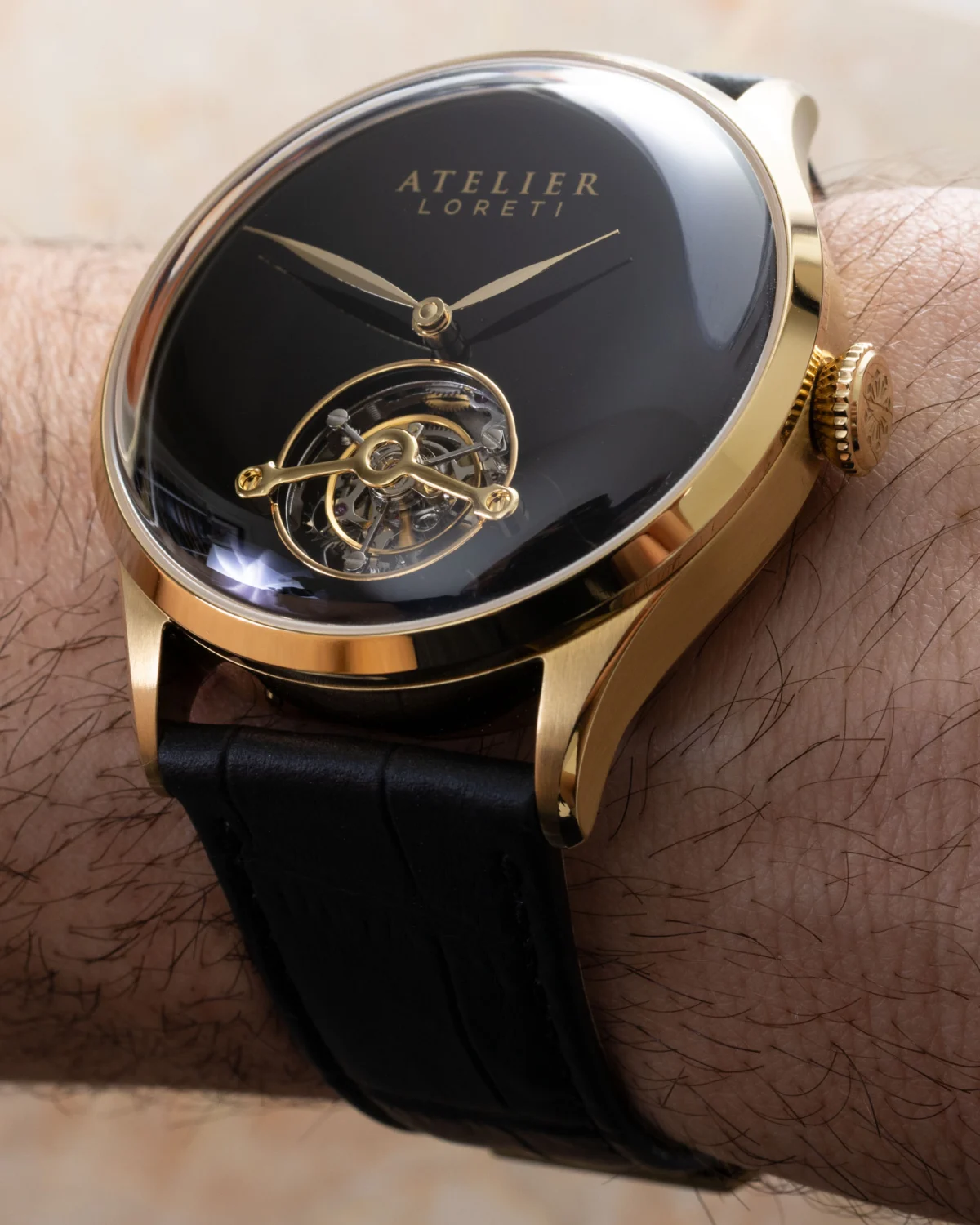
The L.1T movement has been enhanced to operate at a frequency of 3Hz to 4Hz. While the power reserve is estimated to be slightly under two days, the movement’s thickness is a respectable 5.67mm. It is designed to display only the time, with hour and minute hands, and features the tourbillon cage prominently visible in an aperture at the 6 o’clock position.
The original purpose of the tourbillon – counteracting gravity – is largely theoretical in a wristwatch, as the watch is rarely in a fixed vertical position. Therefore, its inclusion is primarily for aesthetic and mechanical appreciation. The Atelier Loreti tourbillon experience, for its price point, is commendable. While it may not feature the hand-finished embellishments found in ultra-high-end timepieces, its construction is elegant and avoids an inexpensive appearance. For those seeking an engaging mechanical watch that sparks interest, the Celestial Tourbillon offers significant appeal.

Design and Aesthetics: A Modern Interpretation
The case of the Atelier Loreti Celestial Tourbillon measures 42mm in width and approximately 14mm in thickness. While Atelier Loreti claims a case thickness of 10.85mm, this measurement does not include the domed, box-style sapphire crystal, which contributes to the overall perceived height. The lug-to-lug distance is around 49mm, and the watch boasts a respectable 100 meters of water resistance, achieved without the need for a screw-down crown.
The steel case is available in various finishes depending on the model. The reviewed PVD-coated gold-tone version complements the deep black onyx dial beautifully. While dials without hour markers, such as the Movado Museum Dial, have proven popular by prioritizing aesthetics over strict legibility, and brands like H. Moser & Cie. have found success with markerless luxury tourbillons, the absence of hour markers on the Celestial Tourbillon does present a challenge for precise time-telling. This design choice, however, aligns with a modern approach that values visual impact.

It’s worth noting that the movement appears to feature a flying tourbillon, though a decorative bridge-like structure is present over the tourbillon window on the dial. This bridge does not connect to the tourbillon itself, suggesting it is purely ornamental. It is plausible that future iterations of the L.1T movement might omit this bridge for a more unobstructed view of the tourbillon’s rotation.
Dial Variations and Strap Options
The Atelier Loreti Celestial Tourbillon collection is launched in four distinct versions, each featuring a natural stone dial. The gold-toned steel case is offered with either a blue aventurine dial, aptly named "A Sky in Motion," or the "Pure Depth" black onyx dial. For those preferring a natural steel case, options include a turquoise dial, "Ancient Memory," and a silver meteorite dial, "Beyond Earth." The meteorite dial variant commands a slightly higher price due to the inherent cost of the material.

The textured black leather straps accompanying these watches are functional and well-made, though not exceptionally luxurious. For an elevated aesthetic, an upgrade to an alligator or crocodile strap would significantly enhance the watch’s presence. Atelier Loreti also indicates that each Celestial Tourbillon will be shipped with a second, hand-selected strap to complement the chosen timepiece.
Future Horizons for Affordable Tourbillons
While the Atelier Loreti Celestial Tourbillon successfully brings the captivating tourbillon complication to a more accessible price point, there remains an opportunity for further advancement. The author of the original article expresses a desire for affordable tourbillons that also achieve COSC Chronometer certification. This would address the practical aspect of accuracy, enhancing the tourbillon’s utility beyond its visual appeal. The current design, with its lack of hour markers, further emphasizes that this is a watch for enthusiasts who appreciate the mechanical spectacle over precise timekeeping.

Conclusion: A New Chapter for the Tourbillon
The launch of the Atelier Loreti Celestial Tourbillon marks a significant moment in the democratization of haute horlogerie. By leveraging an innovative movement based on a reliable Japanese caliber and focusing on aesthetic appeal, Atelier Loreti has made the tourbillon accessible to a wider audience. The $850 USD price point for most versions, and $1,050 USD for the meteorite dial variant, positions these watches not as status symbols to project wealth, but as invitations to engage with the fascinating world of mechanical watchmaking. The tourbillon, once a rarefied symbol of luxury, is now poised to become a more common expression of passion for those who appreciate the art and engineering of timekeeping.