










The world of vintage watch collecting, while seemingly well-trodden, still harbors pockets of undiscovered horological territory. For seasoned enthusiasts, the allure of unearthing a rare gem, a piece overlooked by mainstream narratives, remains a potent driving force. It was precisely this spirit of discovery that led to the acquisition of a virtually unknown vintage Jaeger-LeCoultre, a watch that, despite its unassuming provenance, has become a personal favorite due to its intriguing history and unique design. This circa 1981 Jaeger-LeCoultre 114.100.54, affectionately nicknamed the "Baby Midas," represents a fascinating, albeit brief, foray by the brand into the integrated bracelet sports watch genre, decades before it became a cornerstone of their modern collections.

The Genesis of a Mystery: Jaeger Paris and its Role
To understand the significance of the Jaeger-LeCoultre 114.100.54, one must first delve into the historical context of "Jaeger Paris." The original Jaeger company, founded by Edmond Jaeger, was a formidable force in precision instrumentation. Jaeger’s expertise extended beyond watchmaking, encompassing a wide array of gauges and dials for automotive, aviation, and naval applications. Many classic automobiles still feature sought-after Jaeger-signed instrumentation, a testament to their engineering prowess.
The pivotal merger with Jacques-David LeCoultre in 1937 gave birth to the renowned Jaeger-LeCoultre name. However, the original Jaeger entity maintained its instrumentation operations from its French headquarters in Paris. This Parisian office evolved into a significant secondary hub for Jaeger-LeCoultre, contributing to the brand’s design evolution from the early 20th century through the 1960s. The 17th arrondissement in Paris became a locus of innovation, producing some of the brand’s most memorable designs. By the early 1980s, however, the distinct Jaeger brand’s presence in instrumentation had waned, and the Paris office, once a vibrant satellite, had become a more specialized, less prominent entity within the larger Jaeger-LeCoultre structure.

A Radical Departure: The 114.100.54 Emerges
It was within this context of a shifting corporate landscape that the Jaeger Paris branch, in collaboration with Cyma, produced the 114.100.54. This ultra-slim, integrated dress watch, characterized by its avant-garde design, was a radical departure from the more conventional timepieces Jaeger-LeCoultre was known for. Limited production estimates suggest that fewer than 200 examples were ever manufactured, primarily between 1981 and 1983. This scarcity, coupled with an astonishing array of dial variations among the few known examples, adds layers of mystery to an already obscure piece.
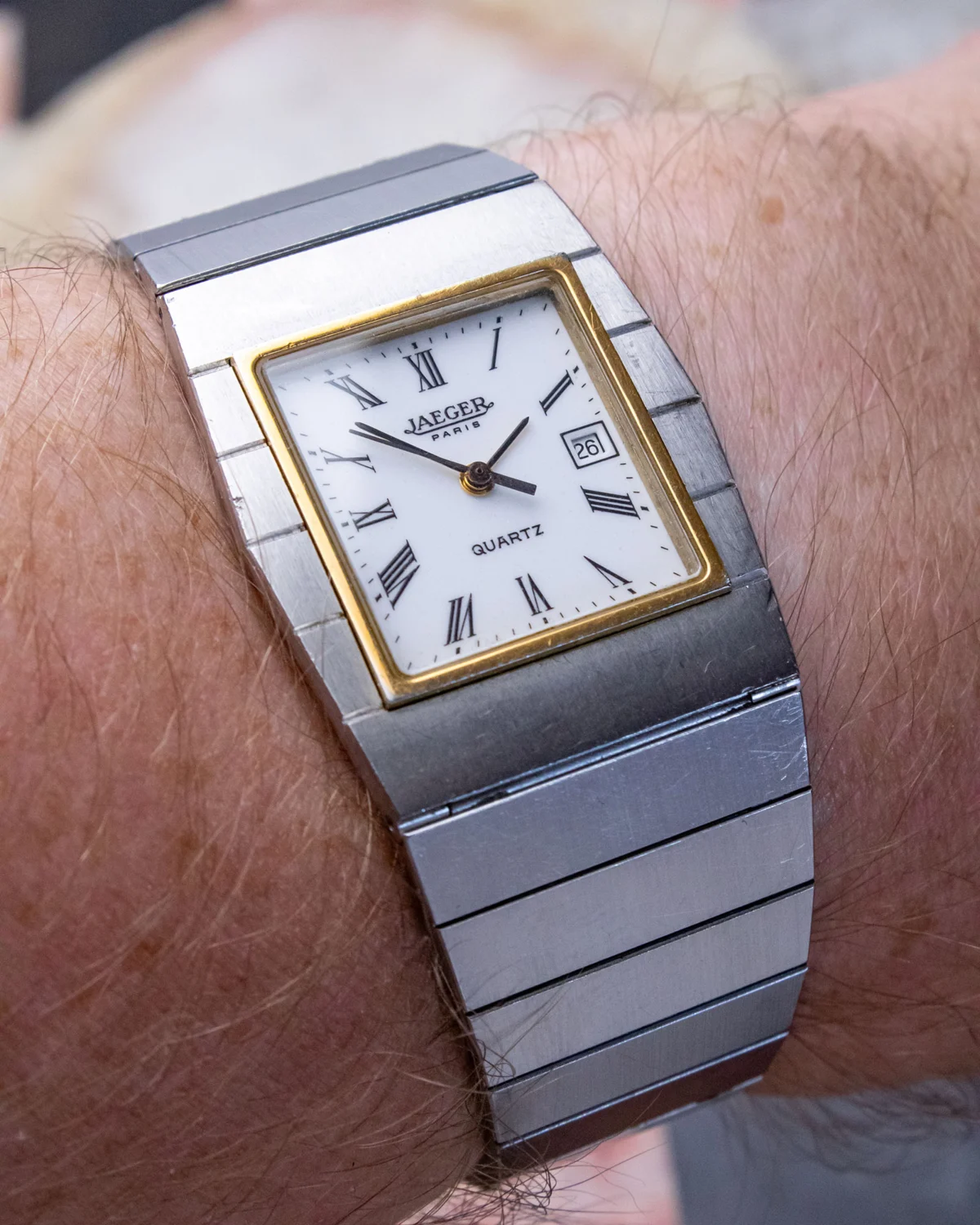
The watch’s design language clearly signals its 1980s origin. The stainless steel case, measuring a mere 27.5mm in width and 35mm from lug to lug, boasts an astonishingly slim profile, with a case thickness of just 5.5mm. This extreme thinness is achieved by cleverly integrating the crown and caseback beneath the main case body, creating a sleek, almost seamless appearance. The hexagonal silhouette, with its subtly tapering points, evokes a sense of sophisticated modernity, drawing a subtle parallel to the iconic Rolex King Midas, a comparison that inspired the "Baby Midas" moniker.

Design Details: A Fusion of Eras
The case’s symmetry and the gentle taper of its lugs seamlessly transition into the integrated bracelet, a hallmark of the era’s avant-garde watch design. The bracelet itself is not merely an appendage but an extension of the case’s aesthetic. Five distinct grooves are integrated into the flat, linear-brushed main case, visually harmonizing it with the bracelet’s design, a concept reminiscent of the Piaget Polo 79.
A key design element that prevents the 114.100.54 from appearing overly monolithic is the slim, gold-plated rectangular bezel. This subtle touch of gold provides a sophisticated contrast, framing the dial and adding a refined visual break between the case and the watch face. This juxtaposition of brushed steel and polished gold, combined with the minimalist case form, encapsulates the era’s design sensibilities.

The Dial: A Nod to Tradition Amidst Modernity
In contrast to the case’s bold modernist statement, the dial of the Jaeger-LeCoultre 114.100.54 presents a more traditional aesthetic. The gloss white dial, adorned with slim, black-printed Roman numerals, would not be out of place in Jaeger-LeCoultre’s more conventional offerings or even those of Cartier during the period. The simple stick hands, an outer minute track, and a date window positioned at 3 o’clock all contribute to a conventionally handsome and legible display.
However, the prominent "Quartz" text at the 6 o’clock position serves as an unambiguous marker of its production era. This was a time when quartz movements, still relatively new and technologically advanced, were often featured prominently, a stark contrast to today’s enthusiast perception where mechanical movements often hold greater sway. The "Jaeger Paris" signature at 12 o’clock unequivocally indicates its intended market: the French domestic sphere. The inclusion of "Swiss Made" text beneath the minute track, however, reassures that despite the Parisian branding, the watch’s manufacturing adhered to the high standards of Swiss watchmaking.

The Movement and Bracelet: Engineering for Slenderness
The pursuit of the watch’s remarkable thinness necessitated the use of an ETA quartz movement. While this may lack the historical prestige of Jaeger-LeCoultre’s in-house mechanical calibers, it was a practical and effective choice for achieving the desired ultra-slim profile. The reliability of vintage quartz movements is well-established, and in this context, the choice is justifiable, as the watch’s primary appeal lies in its spectacular thinness and integrated design.
The stainless steel bracelet accompanying the 114.100.54 is a masterclass in understated elegance. The textured case design ensures a virtually seamless transition to the single-link bracelet, with the all-over brushed finish creating a subdued play of light. In keeping with vintage bracelet construction, it is both slim and remarkably flexible, allowing it to drape comfortably around the wrist for a streamlined and unobtrusive wear. The hidden jewelry-style flip-lock clasp maintains the bracelet’s visual continuity, and an ingenious spring bar link system facilitates effortless sizing.

The "Baby Midas" Nickname: A Tribute to a Design Precursor
The affectionate nickname "Baby Midas" stems from the watch’s visual similarities to the Rolex King Midas. While the Jaeger-LeCoultre 114.100.54 is smaller and possesses a distinctively 1980s modernist edge, the hexagonal case shape and the integrated bracelet concept share a conceptual lineage. The "Midas" reference evokes a sense of preciousness and distinctiveness, attributes that this rare Jaeger Paris timepiece certainly possesses.
A Collector’s Perspective: Uncovering Hidden Horological Treasures
For collectors, the thrill of discovering such an obscure timepiece is immense. The Jaeger-LeCoultre 114.100.54 represents a deviation from the brand’s mainstream narrative, a testament to the creativity and experimental spirit that existed even within established luxury watch houses during transitional periods. The sheer rarity, the intriguing history of the Jaeger Paris sub-brand, and the unique design elements combine to make this watch a compelling acquisition.

While not the most complicated or historically influential piece in Jaeger-LeCoultre’s vast catalog, the "Baby Midas" offers a glimpse into a less-documented chapter of the brand’s past. Its existence highlights that even within well-documented histories, uncharted territories and overlooked designs can still yield fascinating discoveries. The journey into the unknown, often associated with risk, can also lead to the uncovering of mysterious and rewarding horological treasures.
The Broader Implications: A New Appreciation for Niche Designs
The rediscovery of watches like the Jaeger-LeCoultre 114.100.54 has broader implications for the vintage watch market and for the appreciation of horological history. It underscores the fact that value and desirability are not solely dictated by production numbers or mainstream recognition. Niche designs, even those with limited production runs and from less prominent periods, can hold significant appeal for collectors seeking unique pieces with compelling stories.

This watch’s existence also prompts a re-evaluation of design trends. The integrated bracelet sports watch, now a dominant force, was being explored in various forms decades ago. The Jaeger Paris 114.100.54 stands as an early, albeit niche, example of this design evolution, showcasing a distinctively 1980s interpretation. Its rediscovery encourages a deeper dive into the archives of major watch brands, potentially unearthing other forgotten gems that could offer new perspectives on the history of watchmaking. The allure of the "terra incognita" in horology remains, promising continued excitement for those willing to venture beyond the well-trodden paths.