











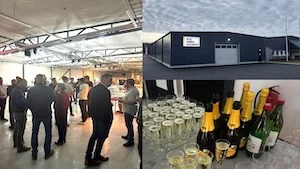
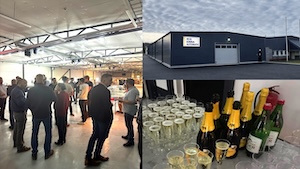
ACG Kinna Automatic AB, a prominent member of the Swedish Textile Machinery Association (TMAS), has officially inaugurated a 1,000-square-meter expansion of its headquarters in Skene, Sweden, marking a significant milestone in the company’s strategic growth. The expansion, announced on March 25, 2026, serves as a direct response to a record-breaking fiscal year in 2025 and a sustained increase in global demand for fully automated production lines within the textile and finished goods sectors. By centralizing operations and increasing specialized assembly capacity, the company aims to streamline its logistics and accelerate the delivery of its complex robotic systems to an international clientele, particularly in Europe and North America.
The decision to expand the existing Skene facility rather than relocate highlights ACG Kinna’s commitment to its regional roots and its workforce. According to Sales and Marketing Manager Tomas Aspenskog, the move was necessitated by a series of high-profile acquisitions over the last five years that brought new technologies and personnel under the ACG Kinna umbrella. The new facility provides the necessary footprint to integrate these diverse engineering teams and offers the physical space required for the assembly and testing of large-scale, modular production lines before they are shipped to customers worldwide.
Strategic Operational Consolidation in Skene
The 1,000-square-meter addition is more than a simple increase in floor space; it represents a tactical shift toward operational synergy. By connecting the new wing directly to the existing headquarters, ACG Kinna has created a centralized hub where research and development, engineering, and final assembly can coexist. This proximity is expected to reduce the "lead-to-delivery" time for bespoke automation solutions, which often require intensive collaboration between software developers and mechanical engineers.
The expansion also addresses the logistical complexities inherent in manufacturing large-scale industrial machinery. With additional specialized assembly zones, the company can now manage multiple large-scale projects simultaneously without the bottlenecks that previously challenged its production schedule. For suppliers, the centralized location simplifies the supply chain, while for customers, it offers a single site for factory acceptance testing (FAT), where they can see their completed robotic lines in operation before final installation.
The Catalyst for Growth: The 2025 Record Year
The impetus for this capital investment was a landmark performance in 2025. As global supply chains faced continued volatility and labor costs rose, manufacturers of home furnishings—specifically pillows and duvets—turned toward automation as a survival strategy. ACG Kinna’s trademarked philosophy, "Complete Process – One Supplier," resonated with a market seeking to minimize the risks associated with multi-vendor production lines.
In the bedding sector, the company’s pioneered robotic pillow lines have set a new industry standard. These systems manage the entire lifecycle of production, beginning with the raw fiber handling and opening, progressing through high-precision filling and sewing, and concluding with digital quality control and automated packaging. This end-to-end approach eliminates the need for manual intervention, which has traditionally been a source of both high labor costs and potential hygiene or quality inconsistencies.
A Chronology of Strategic Acquisitions
The current expansion is the culmination of a decade of aggressive diversification and technological integration. ACG Kinna has been part of the family-owned ACG Group since 2013, but its most transformative growth occurred within the last five years.
- Nowo Machinery (Finland): Five years ago, ACG Kinna acquired Nowo Machinery, a specialist in fiber processing. This acquisition was pivotal, as it allowed the company to control the "front end" of the production line—the raw material handling—ensuring that the fiber being fed into the sewing and filling units was of consistent quality.
- EyeTech (Sweden): More recently, the acquisition of EyeTech brought advanced machine vision solutions into the fold. EyeTech’s expertise in AI-driven visual inspection has been integrated into ACG Kinna’s quality control modules, allowing for real-time detection of defects that the human eye might miss.
- Styrteknik Europe (Sweden): The addition of Styrteknik Europe, a manufacturer of industrial sewing machines, provided the "back end" expertise needed for heavy-duty applications, such as the production of industrial filter bags and high-durability home textiles.
By integrating these specialized entities, ACG Kinna transformed from a machinery manufacturer into a full-scale systems integrator. This evolution is a primary driver behind the need for the new 1,000-square-meter assembly space in Skene.
Diversification into the Industrial Filtration Market
While the home furnishing sector remains a core pillar of ACG Kinna’s business, the company is rapidly diversifying into the technical textiles market, specifically industrial filtration. The expansion in Skene will play a critical role in supporting the development of automated lines for finished filter bags. These products are essential for air and liquid filtration in industries ranging from cement production to pharmaceutical manufacturing.
The company has confirmed that it will showcase its latest breakthroughs in filter bag automation at the Filtech 2026 exhibition in Cologne, Germany, scheduled for June 30 to July 2. This move into filtration represents a strategic hedge against fluctuations in the consumer goods market. The filtration sector is driven by increasingly stringent global environmental regulations, which mandate that industrial facilities upgrade their air quality systems, thereby creating a steady demand for high-quality, precision-manufactured filter bags.
Industry Implications: The Rise of "Reshoring" and Automation
The growth of ACG Kinna reflects a broader trend in the global manufacturing landscape: the "reshoring" of textile production to Europe and North America. For decades, textile manufacturing was offshored to regions with low labor costs. However, the rise of automation has shifted the economic calculus.
Therese Premler-Andersson, Secretary General of TMAS, notes that automation has become a "must" for modern manufacturers. Several factors are driving this transition:
- Traceability and Regulation: New trade regulations, particularly in the EU, require detailed traceability of textile products. Automated systems with integrated digital tracking make compliance significantly easier.
- Labor Scarcity: Finding skilled operators for industrial sewing and fiber processing has become increasingly difficult in Western markets. Robotic systems fill this void, operating with a level of consistency that manual labor cannot match.
- Sustainability: Automated systems are inherently more efficient, reducing material waste and energy consumption. In an era where "Green Manufacturing" is a corporate mandate, the precision of ACG Kinna’s robotic lines provides a clear environmental advantage.
Premler-Andersson highlighted that ACG Kinna’s expansion is part of a wider pattern among TMAS members, who are collectively positioning Sweden as a global leader in "21st-century production tools."
Technological Analysis: The "One Supplier" Advantage
From a technical perspective, the "One Supplier" model offered by ACG Kinna addresses the primary pain point of industrial automation: interoperability. When a manufacturer buys a filling machine from one vendor, a sewing machine from another, and a packaging unit from a third, they often face "software silos" where the machines do not communicate effectively.
ACG Kinna’s modular solutions solve this by utilizing a unified control architecture. This means that a single software update can optimize the entire line, and data from the EyeTech vision system can be used to instantly adjust the tension on a Styrteknik sewing head. This level of synchronization maximizes "Uptime" and allows manufacturers to switch between different product specifications (e.g., changing from standard pillow sizes to king-size duvets) with minimal downtime.
Furthermore, having a single project leader and installation team reduces the "hidden costs" of automation. Manufacturers avoid the finger-pointing that often occurs between multiple vendors when a line fails to meet its performance targets.
Future Outlook and Market Projections
As ACG Kinna settles into its expanded facility, the outlook for the company remains bullish. The expansion provides the capacity to handle the projected growth in the North American market, where the "Made in USA" movement is driving a surge in domestic textile manufacturing. Similarly, in Europe, the focus on circularity and local production is creating a robust pipeline of orders for automated textile solutions.
The company’s ability to pivot between consumer goods (bedding) and industrial goods (filtration) provides a balanced portfolio that is well-suited for the economic climate of 2026. With the Filtech exhibition on the horizon and the new assembly lines in Skene beginning to operate at full capacity, ACG Kinna is positioned to remain at the forefront of the global textile machinery industry.
The expansion in Skene is not merely a story of a company getting bigger; it is a story of the textile industry getting smarter. By investing in physical space and specialized technology, ACG Kinna is providing the infrastructure necessary for a more efficient, sustainable, and localized manufacturing future. As the market continues to "buzz" with activity, the 1,000-square-meter expansion stands as a testament to the enduring power of Swedish engineering and the global necessity of automation.