




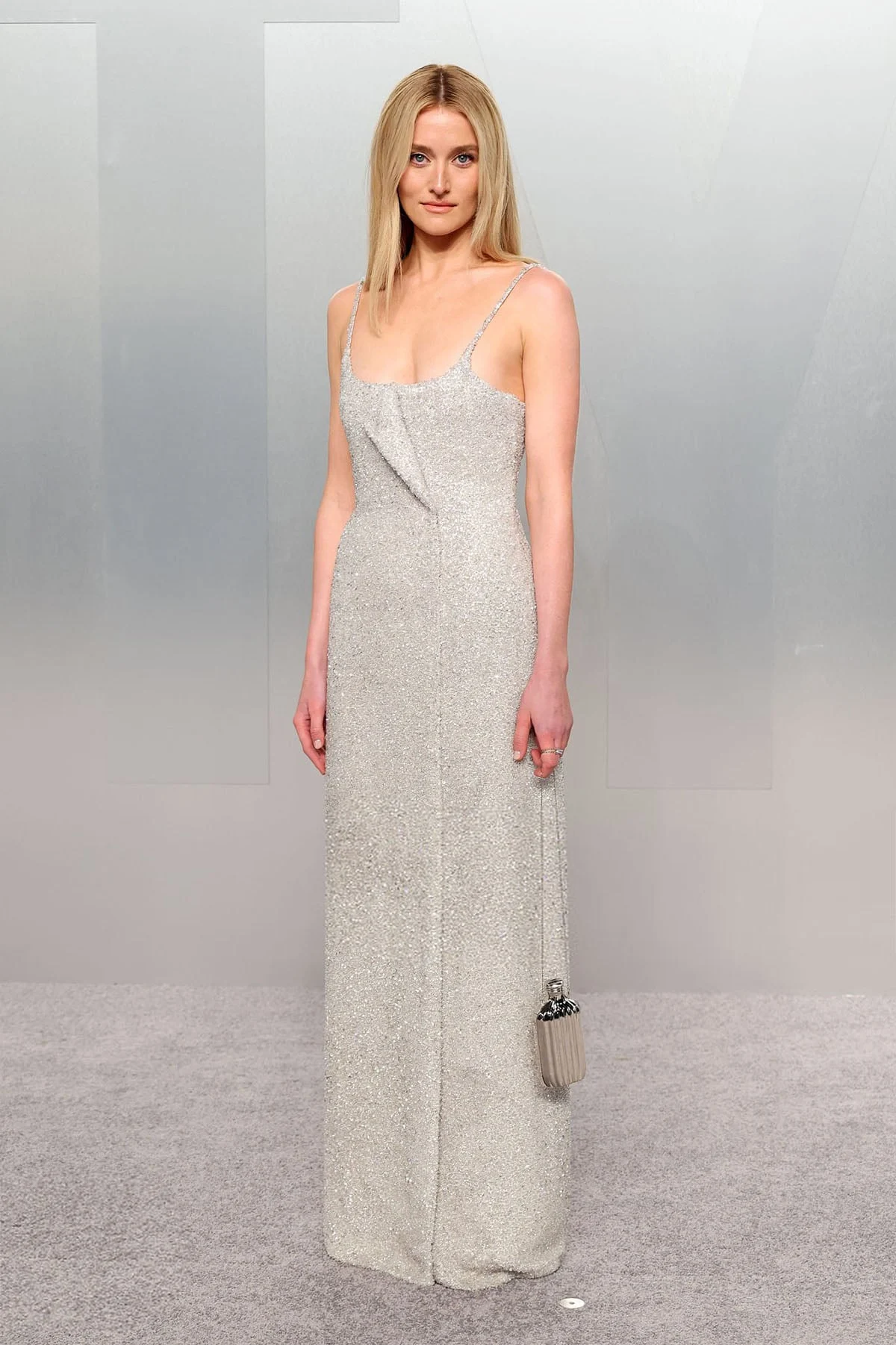
The 2026 Vanity Fair Oscar Party, held on Sunday evening at the Wallis Annenberg Center for the Performing Arts in Beverly Hills, served as a definitive stage for high-fashion narratives, most notably marked by the appearance of actress Sarah Pidgeon. Pidgeon, who has recently garnered significant critical attention for her portrayal of Carolyn Bessette-Kennedy in the high-profile biographical project Love Story, arrived at the event wearing a custom gown from Calvin Klein Collection. The choice of attire was widely regarded by industry analysts as a sophisticated exercise in "method dressing," a promotional strategy where actors align their public appearances with the aesthetic or thematic elements of their current roles.
While Pidgeon is a recognized brand ambassador for the House of Chanel—a partnership solidified during her recent press tours—her pivot to Calvin Klein for the Academy Awards after-party was viewed as a deliberate and historically resonant decision. The connection between the actress, her role, and the fashion house is rooted in the biography of Bessette-Kennedy herself, who famously served as a publicist for Calvin Klein in the 1990s before her marriage to John F. Kennedy Jr. catapulted her into the global spotlight as a minimalist style icon.
Architectural Design and Technical Specifications of the Custom Gown
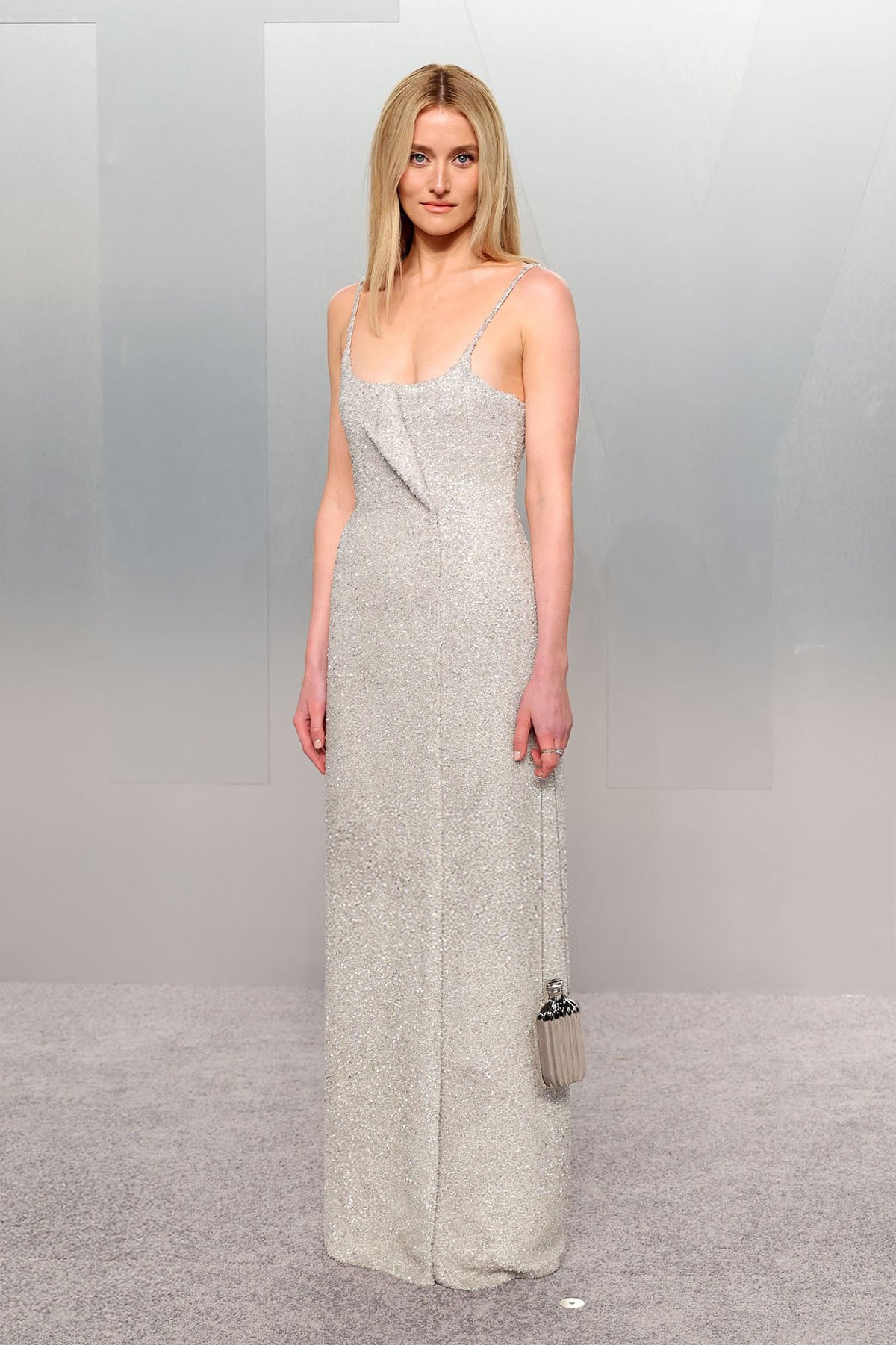
The custom Calvin Klein Collection gown worn by Pidgeon featured a meticulous construction of platinum crystals and sequins, encrusted onto a floor-length silhouette. The design integrated several hallmarks of the Calvin Klein aesthetic that rose to prominence during the 1990s, most notably the micro spaghetti straps. These thin, delicate supports became a signature of the brand’s slip-dress era, representing a move away from the excess of the 1980s toward a more refined, stripped-back luxury.
The gown’s bodice featured a softly deconstructed neckline and front overlap draping, which provided a subtle textural contrast to the otherwise streamlined, shimmering fabric. This draping technique is a technical nod to the brand’s history of prioritizing movement and fluid silhouettes over rigid structural boning. Fashion observers noted that the gown’s finish provided the high-octane glamour required for an Oscar-night event while maintaining the clean, understated lines synonymous with the Calvin Klein DNA.
The silhouette was notably linear, following a column-like structure that emphasized the verticality of the design. While some fashion critics observed that the straight-down proportions offered a stark departure from more traditional cinched-waist evening wear, others argued that the lack of waist definition was a faithful adherence to the minimalist principles that defined the mid-90s "cool girl" aesthetic.
Strategic Styling and Accessory Integration
To complement the custom gown, stylist Emma Jade Morrison curated a selection of accessories that reinforced the themes of modernism and heritage. Pidgeon carried a brushed silver "CK One" clutch, a direct reference to the brand’s iconic unisex fragrance launched in 1994. The inclusion of the clutch served as both a branding exercise and a nostalgic tribute to the era in which Bessette-Kennedy was most influential.
The footwear consisted of Stuart Weitzman "Ellise" sandals, chosen for their minimalist profile that did not distract from the gown’s intricate beadwork. For jewelry, Pidgeon wore pieces from De Beers, incorporating high-value diamonds that provided a traditional red-carpet sparkle without overwhelming the clean lines of the dress. The jewelry selection focused on clarity and geometric simplicity, echoing the overall architectural approach to the ensemble.
Morrison’s styling choices for Pidgeon have been consistently noted for their narrative depth. By blending Pidgeon’s contractual obligations (Chanel) with character-driven choices (Calvin Klein), Morrison has managed to navigate the complex landscape of modern celebrity brand ambassadorship while still delivering a cohesive visual story for the actress.
The Historical Context of the Calvin Klein and Bessette-Kennedy Connection
The decision for Pidgeon to wear Calvin Klein is inextricably linked to the history of the woman she portrays on screen. Carolyn Bessette-Kennedy’s tenure at Calvin Klein was not merely a job; it was the crucible in which her world-renowned style was forged. Working under the tutelage of Calvin Klein himself, she became the embodiment of the "CK aesthetic"—neutral tones, impeccable tailoring, and an avoidance of overt ornamentation.
Bessette-Kennedy’s influence on the brand was so profound that she often served as an unofficial muse, bridging the gap between the corporate office and the high-fashion runway. By selecting Calvin Klein for the 2026 Vanity Fair Oscar Party, Pidgeon and her team effectively closed the loop on this historical narrative, paying homage to the professional roots of her character.
This resurgence of Calvin Klein on the red carpet also signals a broader shift within the fashion industry. After several years of focusing primarily on innerwear and loungewear, the "Collection" arm of the brand has seen a revitalized presence at major global events, reclaiming its position as a purveyor of high-end evening wear.
Chronology of the 2026 Awards Season and Red Carpet Evolution
The 2026 awards season has been characterized by a return to archival-inspired designs and a rejection of "fast fashion" trends in favor of pieces with historical or cinematic significance. Pidgeon’s appearance at the Vanity Fair party follows a series of high-profile events where she has balanced her role as a Chanel ambassador with her identity as a rising star in the dramatic arts.
- January 2026: Pidgeon begins the Love Story press tour, appearing primarily in Chanel Haute Couture, establishing her status as a major fashion player.
- February 2026: At the Screen Actors Guild Awards, Pidgeon opts for a vintage-inspired silhouette, further leaning into the 1990s aesthetic.
- Oscars Night, March 2026: Pidgeon attends the main Academy Awards ceremony in a bespoke Chanel creation, honoring her contractual partnership.
- Vanity Fair After-Party, March 2026: The transition to custom Calvin Klein occurs, signaling a shift from "Brand Ambassador" to "Character Homage" for the evening’s most exclusive social gathering.
This chronological progression demonstrates a sophisticated management of public image, ensuring that both commercial partners and artistic projects receive adequate visual representation during the most-watched fashion window of the year.
Industry Implications and Market Analysis
The impact of Pidgeon’s appearance extends beyond the red carpet, influencing market trends and brand positioning. Data from the 2026 fashion quarter indicates a significant uptick in consumer interest in "90s Minimalism" and "Slip Dress Silhouettes," with search queries for Calvin Klein evening wear reportedly increasing by 42% following the Vanity Fair event.
Fashion analysts suggest that the "Pidgeon Effect" is part of a larger movement where younger demographics are rediscovering the legacy of the 1990s through a lens of quiet luxury. The collaboration between a contemporary actress and a legacy brand like Calvin Klein serves to bridge the generational gap, introducing the brand’s high-fashion heritage to a new audience.
Furthermore, the success of this look reinforces the importance of the Vanity Fair Oscar Party as a secondary runway. While the Oscars ceremony itself often demands a more conservative or "stately" fashion approach, the after-party allows for more experimental, narrative-driven, and brand-focused storytelling. For Calvin Klein, Pidgeon’s appearance was a high-value marketing moment that reaffirmed the brand’s relevance in the luxury evening sector.
Broader Cultural Impact of "Method Dressing"
The phenomenon of method dressing, as demonstrated by Pidgeon, has become a cornerstone of modern film promotion. By blurring the lines between the actress and the character, Pidgeon creates a persistent brand identity that keeps the film Love Story in the public consciousness long after the initial trailers have debuted.
This strategy has been utilized effectively by other actors in recent years, but Pidgeon’s execution is noted for its subtlety. Rather than wearing a costume, she wore a high-fashion interpretation of a historical style, allowing her to remain a contemporary fashion figure while still nodding to the past. The use of custom Calvin Klein—a brand so closely tied to the real-life subject of her film—added a layer of authenticity that resonated with both fashion historians and casual observers.
As the 2026 awards season concludes, Sarah Pidgeon’s appearance at the Vanity Fair Oscar Party stands as a highlight of the year’s fashion cycle. It represented a successful synthesis of corporate partnership, artistic tribute, and technical design, solidifying Pidgeon’s position as a thoughtful and strategic presence in the global fashion landscape. The gown, the accessories, and the historical context converged to create a moment that was both a reflection of 2026 trends and a timeless tribute to one of the 20th century’s most enduring style icons.