










The horological landscape has witnessed a new convergence of automotive heritage and precision engineering with the unveiling of the Baume & Mercier Riviera Chronograph GPSI Limited Edition. Released in October 2026 to coincide with the prestigious Gran Premio Storico d’Italia—a premier historic racing event held at the iconic Mugello Circuit—this timepiece serves as the official commemorative chronograph for the festivities. As the designated official timekeeper of the event, Baume & Mercier has moved away from the traditional, high-contrast aesthetic often associated with track-side timing, opting instead for a refined, balanced design language that emphasizes the elegance of classic motorsports over mere functional utility.
Event Context: The Gran Premio Storico d’Italia at Mugello
The Gran Premio Storico d’Italia, hosted at the Mugello circuit in Tuscany, has established itself as a cornerstone of the international vintage racing calendar. The event serves as a living museum, featuring rare pre- and post-war racing machinery that requires both high-level maintenance and precise historical stewardship. Baume & Mercier’s partnership with the event is rooted in the brand’s long-standing connection to the luxury lifestyle and its technical capacity for creating reliable, high-end chronographs.

By choosing the Riviera collection—a line historically defined by its dodecagonal bezel and integrated design—as the canvas for this limited edition, the brand signals a departure from the "utility-first" approach of typical racing watches. The event itself celebrates the golden age of Italian motoring, a theme that permeates the design choices of the timepiece, specifically through the integration of the Italian tricolor motif within the dial’s accents.
Design Philosophy and Architectural Specs
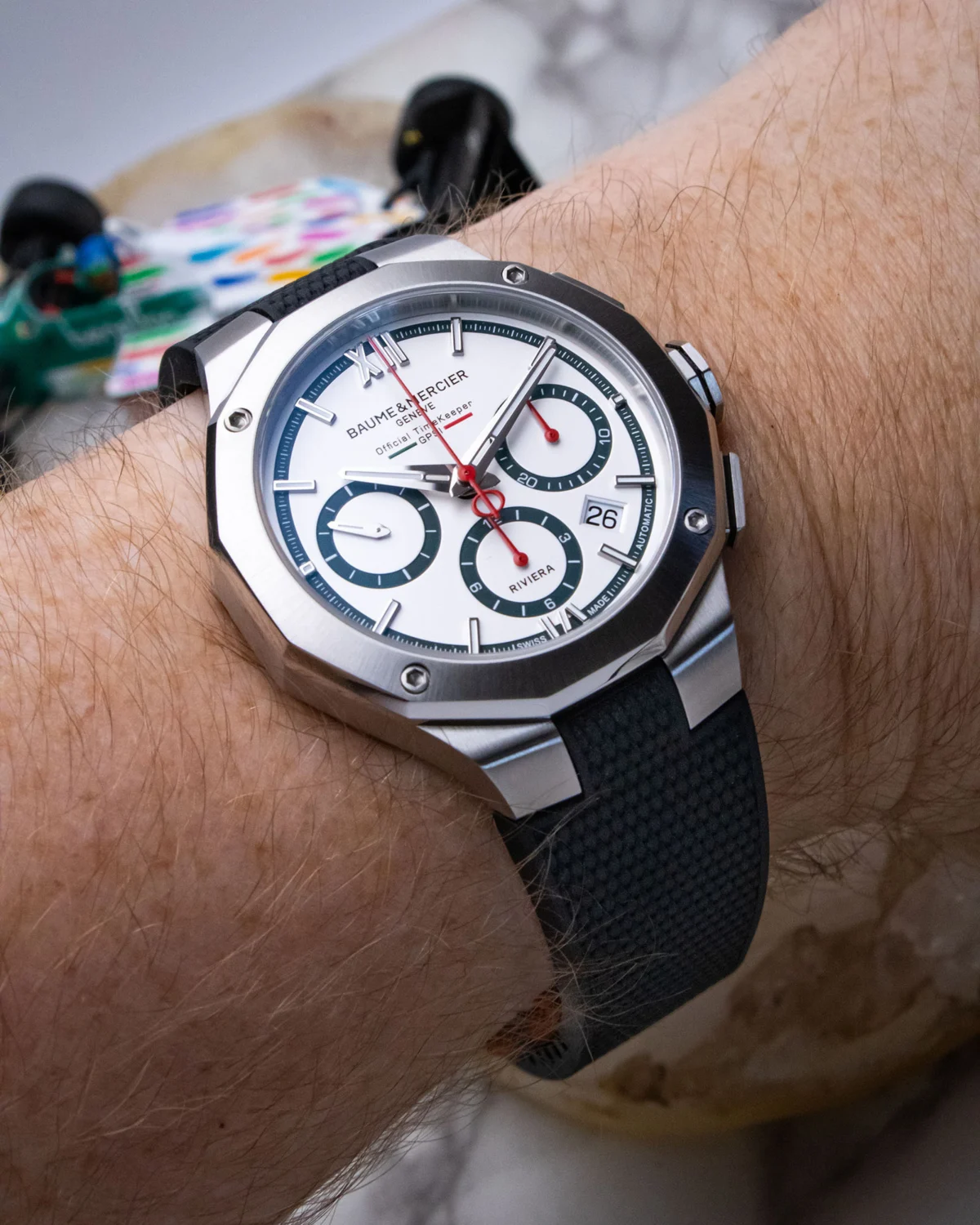
The Baume & Mercier Riviera Chronograph GPSI Limited Edition is built upon a stainless steel chassis that measures 41mm in diameter and 13.94mm in thickness. While these dimensions place it in the mid-to-large category of contemporary men’s watches, the architecture of the case is engineered to maximize wearability. The integration of the lugs, which are short and downturned, allows the watch to conform to a wide variety of wrist shapes, mitigating the visual and physical footprint typically associated with a 41mm case.
A critical design choice in this iteration is the distribution of the case volume. A significant portion of the watch’s height is concentrated in the caseback, which facilitates a lower center of gravity when worn. This design nuance allows the watch to "nestle" against the wrist bone, providing a more balanced feel. The iconic 12-sided bezel, characterized by its sunburst brushing and polished chamfers, remains the focal point of the aesthetic. Although the presence of four external hex bolts has been a subject of debate among collectors—with Baume & Mercier reportedly shifting toward cleaner iterations in other models—these elements serve to reinforce the industrial, automotive-inspired DNA of the Riviera collection.

Dial Composition and Aesthetic Nuance
In a departure from the high-legibility, high-contrast dial configurations of standard racing chronographs, the GPSI Limited Edition prioritizes aesthetic harmony. The dial is executed in a matte white opaline finish, eschewing the stamped wave patterns found on standard production models. This clean, minimalist approach allows the secondary design elements to emerge with greater clarity.
The chronograph features applied Roman numerals and lozenge indices, which are polished to a high sheen, maintaining the "dress-watch" sensibility of the Riviera line. The handset, consisting of semi-skeletonized dauphine hands, is beveled to catch the light, emphasizing luxury over the utilitarian demands of a cockpit.
The color palette is a subtle homage to Italian racing history. Forest green rings surround the sub-dials and the peripheral minutes track, providing a subdued, sophisticated contrast against the white backdrop. The use of "rosso corsa" (racing red) for the chronograph functions provides the necessary pop of color, completing the tricolor thematic without overwhelming the dial. Notably, the watch does not feature a tachymeter scale, a choice that acknowledges the reality that such tools are rarely used in modern environments, thus prioritizing the watch’s role as a luxury accessory.

Technical Specifications and Performance
At the heart of the timepiece lies the Valjoux 7753 automatic chronograph movement. This caliber has served as a workhorse in the watch industry for decades, known primarily for its robust architecture and relative ease of maintenance. Operating at 28,800 vibrations per hour (4Hz), the movement offers a power reserve of approximately 48 hours.
While the 7753 is not a "next-generation" caliber in terms of power reserve duration or silicon escapements, its selection underscores the brand’s commitment to reliability and serviceability—two attributes that are critical for owners who intend to wear the watch in diverse environments. The movement is visible through a sapphire caseback, which features a printed logo of the Gran Premio Storico d’Italia. The bridge work is finished with perlage, while the rotor is adorned with traditional Côtes de Genève stripes, offering a level of decoration consistent with the brand’s positioning.
The watch is secured by an integrated black rubber strap with a fabric-like texture. This choice of material bridges the gap between the formal aesthetic of the case and the sporting requirements of the event. The strap utilizes a butterfly-style deployant clasp, which mimics the design language of the Riviera’s signature metal bracelet. However, as the strap is a "cut-to-fit" style, owners should note that it requires careful sizing upon purchase, as it offers limited adjustability once the rubber is trimmed.

Industry Implications and Market Positioning
The introduction of the Riviera Chronograph GPSI Limited Edition highlights a broader trend among Swiss watchmakers to move away from the "tool watch" archetype in favor of "lifestyle-centric" design. By aligning with historic automotive events rather than modern, high-intensity series like Formula 1, Baume & Mercier is targeting a demographic that values the romanticism of automotive history over the clinical precision of modern racing.
From an economic perspective, the $5,100 MSRP positions the watch firmly in the competitive luxury segment. The lack of explicit information regarding the total number of units produced suggests that the brand is focusing on exclusivity and collection-building rather than mass-market penetration. For Baume & Mercier, this strategy serves to reinforce the value of the Riviera collection as a versatile, high-end offering that can pivot between dressy, casual, and commemorative roles without losing its core identity.
Chronology and Future Outlook
The launch of this limited edition in October 2026 marks a significant milestone in the current lifecycle of the Riviera collection. Following the successful reintroduction of the line in recent years, the GPSI model serves as a proof-of-concept for how the brand can customize its flagship sports watch to appeal to niche collector groups.

Industry analysts suggest that the success of this model will likely determine the frequency of future "event-based" limited editions within the Baume & Mercier portfolio. If the market response to the 2026 Mugello release remains positive, it is expected that the brand will continue to utilize the Riviera platform as a medium for celebrating cultural and automotive partnerships.
As of late 2026, the watch is available through authorized dealers globally. Interested parties are encouraged to verify availability with local retailers, as the limited production numbers are expected to result in a rapid sell-through among collectors of automotive-themed horology. The combination of its historic association, refined aesthetic, and established, reliable mechanics makes the Riviera Chronograph GPSI Limited Edition a notable addition to the 2026 horological calendar, serving as a testament to the enduring appeal of the classic, Italian-inspired racing chronograph.