









Living with psoriasis does not necessitate a complete overhaul of one’s daily hygiene or cosmetic routines, yet it requires a nuanced understanding of how external factors interact with an overactive immune system. Psoriasis is a chronic, immune-mediated condition characterized by the rapid buildup of skin cells, leading to scaling and inflammation. Because the disease is rooted in systemic immune dysfunction rather than mere external irritation, many topical products remain safe for use. However, the skin of a psoriasis patient is frequently in a state of heightened sensitivity, meaning that products capable of causing physical or chemical trauma can inadvertently trigger or exacerbate flare-ups.
The biological mechanism driving this vulnerability is known as the Koebner phenomenon. First described by Heinrich Köbner in 1876, this clinical observation notes that local trauma to the skin—ranging from minor abrasions and sunburns to chemical burns—can stimulate the immune system to manifest new psoriatic plaques in areas that were previously clear. Research published in the journal Bioscience Reports indicates that this phenomenon occurs in approximately 25% to 30% of patients diagnosed with the condition. Dermatologists emphasize that while not every patient experiences this response, those who notice plaques forming at the site of a scratch or cut should operate under the assumption that they are susceptible to Koebnerization.
The Dynamics of Skin Trauma and Immune Activation
The clinical implications of the Koebner phenomenon are significant. When the skin barrier is compromised by harsh surfactants, potent acids, or physical abrasion, the resulting inflammatory cascade can prompt a localized immune response. For patients whose psoriasis is not currently managed by systemic therapies, the skin is effectively "primed" for such reactions. In these instances, even mild trauma—such as the friction from a physical scrub or the chemical burn of a high-concentration peel—can seed new, persistent plaques.
Conversely, patients whose condition is well-controlled via systemic treatments, such as biologic therapies, experience a substantially lower risk of developing new lesions through external trauma. Biologics work by targeting specific components of the immune system to reduce the underlying systemic inflammation that drives plaque formation. While the risk is not entirely eliminated, the stability provided by these medical interventions offers patients greater flexibility in their lifestyle and grooming choices.
Evaluating Common Skin Care Ingredients
A pervasive misconception among patients is that because psoriatic plaques are thick and scaly, they require aggressive, high-potency treatments to "strip" the skin back to a healthy state. Dermatologists warn that this approach is often counterproductive.
Alpha-hydroxy acids (AHAs) and beta-hydroxy acids (BHAs)—such as glycolic, lactic, and mandelic acids—are common in modern skincare but must be used with extreme caution. At high concentrations, these acids dissolve the intercellular cement holding dead skin cells together, which can reach deeper into the epidermis than intended, causing chemical injury. Experts generally recommend that leave-on products containing glycolic acid should not exceed a 5% concentration, while lactic acid should remain below 8%.
Salicylic acid remains a notable exception. When used in low concentrations, such as the 2% found in many over-the-counter formulations, it acts as a keratolytic agent. By gently thinning the scales, salicylic acid can actually enhance the penetration and efficacy of prescribed topical steroids or vitamin D analogues. The key to successful application, however, lies in pairing these treatments with emollients to prevent excessive dryness.
The Hazards of Physical Exfoliation and Abrasive Procedures
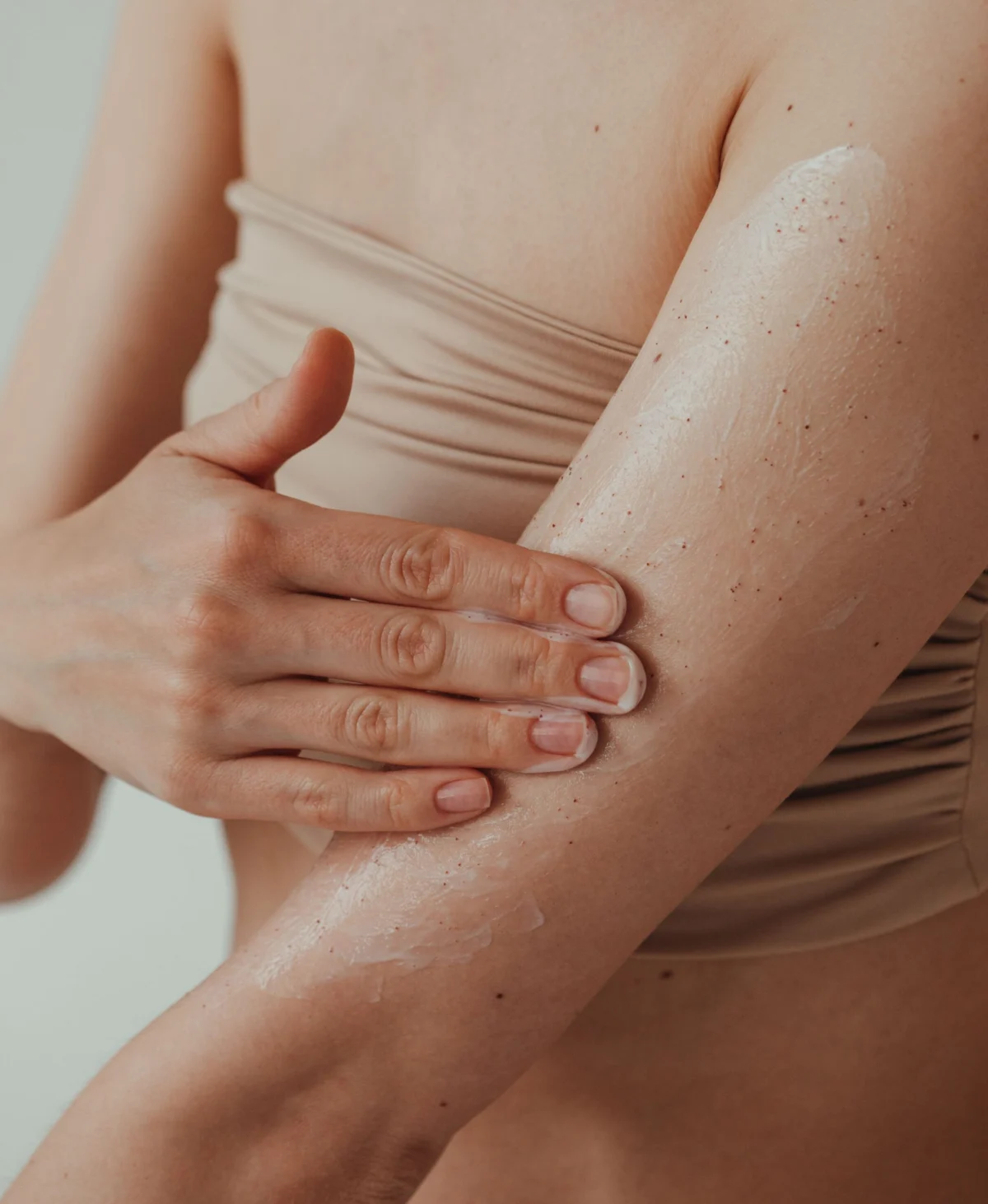
The instinct to manually remove scales with physical exfoliants, such as walnut shell scrubs or loofahs, is a frequent source of clinical concern. These tools do not distinguish between dead scale and the delicate underlying tissue. By abrading the skin, they create the very micro-trauma necessary to trigger the Koebner phenomenon.
This caution extends to professional, in-office cosmetic procedures. Microneedling and certain laser therapies operate on the principle of controlled injury to stimulate collagen production. For a patient in the midst of a flare-up, this "controlled" injury is rarely beneficial. While excimer lasers have been clinically validated for the treatment of psoriasis-related redness and inflammation, aggressive aesthetic procedures that disrupt the skin barrier should generally be avoided until the condition has reached a state of clinical remission.
Surfactants and the Importance of the Skin Barrier
The health of the skin barrier is paramount for those living with chronic inflammatory skin diseases. Surfactants, the cleansing agents that create lather in soaps and body washes, are often a point of friction. Many high-lather products, particularly those containing sodium lauryl sulfate (SLS), act as harsh degreasers, stripping away essential ceramides and lipids.
A useful rule of thumb for patients is to avoid cleansers that produce excessive, heavy lather, as this often indicates a high concentration of surfactants. Instead, dermatologists advocate for gentle, non-stripping, fragrance-free cleansers. The distinction between "fragrance-free" and "unscented" is critical; "unscented" products often contain masking chemicals that can cause contact dermatitis, further inflaming the skin and potentially inciting a flare-up.
Essential Oils and Natural Ingredient Risks
The trend toward "all-natural" or "botanical" skincare products poses a unique risk to the psoriasis community. The assumption that botanical origin equates to safety is medically inaccurate—many potent allergens and irritants, such as poison ivy or various essential oils, are entirely natural.
Ingredients such as peppermint oil, menthol, tea tree oil, and witch hazel are frequent culprits. Menthol, while providing a temporary, cooling sensation that may feel soothing on an itchy patch, is a known irritant that can trigger an immune response. Dermatologists advise that any product resulting in a tingling or burning sensation should be washed off immediately, as these sensations are indicators of inflammation rather than therapeutic activity.
Lifestyle Considerations: Hair Care and Body Art
The impact of psoriasis extends beyond the face and body to the scalp and aesthetic preferences. Hair dyes containing para-phenylenediamine (PPD) present a substantial risk, as allergic reactions to these compounds can lead to intense scalp inflammation. In a patient whose immune system is already hyper-reactive, an allergic contact dermatitis event can rapidly spiral into a widespread psoriatic flare, making the condition significantly more difficult to manage.
Similarly, the popularity of tattoos creates a dilemma. The process of tattooing involves thousands of needle punctures, representing a form of deliberate, repetitive micro-trauma. Reports of patients developing psoriatic plaques in the exact pattern of their new ink are well-documented in dermatological literature. However, for individuals on effective systemic biologic therapy, the inflammatory pathways are often sufficiently suppressed to allow for body art without the subsequent development of new plaques.
Establishing a Cohesive Care Plan
The broader implication for the estimated 7.5 million Americans living with psoriasis is the necessity of a structured, professional care plan. While individual triggers vary, the consensus among medical professionals is clear: the most effective strategy for living comfortably with psoriasis is achieving consistent disease control through medical intervention.
Once a patient is under the care of a dermatologist and has identified a therapeutic regimen that stabilizes their immune response, the restrictions on skincare and lifestyle choices often loosen. The importance of the "patch test"—applying a small amount of a new product to an inconspicuous area for 48 to 72 hours—cannot be overstated. This simple, preventative measure allows patients to screen for sensitivities without risking a total-body flare.
Ultimately, while the nature of psoriasis requires vigilance, it does not mandate a life of austerity. By prioritizing hydration, avoiding known chemical and physical irritants, and working closely with a medical professional to maintain systemic control, patients can integrate many modern skincare and lifestyle practices safely. The goal remains a balance between achieving aesthetic and cosmetic desires and respecting the biological boundaries of a sensitive, immune-compromised skin barrier.