









The Middle Eastern watchmaking industry has reached a significant milestone with the unveiling of the Nuncier Lunar Mission, a timepiece that solidifies the brand’s status as a serious contender in the global horological market. Formerly known as Nuun, the independent brand has officially entered into its second collaborative agreement with the National Aeronautics and Space Administration (NASA), becoming the first watchmaker from the Gulf Cooperation Council (GCC) region to receive such an endorsement. This limited-edition release serves as a conceptual tribute to the Apollo 11 moon landing, translating the textures and technical rigors of lunar exploration into a wearable, high-performance format.
The Evolution of Nuncier and the NASA Partnership
Nuncier’s journey from a niche regional player to an internationally recognized name is defined by its ability to leverage its unique identity while embracing universal themes. The brand’s transition from Nuun signaled a broader strategic intent to appeal to a global collector base that values both avant-garde design and technical integrity.
The partnership with NASA represents a rigorous vetting process. NASA’s licensing guidelines are notoriously stringent, requiring partners to maintain a standard of quality and branding that aligns with the agency’s historical prestige. The first collaboration between the two entities established a baseline for this relationship, proving that the brand could handle the agency’s intellectual property with the necessary gravitas. This second iteration, the Lunar Mission, is not merely a branding exercise but a design study that integrates space-age materials and motifs into a cohesive, functional timepiece.
Engineering the Lunar Aesthetic
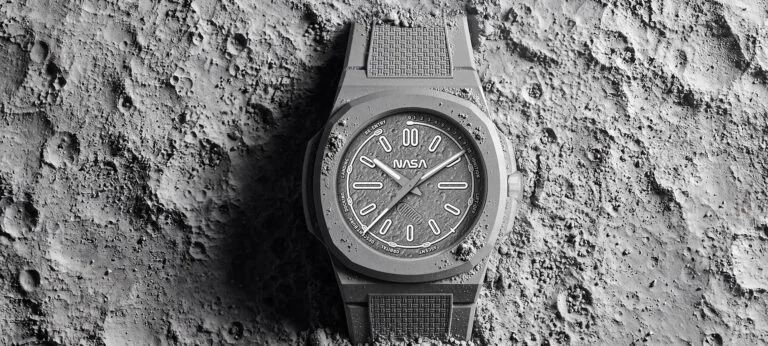
The Nuncier Lunar Mission is constructed around a 40.5mm Grade 2 titanium case, a material choice that reflects the aerospace industry’s reliance on lightweight, durable, and biocompatible metals. To achieve the specific "lunar surface" aesthetic, the brand utilized a proprietary finishing technique to create a matte "concrete" effect. This grainy, medium-gray texture mimics the regolith—the layer of loose, heterogeneous superficial deposits covering solid rock—that defined the landscape navigated by the Apollo astronauts.

The technical execution extends to the dial, which is the watch’s most visually complex feature. By employing a cratered, topographical relief, the dial provides a three-dimensional representation of the Moon’s geography. A critical design element is the inclusion of a stylized recreation of Neil Armstrong’s boot print, positioned at the 6 o’clock marker. This serves as a focal point, grounding the watch’s abstract design in the historical context of the July 1969 landing.
Furthering the mission-oriented design, the dial features a raised outer ring calibrated with the distinct stages of a NASA flight mission, from liftoff to lunar module descent. The departure from the brand’s signature Eastern Arabic numerals to futuristic, raised lozenge indices reinforces the watch’s commitment to a universal, space-exploration aesthetic. The watch is protected by sapphire crystals on both the front and the display caseback, ensuring durability while maintaining a water resistance rating of 100 meters, which is standard for a robust modern sports watch.
Mechanical Foundation and Performance
Underneath the lunar-themed exterior, the Nuncier Lunar Mission is powered by the Miyota 9039 automatic movement. The choice of the 9039—a movement favored by independent watchmakers for its reliability and thin profile—allows the watch to maintain a balanced, slim silhouette. Operating at 28,800 vibrations per hour (vph), the movement provides a 42-hour power reserve.
A notable customization for this edition is the bespoke rotor, which features an astronaut motif. This mechanical detail is visible through the exhibition caseback, bridging the gap between the internal mechanics and the watch’s thematic narrative. The exclusion of a date complication, a standard feature of the 9039, serves to clean up the dial layout, ensuring that the cratered textures remain the primary visual focus for the wearer.
For the strap, Nuncier has utilized its proprietary "Nanotech" material. This dirt-resistant rubber compound is molded in a matching lunar gray, featuring a raised weave pattern that provides both comfort and a secure fit. The strap is secured by a sandblasted Grade 2 titanium buckle, maintaining the monochrome, industrial aesthetic of the watch head.

Chronology of Lunar Horology
The history of horology and space exploration is inextricably linked. The first watch on the Moon, the Omega Speedmaster, set a precedent for mechanical reliability in extreme environments. Since then, the "Moonwatch" aesthetic has become a genre of its own. Nuncier’s contribution to this legacy is unique in its approach; rather than attempting to replicate the functional tools used by astronauts in the 1960s, the Nuncier Lunar Mission interprets the lunar experience through a modern, design-forward lens.
The chronology of this specific project reflects a multi-year development cycle. Following the initial success of the first NASA-licensed release, the brand focused on iterative improvements to its case-finishing techniques. The transition from the branding phase to the current "Lunar Mission" iteration took approximately 18 months of research into material textures and dial manufacturing processes.
Broader Impact on the Middle Eastern Watch Industry
The significance of a GCC-based brand securing a NASA partnership cannot be overstated. For decades, the global watchmaking industry has been dominated by Swiss, Japanese, and, more recently, American and British independents. Nuncier’s success acts as a proof-of-concept for other designers in the Middle East, demonstrating that regional brands can compete on the global stage if they invest in intellectual property and high-concept collaborations.
From a market perspective, the Lunar Mission is positioned as a "lifestyle sport watch." By targeting the intersection of space enthusiasts, watch collectors, and fans of monochromatic, minimalist design, Nuncier is diversifying its audience. Data from current market trends suggests a growing appetite for "themed" watches that do not rely on excessive branding but rather on narrative-driven design.
Industry Implications and Future Outlook
The release of the Nuncier Lunar Mission invites a broader discussion regarding the future of independent watchmaking. As large conglomerates continue to consolidate, the agility of smaller, independent brands becomes a strategic advantage. Nuncier has effectively utilized its status to move quickly, securing partnerships and producing designs that might be considered too "niche" for larger, more conservative manufacturers.

Furthermore, the emphasis on titanium construction and custom rotor design indicates that Nuncier is prioritizing long-term brand equity over short-term sales. By creating a watch that is technically proficient—with its 100m water resistance and reliable Miyota caliber—the brand is ensuring that the product appeals to enthusiasts who value utility as much as aesthetics.
As the brand moves forward, the primary challenge will be sustaining the momentum generated by its NASA partnership. The ability to innovate within the parameters of a highly regulated licensing agreement is a testament to the brand’s design team. Looking ahead, industry analysts anticipate that this partnership will provide a platform for further technical experimentation, potentially leading to more complex movements or the incorporation of more exotic, space-grade materials in future iterations.
In conclusion, the Nuncier Lunar Mission is a sophisticated piece of horology that successfully balances the gravitas of historical space exploration with a modern, monochromatic design language. By securing its position as a NASA-approved watchmaker, Nuncier has not only elevated its own brand identity but has also placed the Middle Eastern independent watchmaking scene firmly on the international horological map. The watch stands as a reminder that the story of space exploration remains one of the most powerful sources of inspiration in industrial design, capable of bridging cultures and regions through a shared fascination with the final frontier.