


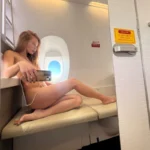


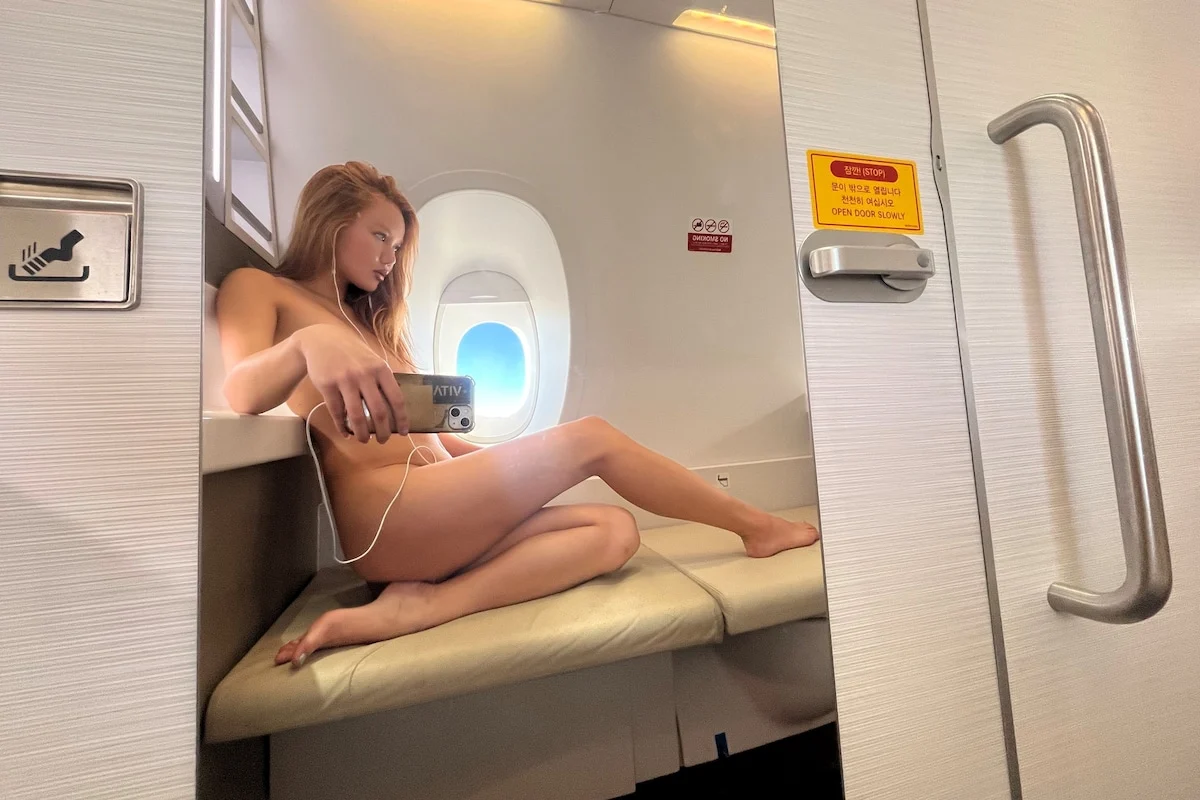
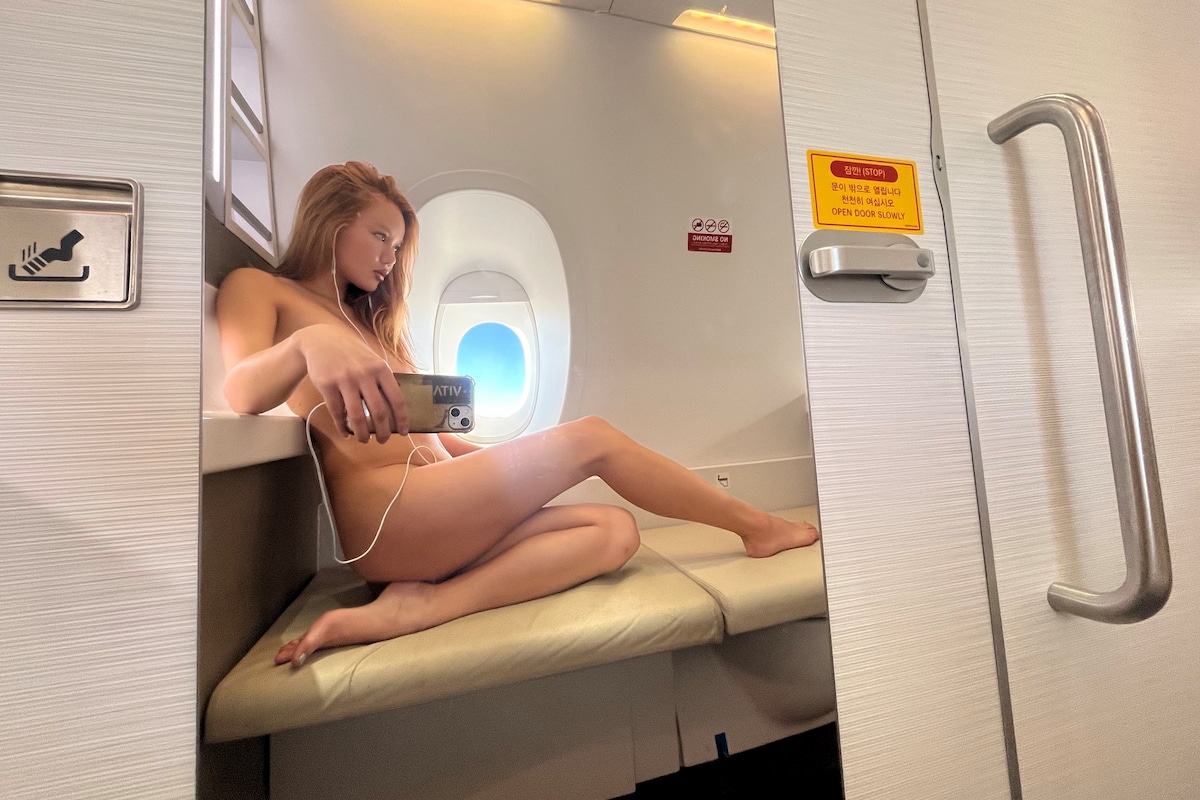
The intersection of commercial aviation and contemporary art has long been fertile ground for examining the modern human condition, characterized by relentless mobility, digital hyper-connectivity, and profound isolation. This dichotomy is central to the work of conceptual artist and photographer John Yuyi, whose latest publication, Aeroplane Mode 2, archives an eight-year ongoing performance piece executed entirely within the confines of commercial aircraft lavatories. The zine compiles a series of nude self-portraits captured at 35,000 feet during long-haul flights between global cultural capitals, transforming a sterile, utilitarian public amenity into a private studio for ironic, intimate self-exploration.
Main Facts of the Project and Exhibition
Aeroplane Mode 2 serves as the second installment in an archival zine series cataloging Yuyi’s airborne self-portraiture. Spanning photographs taken primarily between 2021 and 2026, the collection showcases a technical and aesthetic evolution from her earlier in-flight works. While her initial bathroom self-portraits heavily relied on found props—such as toilet seat covers, toilet paper drapery, and airline ephemera—the newer body of work focuses on architectural angles, harsh fluorescent lighting, and the distortion capabilities of modern smartphone camera technology, specifically the widespread adoption of the 0.5 ultra-wide-angle lens.
The physical publication launch and accompanying book signing are scheduled for September 30, 2026, at Dashwood Books in New York City, with distribution handled through specialized art book platforms. Rather than operating as conventional photographic vanity projects, Yuyi’s images deliberately subvert the tropes of digital “thirst traps,” favoring compositionally strange, clinical, and whimsical examinations of the human form trapped within standardized, pressurized transit modules.
Chronology and Background Context
The genesis of the project dates back to 2018 during a grueling 16-hour flight from New York to Taipei. At the time, Yuyi was navigating a jarring dissonance between her professional success and her precarious personal circumstances. Having recently relocated from Taiwan to New York on an artist visa, her career in fashion and contemporary art experienced an abrupt ascent. She was routinely flown business class by major luxury houses to global capitals—collaborating with Gucci in Florence and Miami, Burberry in Seoul, and Kenzo across parts of Africa.
However, this corporate-sponsored jet-set lifestyle sharply contrasted with her financial and social reality on the ground. Upon returning to New York, Yuyi resided in a shared Chinatown apartment alongside multiple roommates and persistent pest infestations. As a self-taught freelancer operating outside traditional academic institutions, she struggled to forge meaningful interpersonal connections in a foreign metropolis.
During interviews reflecting on this period, Yuyi has described experiencing intense alienation, occasionally enduring days without speaking to another human being outside of local bodega staff. It was within this specific crucible of frantic professional mobility coupled with acute, chronic loneliness that the performance began. What started as an impulsive, fleeting distraction to alleviate the crushing boredom of long-haul travel evolved into a methodical, ritualistic documentation of her physical self within transient spaces.
Data, Statistics, and the Architecture of Modern Transit
To fully contextualize Yuyi’s project, one must examine the broader socioeconomic and psychological metrics of contemporary air travel. According to global aviation data from the International Air Transport Association (IATA), international passenger traffic has steadily rebounded and surpassed pre-pandemic highs, with billions of passengers spending cumulative months of their lives suspended in pressurized cabins.
Commercial aircraft lavatories occupy a unique psychological space in modern infrastructure. Measuring on average less than three feet wide and five feet deep, these compartments represent the only true private enclosures within a densely populated, highly regulated public tube traveling at speeds exceeding 500 miles per hour. Sociologists and cultural critics frequently categorize airports and aircraft as "non-places"—transitory zones devoid of distinct historical, relational, or identity-forming characteristics, as theorized by anthropologist Marc Augé.
In Yuyi’s work, the airplane bathroom functions as a microscopic stage within these non-places. The environment is heavily technologized, relying on vacuum waste systems, recirculated air, and clinical LED or fluorescent illumination. This technological fetishism bears resemblance to the speculative fiction of J.G. Ballard, where humanity intersects awkwardly with advanced machinery. By inserting an organic, unclad body into this hyper-engineered, sterile box, Yuyi highlights the friction between biological vulnerability and industrialized transit.
Artistic Evolution and Digital Identity
Yuyi’s broader artistic repertoire has consistently interrogated the friction between physical reality and digital self-representation. Since graduating from fashion college, she has utilized her own skin and body as a canvas. Notable past projects include custom temporary tattoo installations exploring mass consumerism, body dysmorphia, and internet culture.
In 2023, she gained widespread attention for a photo book documenting her surgical intervention and subsequent regret regarding a rhinoplasty procedure: In memory of my ear bone that was once in my nose for two weeks. The day before it went back to my ear, I decided to take my nose on a date to an amusement park, just the two of us. Before undergoing a reversal procedure, she photographed her temporary facial modification on rollercoasters and theme park rides, framing the surreal experience as a testament to the absurdities of modern cosmetic alteration culture.

This blend of dark humor, vulnerability, and systemic documentation carries directly into Aeroplane Mode 2. While the first volume emphasized styling through props harvested from the aircraft cabin, the second volume demonstrates a mature visual literacy attuned to the aesthetics of social media. The integration of the iPhone ultra-wide-angle lens warps the cramped environment of the lavatory, stretching the mirrors, chrome handles, and wall panels into distorted, dreamlike geometries that frame the artist’s body in unconventional ways.
Official Responses and Critical Reception
While mainstream aviation authorities maintain strict regulations regarding conduct inside aircraft cabins—prohibiting disruptive behavior, smoking, and interference with crew instructions—artistic interventions of a quiet, non-disruptive nature in private lavatories exist in a legal and operational gray area. Representatives from major commercial airlines have not formally commented on Yuyi’s ongoing series, as the self-portraits are executed discreetly behind locked doors without impacting flight safety, other passengers, or operational schedules.
Art critics and photography curators have noted that the project succeeds precisely because of its unobtrusive nature. Rather than staging a public spectacle that challenges flight attendants or violates federal aviation regulations, Yuyi’s performance is entirely internalized. The transgression occurs exclusively between the artist, her camera, and the anonymous mass of sleeping passengers situated mere feet away on the other side of a thin, folding door.
Broader Impact and Societal Implications
Aeroplane Mode 2 transcends simple autobiography, offering broader commentary on the psychological toll of the modern gig economy and the hyper-mobile creative class. In an era where professional success is frequently measured by frequent-flyer miles, global brand partnerships, and digital visibility, the physical reality of the body can become alienated from the individual.
By systematically stripping away her clothing inside the most anonymous, highly regulated public restroom imaginable, Yuyi reclaims physical agency within a system designed to herd human cargo from point A to point B with maximum efficiency and minimum friction. The zine acts as a visual artifact of the digital age—a meditation on solitude, architecture, and the strange intimacy of moving through the stratosphere alone. As international travel continues to accelerate, works like Aeroplane Mode 2 provide a vital, critical mirror to the surreal conditions of contemporary global citizenship.