









The Traser P65 Tactical Mission Titanium marks a significant evolution in the legacy of military-grade instrumentation, serving as a sophisticated update to the storied P6500 Type 6. While the original P6500 Type 6 was forged in the late 1980s to meet stringent United States Department of Defense specifications for field-service watches, the new P65 Tactical Mission Titanium shifts the focus toward high-performance materials and contemporary manufacturing standards. By transitioning from the traditional carbon-reinforced polymer to Grade 2 titanium, Traser has elevated its foundational design, balancing the requirement for combat-ready durability with the aesthetic and ergonomic preferences of the modern collector.

Historical Context and the Genesis of GTLS Technology
The history of Traser is inextricably linked to the development of Gaseous Tritium Light Sources (GTLS), a technology that revolutionized low-light visibility in horology. In 1969, Swiss physicist Oskar Thüler founded MB-Microtec, a company that pioneered the use of radioactive tritium gas encapsulated in glass capillaries. This innovation allowed for a constant, self-sustaining glow that required no external light source or battery-powered illumination—a critical advancement for military operations conducted in total darkness.
Throughout the 1970s, MB-Microtec refined the application of these tritium tubes, eventually positioning itself as the primary supplier for the global watch industry. The turning point for the brand came in 1989, when the U.S. Department of Defense updated its procurement specifications for service watches (MIL-W-46374F) to include the requirement for GTLS illumination. This mandate effectively birthed the P6500 Type 6, a watch that would become synonymous with tactical reliability and would eventually be issued to or purchased by over 300,000 personnel. The launch of the P65 Tactical Mission series in 2026 serves as a deliberate nod to this legacy, reviving a design language that has remained relevant for nearly four decades.

Engineering Specifications and Material Advancements
The P65 Tactical Mission Titanium distinguishes itself from the standard P65 Tactical Mission Black through several critical engineering upgrades. While the standard version remains a faithful, carbon-reinforced polymer recreation of the original military spec, the titanium model is constructed entirely from Grade 2 titanium. This material selection provides a superior strength-to-weight ratio, significantly enhancing the watch’s resistance to corrosion and impact.
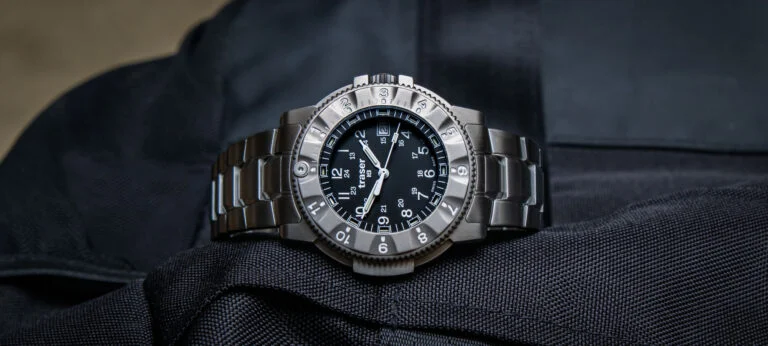
A primary technical enhancement in the titanium model is the implementation of screw-down architecture. Unlike the original P6500’s push/pull crown and standard caseback, the titanium variant utilizes a screw-down crown and a threaded caseback. These modifications facilitate an increase in water resistance from 100 meters to 200 meters, aligning the watch more closely with modern professional diving and tactical requirements. The case dimensions measure 43mm in diameter, 11mm in thickness, and 45.5mm from lug to lug. Despite the 43mm width, the watch’s geometry—specifically its modest lug-to-lug distance and streamlined profile—allows it to maintain a manageable footprint that avoids the "slab-sided" aesthetic common in many contemporary tactical watches.

The bezel remains a defining feature of the series. It is a 12-hour, bidirectional rotating bezel with a 60-click action, mirroring the functional design of the 1989 original. The inclusion of a small, orange-glowing tritium tube at the zero marker provides essential orientation in low-light environments, distinguishing it from the green-emitting tubes used for the hour markers and handset.
Functional Design and Luminescence Architecture
The dial of the P65 Tactical Mission Titanium adheres to the rigorous mil-spec standards established during the late 20th century. The layout features a matte black surface designed to eliminate glare, with high-contrast white Arabic numerals and a secondary 24-hour scale. The use of a syringe-style handset ensures immediate legibility, while the minute track is positioned on an elevated chapter ring, where the tritium tubes are horizontally embedded.

Traser has opted for a strictly functional approach to luminescence. Unlike other models in the company’s catalog that utilize photoluminescent crystal gaskets or decorative glowing accents, the P65 Tactical Mission Titanium limits its illumination to the indexes, hands, and bezel marker. This design choice underscores the watch’s purpose as a professional tool rather than a lifestyle accessory. The movement powering this configuration is the Swiss-made Ronda 715 quartz caliber. With a battery life of approximately five years and an integrated end-of-life (EOL) indicator, the movement prioritizes long-term reliability and low maintenance, consistent with the requirements of field equipment.
Comparative Market Analysis and Industry Impact
The P65 Tactical Mission Titanium sits in a competitive segment of the market that includes brands like Marathon and Luminox, both of which share a lineage with the original mil-spec designs of the 1980s. The Marathon Navigator, for instance, serves as a direct point of comparison for the P65’s utilitarian philosophy.

Industry analysts suggest that the decision to release a titanium version of the P65 is a response to the growing consumer demand for "premium-grade" military heritage pieces. While the $695 to $860 price point places the P65 Tactical Mission Titanium above the entry-level polymer models, it is positioned to capture a demographic that values historical accuracy but requires the structural integrity of titanium and increased water resistance. The watch’s performance on the wrist—which testers describe as smaller and more refined than the Traser P99 T Tactical—suggests that the brand is successfully diversifying its offerings to accommodate both those seeking a robust field tool and those desiring a daily-wear piece with a military pedigree.
Challenges and Future Considerations
Despite its advancements, the P65 Tactical Mission Titanium faces scrutiny regarding its accessory ecosystem. The bracelet, while aesthetically cohesive with the brushed and sandblasted finish of the case, utilizes a friction-pin construction rather than the more modern screw-link system found in higher-end luxury watches. Additionally, the clasp, which incorporates a standard fold-out wetsuit extension, lacks the on-the-fly micro-adjustment capabilities that have become standard in modern sports watches.

From an engineering standpoint, some observers have noted that at its price point, the inclusion of a more advanced movement—such as a solar-powered caliber or a thermo-compensated quartz movement—would have solidified its status as a "top-tier" tactical instrument. However, Traser maintains that the Ronda 715 is a proven, reliable workhorse that aligns with the watch’s mission of simplicity and dependability.
Conclusion: A Legacy Reimagined
The release of the Traser P65 Tactical Mission Titanium represents more than just a material upgrade; it is a reaffirmation of the brand’s identity as the architect of the modern tritium-illuminated watch. By maintaining the design DNA of the P6500 Type 6 while integrating modern, durable materials, Traser has bridged the gap between historical military hardware and the expectations of the 2026 watch market. As the brand continues to evolve, the P65 Tactical Mission Titanium serves as a testament to the enduring utility of the original 1989 design, providing a high-performance, legacy-driven option for enthusiasts and professionals alike. The success of this model will likely influence future iterations of the P65 line, potentially leading to further explorations of advanced alloys and more sophisticated movement technologies within the same compact, historically significant form factor.