









Can a brand whose motto is Very Rare successfully pivot to an entry-level market segment without eroding its prestige? This paradox defines the latest strategic maneuver from H. Moser & Cie., the Swiss independent watchmaker synonymous with ultra-exclusive mechanical complications and minimalist aesthetics. With the introduction of the Off-Grid, a digital-analog hybrid timepiece priced at $4,900 USD, the Schaffhausen-based manufacturer is challenging the industry’s perception of "attainable luxury." While the brand’s production volume typically remains strictly limited to a few thousand units annually—often resulting in five-figure price points—the Off-Grid marks a significant departure from the company’s established business model, offering a broader audience an opportunity to enter the Moser ecosystem.

A Departure from Tradition: The Evolution of the Off-Grid
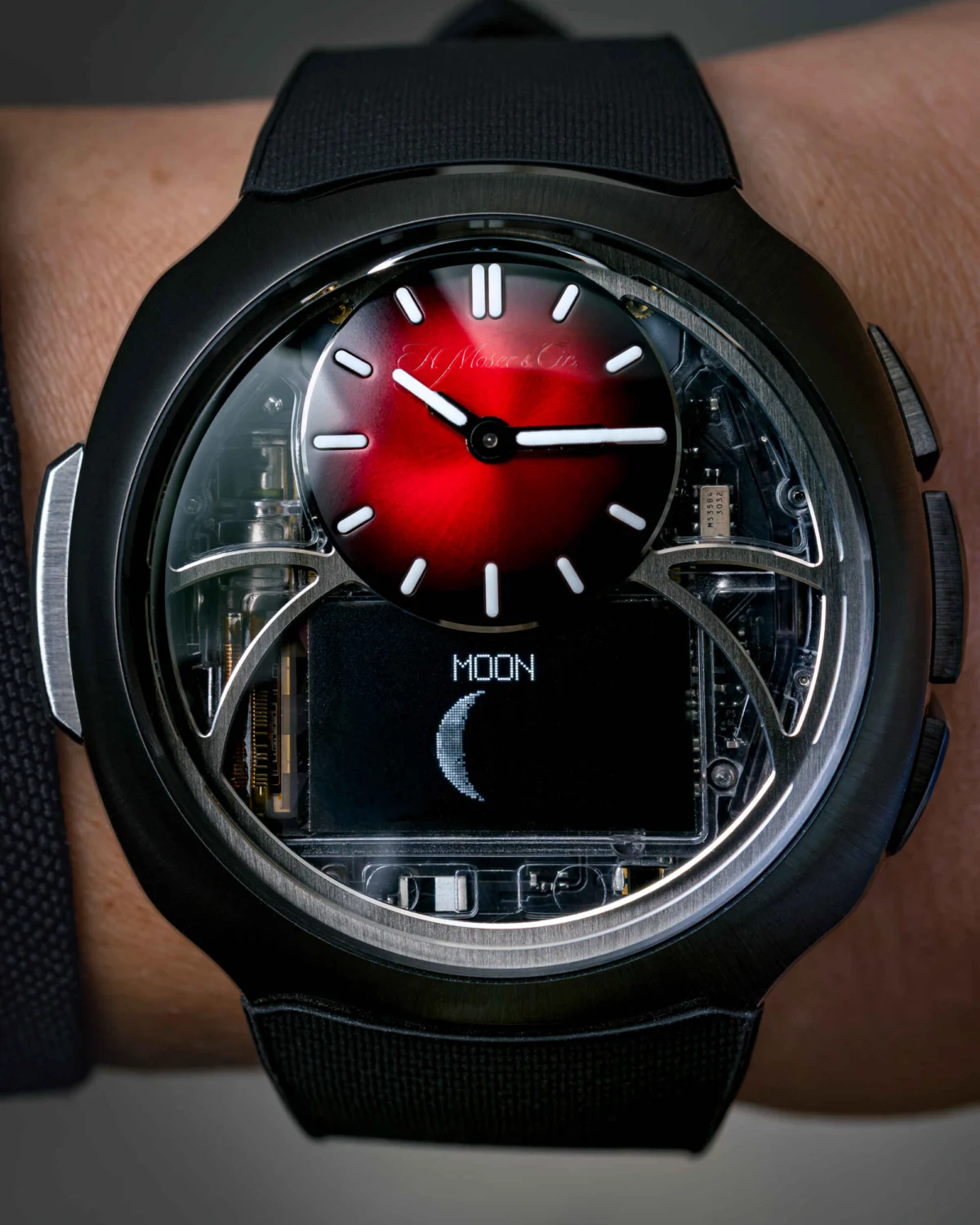
The H. Moser & Cie. Off-Grid represents the manufacturer’s second venture into digital horology. Its predecessor, the Streamliner Alpine Mechanics Edition, launched last year as a highly specialized tool watch designed for Formula 1 teams to facilitate real-time communication between pit crews and drivers. The Off-Grid inherits the technical DNA of that model, utilizing the same robust 42.6mm steel case architecture and a distinctive split-level dial design. The upper section features a classic, miniaturized fumé analog dial, while the lower portion houses a digital display.
However, the functional focus of the Off-Grid has shifted from high-performance racing metrics to travel and utility. By removing the real-time telemetry requirements of the Alpine edition, the engineers at Moser have repurposed the digital interface for a more consumer-oriented experience. The watch offers a comprehensive suite of features, including a GMT function with a built-in country selector, a split-seconds chronograph, a timer, a perpetual calendar, and a vibrating alarm. Perhaps most notable is the inclusion of a perpetual moon phase, which is updated hourly and engineered for 100-year accuracy.

Functional Innovation and the "Off-Grid" Philosophy
The watch derives its name from its departure from the hyper-connected nature of modern smartwatches. Eschewing Bluetooth connectivity and smartphone synchronization, the Off-Grid operates as an independent, standalone device. The user interface is controlled via a system of three buttons: a primary pusher on the left toggles the screen, while the top and bottom pushers on the right navigate the GMT cities and a pre-programmed linguistic dictionary.
This dictionary provides ten essential words—including greetings and polite phrases—in over 21 languages, tailored to the selected time zone. Moser characterizes this feature as a "deliberate departure from the established approach," emphasizing a desire to provide functionality that does not rely on the infrastructure of a smartphone. By choosing to move "off-grid," the brand suggests that the true luxury of the 21st century is not connectivity, but the ability to disconnect from digital noise while maintaining sophisticated, world-traveling utility.

Market Positioning and Strategic Implications
The release of the Off-Grid at a $4,900 price point is an unprecedented move for a brand that has historically occupied the high-end, independent watchmaking space. For context, most Moser timepieces command prices starting well above $20,000, with many complicated models exceeding $100,000. By producing 2,000 units total—1,000 for each of the two colorway references—Moser is significantly increasing its volume compared to its traditional limited-run series.
The two available models are the Ref. 6700-1202, featuring a blue PVD steel case with a black fumé dial on an integrated white rubber strap, and the Ref. 6700-1205, which pairs a black PVD steel case with a deep red fumé dial on a black rubber strap. Analysts note that this move mirrors a broader industry trend where legacy Swiss brands are experimenting with entry-level price points to capture a younger demographic, though rarely with such a stark departure in technical DNA as a digital-analog hybrid.

A Chronology of the Launch
The release follows a carefully staged roll-out strategy designed to honor the brand’s loyal collector base while managing supply:
- September 21–23, 2026: An exclusive early-access window is granted to existing H. Moser & Cie. clients, allowing them the first opportunity to secure the 2,000 available pieces.
- September 24, 2026: The watches become available to the general public, marking the first time a product of this price point is marketed by the brand to a non-traditional audience.
- October 5, 2026: The window for purchasing the Off-Grid closes, emphasizing the limited nature of this production run despite the higher quantity compared to standard models.
The Paradox of Scarcity
The fundamental challenge facing H. Moser & Cie. is the potential dilution of its "Very Rare" brand identity. In luxury goods, scarcity is a primary driver of value. By lowering the barrier to entry and increasing production, the brand risks alienating its core base of collectors who prize the exclusivity of their acquisitions. However, industry observers suggest that Moser is leveraging its reputation for "going against the grain" to justify the move.

The brand has often used irony and unconventional marketing—such as the Swiss Mad Watch, which featured a case made of actual cheese—to critique the industry’s own pretenses. Consequently, the Off-Grid can be interpreted as a meta-commentary on the current watch market: if the brand is famous for being "Very Rare," a watch that is suddenly "less rare" and "more affordable" becomes an exercise in creative subversion rather than a standard commercial product.
Consumer Reception and Future Outlook
The reception of the Off-Grid hinges on how one defines the value proposition of a luxury timepiece. To a traditionalist, a $4,900 digital watch may appear out of place in a portfolio dominated by high-complication mechanical movements. Yet, to an enthusiast seeking a "Moser" piece, the watch serves as an accessible entry point that retains the brand’s distinct visual design language.

The integration of the analog dial and the dormant digital screen serves to bridge this gap. Because the screen is not designed to show notifications or alerts, it does not suffer from the "always-on" fatigue common to smartwatches. When the display is off, the watch functions as a piece of classic design, and when it is active, it transforms into a multi-functional tool.
Ultimately, the H. Moser & Cie. Off-Grid is a calculated risk. It tests whether the brand’s identity is rooted solely in mechanical scarcity or if it resides in the design, the philosophy, and the brand’s ability to surprise. By inviting a new cohort of consumers into the "Moser family" at a lower price point, the company is betting that the experience of owning a piece of their engineering and design ethos will translate into long-term brand loyalty. Whether this expansion compromises the "Very Rare" promise or simply redefines it for a new generation remains to be seen, but the move confirms that H. Moser & Cie. remains one of the most unpredictable and dynamic forces in modern watchmaking.